

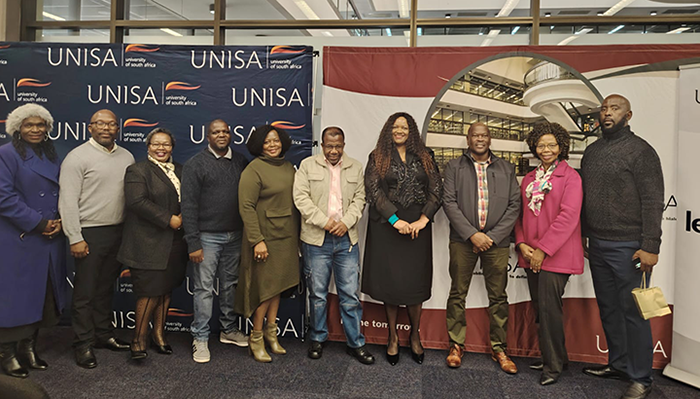
Speakers at the commemoration
The University of South Africa (Unisa), through its Library and Information Services (LIS), in collaboration with the Department of Leadership and Transformation (DLT), the College of Human Sciences (CHS) and the Unisa Gauteng Region, hosted a scholarly dialogue on 29 June 2026 to commemorate the 50th anniversary of the 1976 student uprisings. The event brought together academics, students, researchers and thought leaders to reflect on the enduring significance of the uprisings while examining their relevance to contemporary South Africa and future generations.
The dialogue formed part of a broader initiative to transform remembrance into knowledge production by encouraging critical reflection, research and collaboration to preserve the history of the 1976 student uprisings while contributing to solutions to today's social, educational and governance challenges.
Opening the programme, Acting Executive Director of Library and Information Services, Dr Janice de Wee, welcomed delegates and highlighted the importance of creating scholarly platforms that preserve South Africa's liberation history while inspiring new knowledge and meaningful engagement among academics, students and communities.
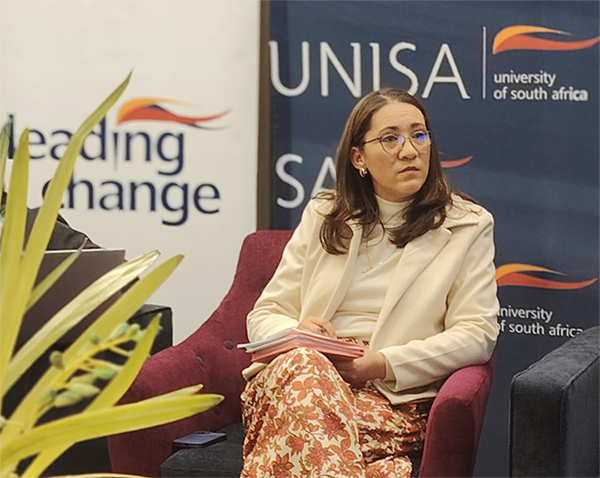
Dr Janice de Wee
She concluded by reminding delegates that while the youth of 1976 left South Africa "a legacy of courage", today's responsibility is "to leave a legacy of knowledge".
Providing the context for the initiative, Dr Phumzile Dlamini, Deputy Director: Governance, Leadership and Management, said the collaboration reflected Unisa's commitment to preserving historical memory while producing knowledge that contributes to institutional and societal transformation.
Describing libraries as strategic spaces for knowledge creation and preservation, Dlamini challenged participants to think beyond commemoration.
"We are planting a tree today. The tree, you might plant it today, but the fruits you might get in the near future."
She urged academics and researchers to consider the legacy they are creating for future generations.
"What is it that we are planting today as academics, as employees of Unisa, so that the youth who are going to follow us will be able to learn from us?"
Dlamini further emphasised that universities have a responsibility to confront pressing societal issues, including graduate unemployment, inequality, digital exclusion and the preservation of indigenous knowledge systems through research and innovation.
Delivering the keynote address, Zandi Mogiba reflected on the courage of the young people who challenged the apartheid education system in 1976, describing them as a generation that fundamentally changed the course of South African history.
"The legacy of 1976 was the courage of youth. Those people who demonstrated then were not merely the recipients of history; they were history makers."
She encouraged participants to move beyond remembrance by asking whether the aspirations of the youth of 1976 had been realised.
Highlighting challenges such as unemployment, poverty, unequal access to education, gender-based violence and digital exclusion, Mogiba called on institutions to invest in young people through education, innovation and technology.
"Our task is not only to remember history; it is to write what comes next."
She concluded by reminding delegates that the future of South Africa rests in the hands of its young people.
"The future belongs to the youth. Our youth is the greatest investment."
In a thought-provoking presentation, Prof Nokuthula Hlabangane challenged delegates to rethink dominant narratives about freedom, identity and knowledge production, urging universities to embrace African philosophies and indigenous knowledge systems as central to transformation.
She argued that the country must move beyond inherited frameworks and cultivate graduates who are not only academically accomplished but also socially conscious and critically engaged.
"The challenge for us at this time is to change the whole frame around which the conversation is confined."
Encouraging young people to pursue a deeper understanding rather than credentials alone, she added, "Please do not exchange enlightenment for education. It is a poor exchange."
The panel discussion, featuring academics and experts from across the university, further explored the unfinished work of transformation and the role of higher education in preserving historical memory while preparing future generations to lead.
Responding during the discussion, Prof Mokhele Madise encouraged young people to take ownership of their future and actively participate in shaping South Africa's development.
"Nothing about us without us. You need to be the ones speaking for yourselves."
He reminded students that every generation faces its own challenges and that today's youth must become leaders in innovation, technology and social transformation.
"Your contribution does not necessarily have to be big. It is a contribution, and the country needs it."
Throughout the dialogue, speakers agreed that commemorating the 50th anniversary of the 1976 student uprisings should extend beyond reflection to action. They called for stronger collaboration among universities, communities, government and industry to ensure that research informs policy, promotes social justice and contributes to sustainable development.
The event concluded with a collective commitment to continue documenting, researching and preserving the history of the 1976 student uprisings while empowering young people to become the next generation of scholars, innovators and leaders.
As delegates reflected on the sacrifices made by the youth of 1976, they reaffirmed that the responsibility of today's generation is not only to honour that legacy, but to build upon it through scholarship, collaboration and purposeful action.
* By Itumeleng Mpete, Marketing Coordinator, Library and Information Services
Publish date: 2026-07-09 00:00:00.0

 Minister Manamela calls for systemic reset of South Africa's PSET sector
 Three Unisa women putting science, research and innovation into action
 From preserving knowledge to shaping the future: Unisa Press and LIS mark 150 years of collective impact
 Supporting success: How Unisa's PRG helped Babalwa Ramncwana take the next step in her academic journey
 Wisdom that connects generations: Unisa celebrates its senior citizens