

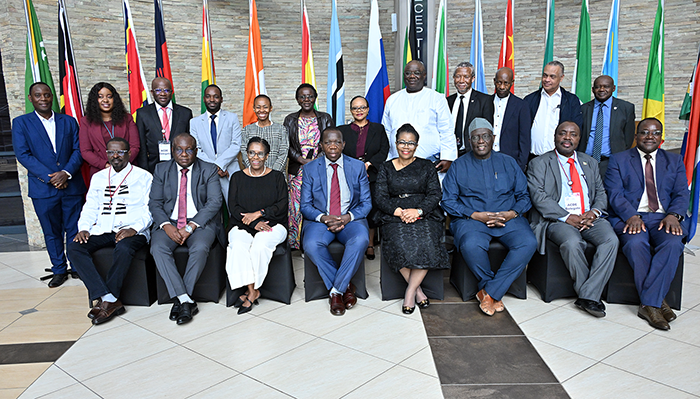
Unisa management with ACDE partners and dignitaries
Unisa, in partnership with the African Council for Distance Education (ACDE), hosted the two-day ACDE 20th Anniversary Seminar on 29 and 30 January 2026, themed Transforming African distance education: Emerging technologies, institutional digitalisation and inclusive quality assurance. Other than celebrating institutional longevity, the seminar highlighted the transformative impact of collaborative leadership, shared continental networks and the resilience of African institutions committed to expanding access to quality education.
The seminar brought together vice-chancellors (VCs), policymakers, researchers, government partners, development agencies, open distance and e-learning (ODeL) practitioners, and industry leaders to reflect on the ACDE’s impactful two-decade journey and engage critically with emerging trends shaping the future of distance education on the African continent.
Delivering the opening and welcome address, Prof Puleng LenkaBula, Unisa’s Principal and VC and Treasurer-General of the ACDE, expressed appreciation for the resilience shown by the ACDE when most universities battled with pandemics such as Covid-19, digitisation systems and the onslaught of artificial intelligence (AI), which, she said, must be embraced. She reiterated that the African continent’s struggles should not derail its implementation processes and aspirations, but rather be addressed through knowledge, research and engaged scholarship.
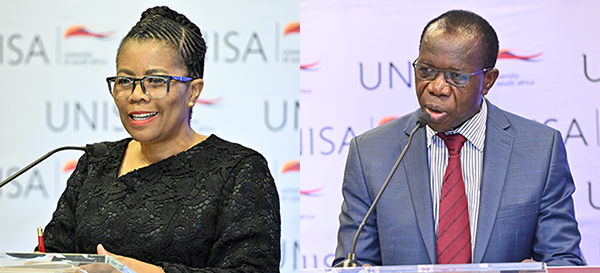
From left: Professors Puleng LenkaBula and Solomon Shibairo
The VC shared that one of the critical issues raised by the ACDE’s member VCs is that universities sometimes marginalise education and prioritise politics. She argued that politics without education, analytics and intellectual thought can lead to outcomes that do not address poverty, inequality and the management of various resources. "The idea of decolonising and Africanising knowledge, as well as ensuring that our universities are bold enough to propel African knowledge in the frontiers of the global knowledge arena, must be primary, and not an alternative," said LenkaBula. She further asserted that these institutions must be self-sustaining, including in terms of financial, technological and human resources.
Prof Solomon Shibairo, ACDE’s President and VC of Masinde Muliro University of Science and Technology, said: "This celebration provides the opportunity to reflect on our journey defined by visionary leadership, institutional courage and collective commitment." He added: "It is also a moment to renew our resolve to advance equitable access to quality higher education through ODeL."
Shibairo further proclaimed that quality assurance is a strategic pillar of the ACDE’s mandate; therefore, the council developed a comprehensive quality assurance toolkit through a consultative process involving member institutions and experts. "I call upon higher education institutions to utilise this toolkit and to actively participate in capacity building efforts," he noted. Shibairo also urged these institutions to invest deliberately in quality assurance, deepen collaborations across borders and linguistic regions, and place innovation at the core of ODeL education.
Reflecting on the significance of the ACDE’s 20-year milestone, Prof Olufemi Peters, ACDE’s first Vice-President and VC of the National Open University of Nigeria, said that this milestone is a call to intergenerational stewardship and that it places responsibility on current and future leaders to safeguard the council’s values while reimagining its role. Additionally, Prof Teresa Mwoma, ACDE’s Secretary-General, attached to Kenyatta University, remarked that from the council’s inception, ACDE partners were inspired by the spirit of African renaissance and a shared conviction that higher education could no longer be confined by geography, infrastructure or privilege.
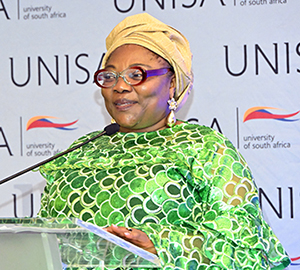
Her Excellency Prof Sarah A. Agbor
Day one’s keynote speaker, Her Excellency Prof Sarah A. Agbor, former Africa Union (AU) Commissioner for Education, Science, Technology and Innovation, Inspector of Administration at the Ministry of Higher Education in Cameroon, and Vice-President of the Forum for Innovation in African Universities, spoke on Building resilient, inclusive and digitally transformed African universities in the age of AI. She said: "This anniversary also celebrates a movement that has democratised knowledge, expanded opportunity, and redefined the meaning of access to higher education in Africa." She continued: "History is calling us to move from access to excellence, from expansion to transformation, from survival to leadership, and from being users of other people's systems to becoming architects of Africa's own future."
Agbor stated: "We live in a moment of profound global rupture where AI is reshaping knowledge, work, creativity and power. Also, geopolitics is being reconfigured by technology, and climate change, pandemics, conflict and demographic pressure are testing the resilience of our institutions." Spotlighting the AU’s Digital Education Strategy, she said it recognises a fundamental truth: that today, digital technologies are no longer optional for education, citizenship or development. She asserted: "Universities must lead African transformation and help define the continent’s future."
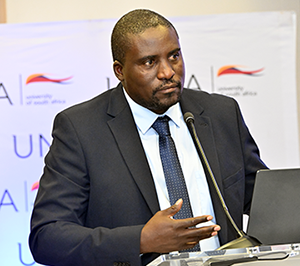
Prof Kenneth Matengu
Day two’s keynote speaker, Prof Kenneth Matengu, VC of the University of Namibia, President of the Association of African Universities, and President of the Pan-African University Council, urged Africa to become the creator of its own innovations rather than just a consumer and dependent of the Global North. "An education system cannot be what it is not designed for. If it is designed to produce knowledge consumers instead of knowledge producers, then it will not do the opposite," he affirmed.
He also highlighted challenges facing the teaching profession, such as teacher remuneration and gender imbalance, and said it is rarely considered a first career option. Matengu continued: "Education is the mother of all professions, yet it is not respected. Africa struggles to invest in higher education, yet it has the largest deposits of minerals." He then urged Africa to invest in research and development to empower it to convert its resources into wealth.
For Matengu, Africa must also create enough industries and ensure access to electricity, as the lack of electricity limits access to technology. Speaking on the role that the ACDE plays in advancing African higher education and development, he emphasised that African countries should complement each other instead of competing. He concluded: "This is the time to consider African problems as opportunities for innovation."
* By Nancy Legodi, acting Senior Journalist, Department of Institutional Advancement
** Photography by Shooheima Champion, Unisa Multimedia Centre
Publish date: 2026-02-03 00:00:00.0

 Unisa students take top honours at 2026 HEQAF Student Paper Presentation Competition
 Young KZN photographers explore the ocean through Unisa lens
 Prof Brendon Barnes champions climate justice through psychology
 Prof Vhahangwele Masindi sets sights on a water-secure future
 Unisa's Top 100 CTA achievers recognised as accounting firms seek emerging talent