
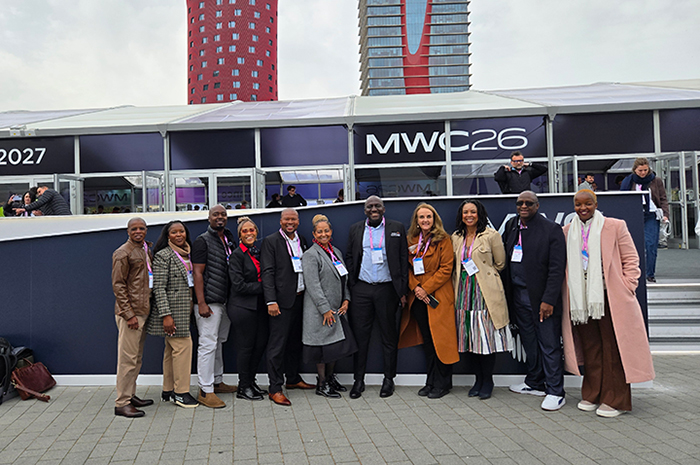
Unisa delegates, from left: Jappie Sono (User Support Technician), Nangamso Makgoka (Acting Director: Project Management), Tumiso Mathye (Network Cable Technician), Trocia Tladi (Acting Director: Property Management), Feresane Sibeko (Executive Director: Facilities), Dr Trudy Forbay (Executive Director: Study Material, Production and Delivery), Matsiababa Motebele (Vice-Principal: Operations and Facilities), Liana Joubert (Office of the Registrar – Deputy Registrar of Student Admission and System Integration), Prof Magdeline Mampilo (Director: School of Computing, College of Science, Engineering and Technology), Dominic Molokoane (Office of the Registrar – Manager: Deputy Registrar Student Administration and System Integration) and Masindi Nditwani (Project Manager: Smart Campus)
The Mobile World Congress (MWC) 2026, held in Barcelona, Spain, from 2 to 6 March, once again proved why it is the global epicentre of digital transformation, bringing together world-leading innovators, policymakers, universities and technology giants to explore the next frontier of intelligent connectivity, AI and enterprise resilience.
Matsiababa Motebele, Unisa’s Vice-Principal: Operations and Facilities, led a diverse cohort of Unisa staff ranging from the Office of the Registrar, ICT, academia and his portfolio to the congress.
For Unisa, MWC 2026 offered crucial lessons and opportunities to align the institution with global higher education trends, accelerate research and commercialisation, and strengthen digital infrastructures in a rapidly evolving world.
One of the strongest themes at MWC 2026 was the growing role of universities as engines of innovation and economic development. Barcelona’s leading public universities showcased how science-based innovation ecosystems can fuel deep‑tech startups, create new industries and transform regions into global talent hubs.
Given its scale, global footprint and research outputs, Unisa is uniquely positioned to replicate this model in Africa. Turning the institution’s Catalytic Niche Area outputs into start-ups, strengthening co-curricular innovation structures, and collaborating more deeply with entities such as the Council for Scientific and Industrial Research can enable Unisa to anchor South Africa’s own science-driven innovation economy.
Another major theme aligned closely with MWC 2026’s focus on AI for empowerment. New teaching assistant management systems showcased how AI can support academic delivery through automated content summaries, thematic mapping of module content, personalised feedback, learning analytics and streamlined content organisation and video processing. These tools reduce administrative load on academics while offering students enhanced access to content, improved learning pathways and consistent module delivery across large cohorts.
MWC 2026 emphasised that modern cyber threats require modern defences. Sessions on AI-driven security technologies demonstrated how artificial intelligence is becoming the "invisible shield" protecting enterprises from increasingly sophisticated threats. From real-time anomaly detection to automated incident response, AI-powered security frameworks are now essential to operational resilience.
For Unisa, security can no longer be a back-office function. By embedding AI‑enabled monitoring tools, strengthening staff and student cyber awareness, and positioning cybersecurity as a value-creation mechanism, Unisa can significantly enhance digital trust and service reliability.
MWC 2026 showcased advanced spatial analytics systems capable of tracking real-time movement of pedestrians and vehicles to optimise congestion, safety and space utilisation. For Unisa, these systems can improve registration flow and reduce long queues, optimise parking and campus traffic, enhance safety and campus navigation, generate accurate analytics on office space utilisation, and monitor environmental emissions for sustainability planning.
Adopting smart‑campus infrastructure powered by spatial intelligence will position Unisa as a leader in data-driven campus management and environmental stewardship.
These technologies and solutions echo MWC 2026’s overarching message: the future belongs to institutions that embrace intelligent, integrated digital ecosystems. In conclusion, MWC 2026 provided Unisa with a roadmap for its future. MWC 2026 underscored that the next era of higher education will be driven by intelligent connectivity, AI-enhanced security, research commercialisation, and smart‑campus transformation.
Unisa’s participation at MWC 2026 marks a bold step toward building Africa’s university of the future: smart, secure, connected and innovation-led.
* Submitted by Dr Trudy Forbay, Executive Director, Study Material, Production and Delivery
Publish date: 2026-03-10 00:00:00.0

 Unisa research chair seeks home-grown solutions for Africa's energy future
 Unisa African Music Festival puts indigenous music centre stage
 Unisa takes isiZulu to Russia as language programme gains ground at RUDN University
 Minister Manamela calls for systemic reset of South Africa's PSET sector
 Three Unisa women putting science, research and innovation into action