
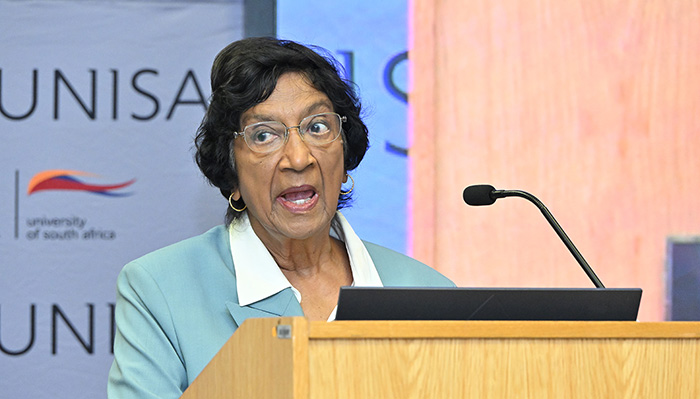
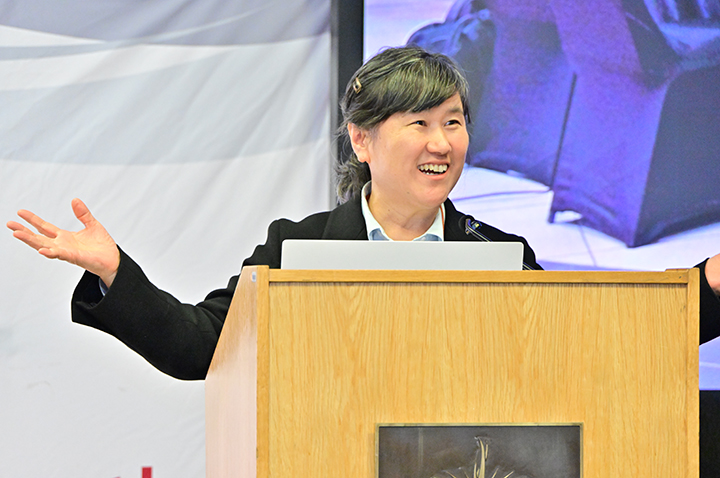
Judge Navi Pillay delivering the keynote address
The Unisa Women's Forum (UWF) and South African Women in Dialogue (SAWID) celebrated International Women's Day (IWD) on 09 March at Unisa's Muckleneuk Campus. The issues women face in society were highlighted at the event, which was held under the theme 'Rights'. Justice. Action. For ALL Women and Girls.
IWD has been around for over a hundred years, as have many of the issues still impacting women's advancement. As powerfully stated on the official IWD website, "Since 1911, IWD belongs to all who care about gender equality. Celebrate women's achievements. Raise awareness about discrimination. Take action to forge gender parity. All IWD activity is valid, that's what makes IWD so inclusive."
In her welcome address, Prof Puleng LenkaBula, Unisa Principal and Vice-Chancellor (VC), applauded the university's inclusion of the 12th official language in South Africa, sign language, to ensure universal access. She recognised Judge Navanethem (Navi) Pillay, who received an honorary award from the institution.
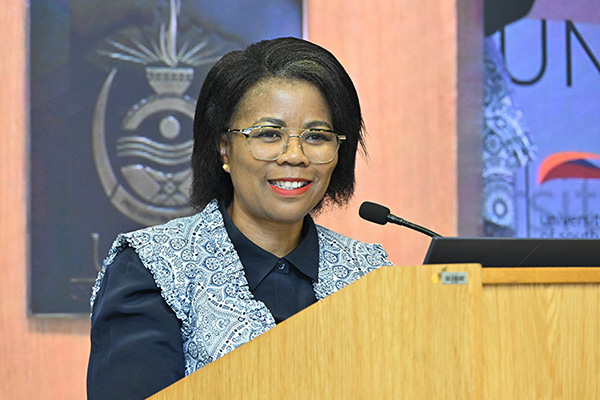
Prof Puleng LenkaBula, Unisa Principal and Vice-Chancellor
The VC pointed out that the university first celebrated this day on 8 March 2010, and highlighted its first institutionalisation by the predecessor to the current Thabo Mbeki African School of Public and International Affairs. She proceeded to delve deep into her history as an activist for processes that sustainably uphold and transform women.
LenkaBula continued: "The year 2026 serves as a landmark year for several anniversaries, including 30 years of the Constitution of the Republic of South Africa, a point to mark when we broke away from a past which led to discrimination in gender, race, class, disability and so forth, to embrace sufficient equality and dignity fully." She issued a rallying call for South Africans to engage with the country's laws and policies to promote equality and fairness.
"Today," she said, "we must remember those women who fought for dignity, fair remuneration, and the rights of women to be respected and contributions by women to be appreciated." In this regard, she cited the Women's March of 1956 to the Union Buildings to stand against the abusive pass laws of the apartheid system. "Feminist, Womanist and Bosadi Theorisations," she continued, "is one of the 10 Catalytic Niche Areas at Unisa and aims to drive and focus on women-centred studies to address societal issues. This is a propeller for the institution to identify aspects in research, innovation, and social impact that make certain that women are empowered and that their ideas are utilised."
In conclusion, she praised Zanele Mbeki, former First Lady of South Africa, as a woman who ensured the empowerment of women through economic freedom. In addition, she commended Mbeki for co-hosting a series of events commemorating IWD. "We celebrate her because she is a leader and has constantly urged us never to hesitate to demonstrate solidarity when others are trampled upon," said the VC. "I plead with the rising generation to know who their pathfinders are, and who took the baton from them, in and outside the university and country."
Lastly, she expressed her distress concerning the fact that women and girls are bearing the brunt of war and patriarchy all over the globe.
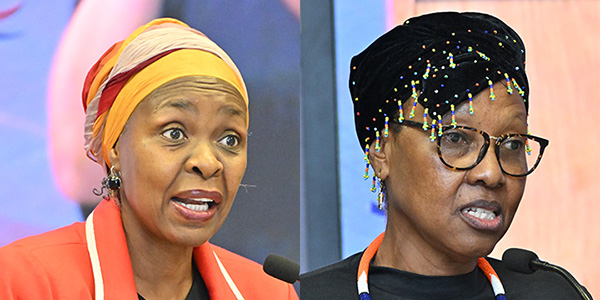
From left, Adv Brenda Madumise, SAWID, and Prof Khanyisile Mbatha, UWF Chairperson
Speaking next, SAWID's Advocate Brenda Madumise emphasised the importance of observing IWD and urged women to reflect on why they gather to celebrate, honour and reflect on a struggle that has not been easy. She called on women to be "upstanders" and have truer conversations about male-oriented spheres as they permeate every aspect of our systems. Madumise concluded by highlighting the backlash and silencing experienced by those who fight for women's rights, inclusive of dignity, safety and reproduction. "We will not win the fight through politeness and civility," she said.
Introducing the keynote speaker, Judge Navi Pillay, Prof Khanyisile Mbatha, Chairperson of the UWF, expressed her agreement with the previous speakers and emphasised the importance of women standing up, uniting and taking action to propel change. She accentuated that Pillay's work is influenced by legal discrimination, and that she catapulted the recognition of rape to the status of an act of genocide.
Pillay, currently serving as an Ad Hoc Judge at the International Court of Justice, said she is a witness to the unspeakable power of women and girls and shared her judicial insights, paralleled by the day's theme. Women's rights, she said, are viewed as unfavourable, misrepresented and marginalised throughout the world. "A treaty on paper does not guarantee justice," she said, when speaking on how human rights are often not under vigilance.
Pillay maintained that justice meant accountability in both public and private spheres, but that sexual crimes were often treated as merely collateral damage. She further noted that women's bodies are battlegrounds, and that when they take a stand, one voice at a time, one witness at a time, they drive change and accelerate the transformation from inside out. In conclusion, Pillay stated that she is an amplifier of women's voices through her work to ensure that women's rights are protected and advocated for, globally and locally.
A panel discussion led by Prof Dorothy Farisani, Treasurer of the UWF, featured Acting Judge Thato Tsautse, Director of Tsautse Attorneys Inc. and Ordained Priest in the Anglican Church of Southern Africa, and Advocate Contilia Bayi, of Unisa's Department of Private Law, who reflected on the inequality of women before the law. Audience participation was ensured through a lively question-and-answer session.
"It is not yet Uhuru for women," said Prof Sizakele Matlabe, Deputy Chairperson of the UWF, when concluding the event. "The struggle to be included and seen as equals continues."
* By Nontsikelelo Ndebele, Journalist Intern, Department of Institutional Advancement
** Photography by Shooheima Champion, Multimedia Centre
Publish date: 2026-03-12 00:00:00.0
 Unisa brings world's leading mission scholars together to tackle global challenges
 Unisa hosts workshop to empower postgraduate student support and quality assurance
 Learn how astronomy and space science are strengthening SA's research and innovation landscape
 From campus mailboxes to two million followers: The untold story of Unisa's digital revolution
 Working, studying, succeeding: Inside Unisa's life-changing employee education programme