

The African college of excellence in the social and human sciences
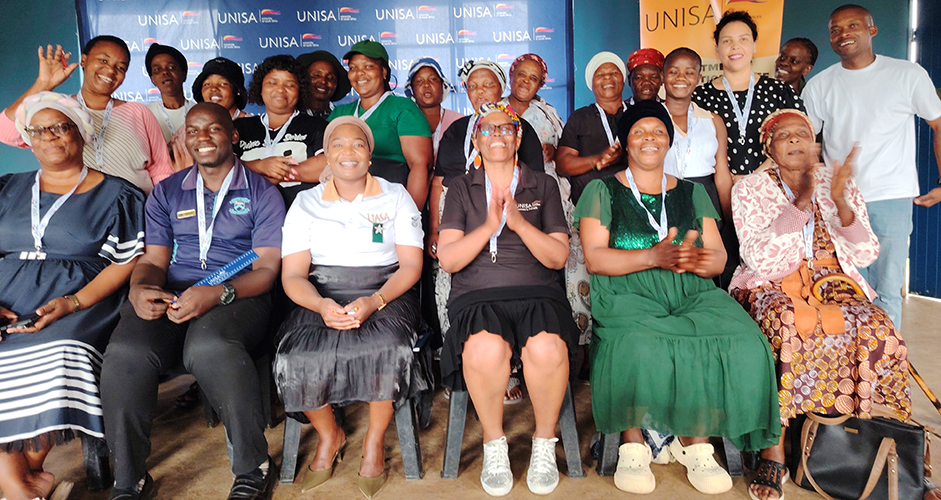
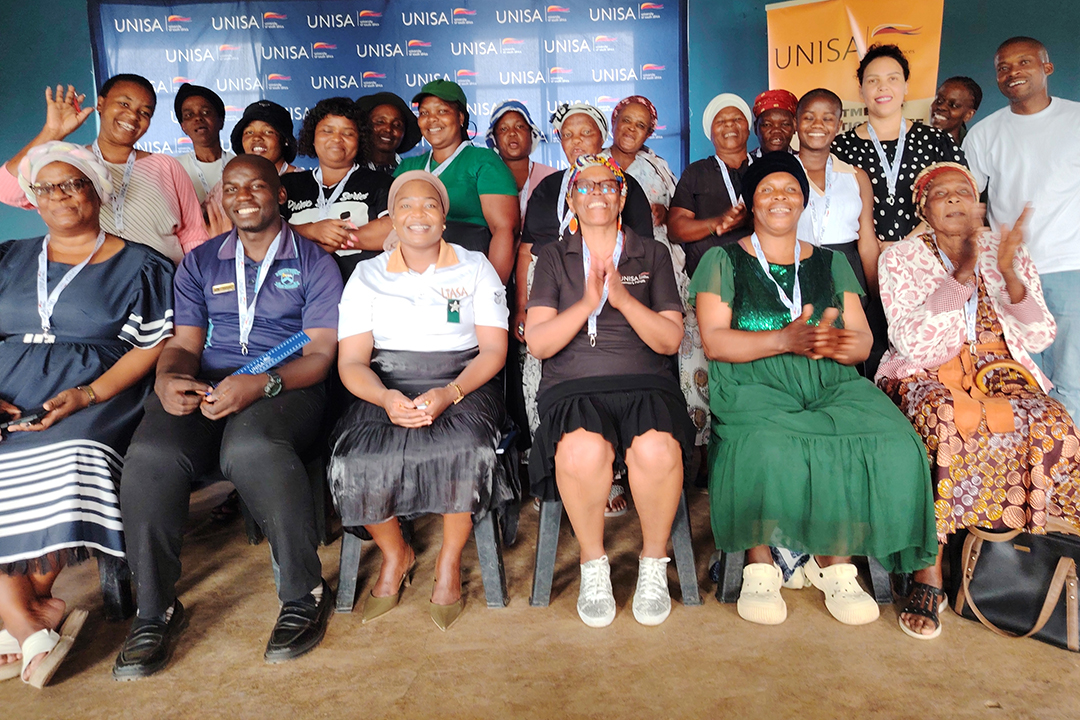
Group photo of project participants and College of Human Sciences (CHS) staff
For women farming the soil of eNdlangubo in northern KwaZulu-Natal, agriculture is about much more than what happens in the field. It puts food on household tables, creates opportunities for income and, for some families, provides an important defence against poverty.
But keeping those fields productive is becoming increasingly difficult.
Water is scarce. Some boreholes are not functioning. Fields are inadequately fenced, leaving crops vulnerable to roaming animals. Access to agricultural extension officers is limited, while farmers say they need soil testing, fertiliser, advice on what to plant and better connections to markets where they can sell their produce.
These realities emerged during the Indaba Zembokodo Zolimo, a community engagement seminar hosted on 21 September 2026 by a women-led interdisciplinary research team from the University of South Africa's (Unisa) College of Human Sciences (CHS).
Working with women smallholder farmers in eNdlangubo, outside Empangeni, the project is exploring how climate-smart agriculture, community knowledge and academic expertise can be brought together to strengthen food security and rural livelihoods.
Hosted at Enqoleni and Ufasimba primary schools, the gathering provided a space for farmers to speak directly about what is happening in their fields and what they need to make agriculture more sustainable.
Chief Bafana Biyela, who attended the engagement, encouraged the Unisa researchers and local farmers to strengthen their partnership and explore how productive use of the land could contribute to tackling hunger and poverty in the area.
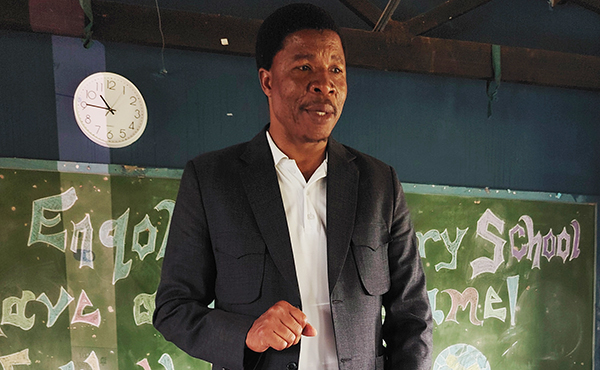
Chief Bafana Biyela, Traditional Chief of Ndlangubo.
The engagement focused on farmers' experiences of agricultural production, climate-smart agriculture, green sustainable libraries and ways of reducing agri-food waste and making better use of agricultural by-products.
But the discussions demonstrated that climate-smart agriculture cannot be separated from basic questions of water, infrastructure and access to resources.
Reliable water emerged as one of the most urgent concerns.
Participants described severe shortages and a lack of functional boreholes, forcing some farmers to depend on artificial dams for irrigation.
This makes watering crops physically demanding and limits farmers' ability to maintain production during dry periods. For smallholder farmers operating with limited resources, unreliable water can determine whether a season produces a viable harvest or significant losses.
It is here that the local challenges confronting eNdlangubo intersect with much larger development questions.
The project's focus on food production and climate resilience speaks directly to the ambitions of the United Nations Sustainable Development Goals, particularly SDG 2 on Zero Hunger and SDG 13 on Climate Action. The farmers’ struggle for reliable water also brings SDG 6 on Clean Water and Sanitation into sharp local focus.
In eNdlangubo, these global goals are not abstract targets. They can be seen in whether a farmer has enough water to keep a crop alive.
Water, however, is only one part of the challenge.
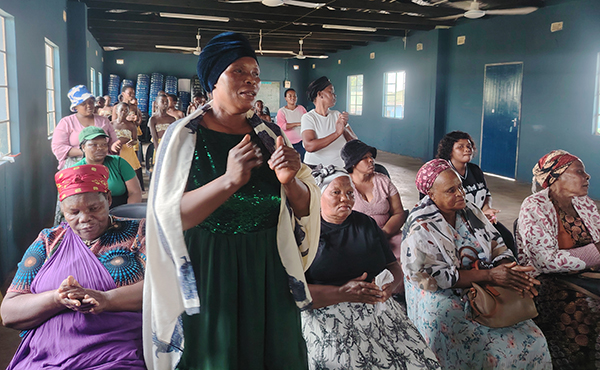
Participants sharing experiences and perspectives during the seminar engagement
Farmers told the Unisa team that they also struggled to access agricultural extension officers who could provide practical advice on soil conditions, crop selection and seasonal planting.
The lack of regular soil testing was identified as another obstacle.
Farmers said knowing what their soil could support would help them make better decisions before spending scarce resources on seeds, fertiliser and other inputs.
Community member said assistance was also needed at the other end of the agricultural process: getting produce to market.
"Can Unisa work together with the Department of Agriculture and come up with any help to assist the farmers with selling their produce, and if we can get an adviser so that we can know what to plant on which season, what sells fast, and where we can sell it?"
His concerns highlighted a fundamental challenge facing smallholder agriculture.
Growing food is only one part of the value chain. Farmers also need access to information, buyers and viable markets if their harvests are to become sustainable sources of income.
That economic dimension extends the project beyond food security. Helping smallholder farmers move from subsistence towards sustainable income speaks to SDG 1 on No Poverty and SDG 8 on Decent Work and Economic Growth, particularly in rural communities where agriculture can provide an important livelihood.
Even when farmers successfully plant and cultivate their fields, inadequate fencing creates another risk.
Participants said roaming livestock and other animals could enter cultivated areas and damage or destroy crops.
For farmers who have invested their labour and limited financial resources into production, such losses can affect both household food supplies and income
Community farmer Mabiyela Nzuza described the difficulties facing local growers.
"The biggest challenge that we are faced with is that we don’t have enough water to water our crops, fertiliser, and the fence to protect our crops from being eaten by the animals. We would appreciate receiving any kind of help from the Department of Agriculture. We have been trying to apply for help from the department, but no one is willing to assist."
Her comments reflected the frustration of farmers who said they had sought assistance but continued to struggle to access the resources and agricultural support they needed.
There is another important dimension to the eNdlangubo project: women are central to both the research and the agricultural knowledge being explored.
The initiative is led by women researchers working alongside women smallholder farmers whose understanding of local soil, crops, water constraints and household food needs has been developed through lived experience.
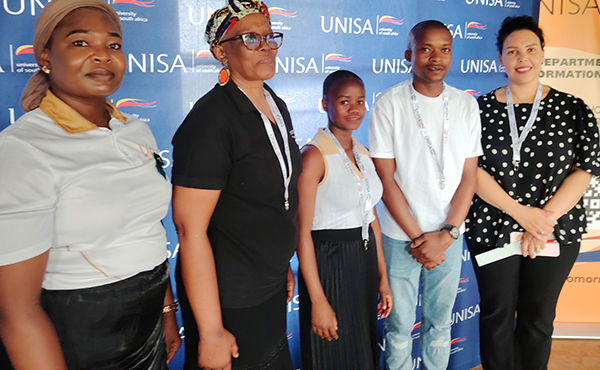
This relationship gives practical expression to Unisa's Feminist/Womanist/Bosadi Theorisations Catalytic Niche Area, which places African women’s experiences, knowledge and agency within scholarship rather than treating them simply as subjects to be studied.
In eNdlangubo, that means recognising women farmers not merely as beneficiaries of university expertise, but as knowledge holders who understand the conditions in which they farm.
Their experiences can help shape research questions and inform conversations about what climate-smart agriculture should look like in rural communities
The approach also resonates with SDG 5 on Gender Equality, particularly where women's participation in agriculture contributes to household livelihoods, food production and community resilience.
The project is also examining agri-food waste and how agricultural products and by-products can be better used.
For communities confronting food insecurity, reducing what is lost or discarded can be as important as increasing production.
This brings another development priority into the project: SDG 12 on Responsible Consumption and Production, which includes reducing food losses and waste and encouraging more sustainable use of resources.
Seen together, the different components of the initiative form a connected chain.
Water affects whether crops can grow. Agricultural advice influences what farmers plant and how successfully they produce it. Fencing protects the harvest. Market access determines whether surplus production can generate income. Better use of agricultural by-products can reduce waste.
Climate-smart agriculture, in other words, cannot be reduced to a single farming technique. It requires looking at the wider system in which farmers operate.
Although formal academic presentations planned for the seminar could not be delivered, the gathering provided something equally important: an opportunity for farmers to articulate their needs directly.
Their priorities were consistent.
They called for functional boreholes and improved water infrastructure, fencing, fertiliser and other agricultural inputs, soil testing, regular access to extension officers and assistance in reaching commercial markets.
These are not simply agricultural concerns.
For households dependent on farming, they affect whether there is food available, whether a harvest can generate income and whether farming remains viable in the face of changing climatic conditions.
The engagement also demonstrated why community knowledge matters to research.
Farmers know where the problems occur because they experience them every day. Academic expertise can help investigate solutions, but meaningful interventions require those two forms of knowledge to meet.
The eNdlangubo engagement demonstrated that farmers already have a clear understanding of many of the obstacles limiting their productivity.
What they are asking for is the support required to overcome them.
That presents an important test for engaged scholarship. Community engagement should not end when researchers leave the venue.
The concerns raised by farmers can inform further discussions about how universities, government departments, agricultural agencies and other partners connect research with practical interventions.
For Unisa, the project brings several strands of its academic and societal mission together: women-centred scholarship through Feminist/Womanist/Bosadi Theorisations, climate resilience, food security and the use of engaged research to respond to challenges identified by communities themselves.
It also shows how global development ambitions can become tangible at community level.
Zero Hunger becomes a question of whether families can produce enough food. Climate Action becomes the ability of farmers to adapt to changing conditions. Gender Equality includes recognising women as farmers, researchers and producers of knowledge. No Poverty and Decent Work become questions about whether a harvest can generate a sustainable livelihood.
For the women cultivating the fields of eNdlangubo, however, those ambitions begin with something much more immediate: water for their crops, protection for their fields, agricultural expertise they can access and markets where they can sell what they grow.
Addressing those needs could help turn farming from a daily struggle against scarce resources into a stronger foundation for food security, household income and rural resilience.
* By Anneline Johns and Zamaswazi Khanyile, Communication and Marketing Interns, KwaZulu-Natal Region
Publish date: 2026-10-02 00:00:00.0

 Unisa students turn Accounting Sciences knowledge into SAICA award-winning social impact
 Unisa turns to West Coast communities to preserve indigenous knowledge of the sea
 Unisa takes water research from the laboratory into communities
 Unisa women researchers join KwaZulu-Natal farmers in fight for food security
 Calls for decolonisation and 'unlearning to learn' take centre stage at Unisa-GCIS heritage dialogue