

Enrolling on average 40% of all accounting students in South Africa
What began with a self-taught beauty skill in Mamelodi has grown into an initiative aimed at helping others turn practical abilities into opportunities for income and enterprise.
For Unisa students Precious Nkosi and Lehlohonolo Nonyane, that idea has now earned national recognition after they won the 2026 South African Institute of Chartered Accountants (SAICA) Student Leadership Awards with their initiative, Ukuzithanda & Co.
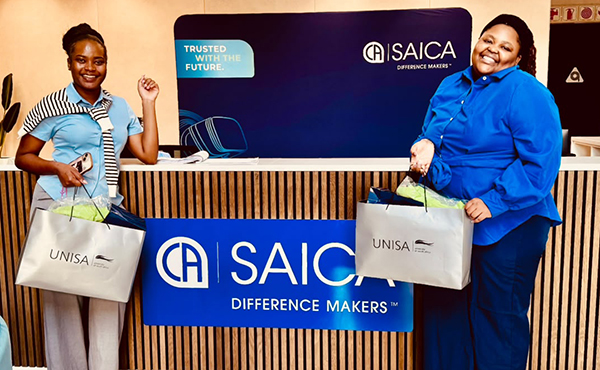
Unisa students Precious Nkosi and Lehlohonolo Nonyane, winners of the 2026 SAICA Student Leadership Awards.
The journey began with Nkosi's passion for beauty.
Growing up in Mamelodi, she became the person family and friends turned to when they needed their hair done, make-up perfected or their appearance prepared for a special occasion. What started as a self-taught skill eventually became a way of generating income and, later, the foundation for a broader idea.
Nkosi, a first-year Accounting Sciences student at Unisa, founded Ukuzithanda & Co as a skills-development initiative that uses beauty training as an entry point into economic participation.
Nonyane, a third-year Accounting Sciences student, joined the initiative in early 2026, bringing her interest in accounting, financial planning and sustainability to Nkosi's entrepreneurial vision.
Together, they have begun building a model that seeks to connect practical skills with opportunities for people who may struggle to access conventional pathways into education and employment.
The idea grew from a concern shared by both students: unemployment affects people across different age groups and circumstances, while many people possess practical abilities that could potentially be developed into sources of income.
"We noticed that there's a high rate of unemployment amongst everyone, and we wanted to help those people earn an income by giving them a skill," Nonyane said.
Ukuzithanda & Co provides beauty-skills training designed to equip participants with practical abilities they can potentially use to establish their own businesses and generate income.
Nkosi has also incorporated nail training into the initiative, allowing participants to develop a practical service skill.
The project is still in its pilot phase and has trained about eight people.
For the students, however, the initiative is based on a broader understanding of what creates economic opportunity.
"Making an income doesn’t only depend on whether you are studying and having a qualification," Nonyane said. "People have hands, and they can use their hands to learn a skill that can enable them to make an income."
That thinking is particularly important in a community such as Mamelodi, which the students see not only through the lens of unemployment but also for its talent, creativity and entrepreneurial potential.
"Mamelodi is not simply a place where unemployment exists," Nonyane said. "It is a community filled with talent, creativity, ambition and people who need opportunities to turn those qualities into sustainable livelihoods."
The initiative is particularly interested in creating opportunities for women, young people and people who may face barriers to traditional education and employment.
Nkosi and Nonyane's partnership began in an unlikely place: an online TikTok study community.
For about two years, the two students studied alongside each other, developing a relationship built around academics, discipline and personal growth.
When Nonyane became a volunteer collaborator on Nkosi's project in early 2026, their different strengths began to complement each other.
Nkosi brought the entrepreneurial vision and practical beauty skills, while Nonyane contributed an Accounting Sciences perspective and an interest in financial planning, sustainability and measuring impact.
Their decision to enter the SAICA Student Leadership Awards together allowed them to test the idea beyond their immediate community.
"Leadership is not about doing everything yourself," Nkosi said. "It is about knowing the vision, recognising the strengths of others and creating space for those strengths to contribute."
For Nonyane, the experience has also changed how she views her Accounting Sciences education.
She is pursuing a Bachelor of Accounting Science at Unisa after transferring from the Diploma in Accounting Science because she wanted to graduate with a bachelor’s degree.
Her studies have taught her to work with numbers, systems, financial information and accountability. Working on Ukuzithanda & Co has required her to apply that thinking to a developing venture while considering questions of sustainability, planning and growth.
"I believe the combination is powerful," she said.
The experience is also contributing to her longer-term ambition of becoming a chief financial officer, while giving her practical exposure to the financial and operational considerations involved in developing an emerging enterprise.
The initiative aligns with four United Nations Sustainable Development Goals: SDG 1, No Poverty; SDG 4, Quality Education; SDG 8, Decent Work and Economic Growth; and SDG 10, Reduced Inequalities.
These goals reflect the students' focus on accessible skills development, entrepreneurship and economic participation.
For Nkosi and Nonyane, however, the connection between education and impact is not simply theoretical.
Nkosi is combining her Accounting Sciences studies with an entrepreneurial idea that grew from a practical skill and a challenge she encountered in her own community.
Nonyane is applying financial and accounting knowledge to an initiative that is still being tested, developed and expanded.
The experience has shown them that university knowledge can be applied beyond examinations and assignments, particularly when combined with lived experience and an understanding of community needs.
The SAICA competition became another learning experience.
The students went through interviews, filming, rehearsals and dry-run presentations, receiving feedback on how to strengthen their concept and communicate it more effectively.
Preparation continued into the evening before the final presentation.
When they eventually faced the 11-member judging panel, the pressure was high. They were also the last team to present.
Nonyane said presenting as a two-person team was intimidating, but their preparation helped them focus on communicating the essence of the project.
Although they ran out of time during the presentation, their idea ultimately emerged as the winning entry at the SAICA awards dinner.
The competition also allowed the students to network with students from other universities and industry representatives, including SAICA leadership and a Standard Bank acquisitions manager.
A Standard Bank workshop provided further exposure to banking and services relevant to businesses.
"It was just an amazing experience as a whole," Nonyane said.
The award has allowed Ukuzithanda & Co to increase its training capacity.
The initiative currently has space to train one person at a time. The students plan to use their prize money to improve the training facility and add three additional training tables, allowing up to four learners to be trained simultaneously.
"This is where we are currently focusing on the expansion of our physical training centre," Nonyane said.
The next phase will also expand the range of beauty services offered, including make-up and hair installation.
The students' ambitions extend beyond the physical training centre in Mamelodi.
They want to develop an academy and eventually create a digital application that would allow people to access the training without travelling to Pretoria.
Someone in KwaZulu-Natal or the Western Cape, for example, could potentially access the same training remotely through the platform.
The longer-term plan is therefore to strengthen the existing centre, increase its capacity, broaden the skills offering and eventually take the model beyond Mamelodi.
For Nkosi, the journey began with an ordinary practical skill. It has since evolved into a larger question: what if a skill that can generate income for one person can be used to help someone else build a livelihood?
For Nonyane, the experience has expanded the meaning of an Accounting Sciences education, showing how financial knowledge can intersect with entrepreneurship, sustainability and social impact.
Their success also illustrates how lived experience and academic knowledge can come together to address challenges within communities.
Both students say access to higher education has been an important part of their journey.
"We love Unisa for allowing us to change lives," Nonyane said.
Their SAICA award is therefore not simply recognition for an idea. It marks an early stage in an initiative that began with a beauty skill in Mamelodi and is now seeking to turn practical knowledge into opportunities for others.
*By Lesego Chiloane, Journalist, Department of Institutional Advancement
Publish date: 2026-10-02 00:00:00.0

 Unisa hackathon winners develop AI solution to support students at risk of falling behind
 Beyond Black Wednesday: Unisa lecture calls for urgent action to protect media freedom and public broadcasting
 Unisa celebrates 25 new PhD graduates advancing research and innovation
 From Maramanzhi to master's: Unisa graduate champions Tshivenda through scholarship
 Unisa students help shape digital complaints system to improve accountability and service delivery