

The African college of excellence in the social and human sciences
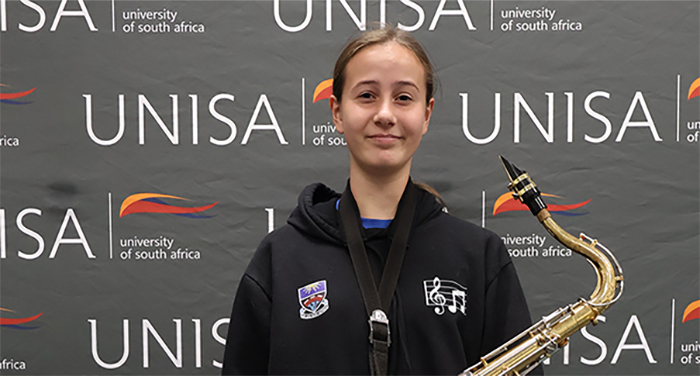
Music student and aspiring saxophonist, 15-year-old Anna Sophia Kriel
At first glance, it might seem unusual to see some of the youngest visitors to a university campus carrying violin cases, music books and drumsticks. Yet at the University of South Africa (Unisa), children as young as five regularly walk through examination venues to take part in one of the institution's longest-standing educational traditions: its music examinations.
For many aspiring musicians, a Unisa music examination is more than a test of technical skill. It is the beginning of a lifelong musical journey that can ultimately lead from a pre-Grade 1 music qualification to doctoral studies in music.
The Directorate of Music recently celebrated a remarkable milestone: 130 years of music examinations. First conducted in 1894, these examinations have become one of the oldest and most respected music assessment programmes in South Africa.
According to Sean Adams, Deputy Director: Professional Support in the Directorate of Music, the programme has evolved significantly while remaining committed to excellence. "Unisa is one of the very few academic institutions where a student can begin with pre-Grade 1 music examinations and progress all the way to doctoral level studies in music," says Adams.
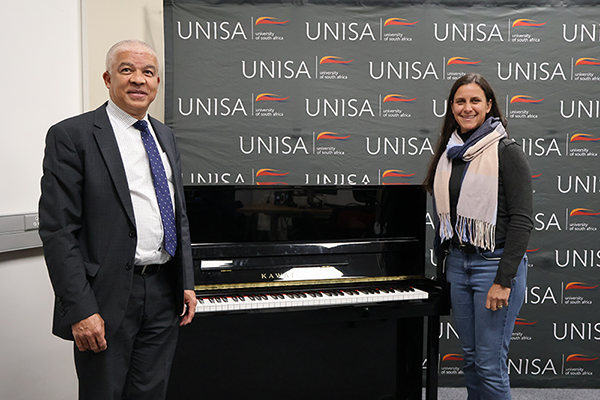
Sean Adams and Karin Bosman
The history of Unisa's music examinations stretches back to a time when South Africa looked very different. In the late 1800s, examiners travelled from the United Kingdom by ship to conduct music assessments in the Cape Colony.
"Those early examiners would arrive by boat from the UK and travel long distances to assess students. It was a completely different world," Adams explains.
Over the decades, the examinations expanded across South Africa and eventually beyond its borders. Today, Unisa offers practical and theoretical examinations in 14 countries and continues to grow its presence across Africa, including Botswana, Zambia, Malawi, Kenya, Tanzania and Uganda.
The Western Cape Region continues to play an important role in the delivery of these examinations. At the Cape Town Campus, candidates complete their examinations in a dedicated soundproof recording studio allocated specifically to music examinations. The studio provides an ideal environment for practical examinations and reflects Unisa's commitment to maintaining high standards in music education and examination practices. Throughout the examination period, aspiring musicians from across the region visit the Cape Town Campus to participate in a tradition that has shaped generations of performers for more than a century.
One of the most remarkable aspects of the programme is the diversity of its candidates.
While many people associate music examinations with school-going children, Unisa's candidates range from preschool learners to retirees pursuing music as a personal passion.
"We have students from as young as five years old and others who are over 80 years old," says Adams. "We have school learners, university students, working professionals and retired individuals. Music is truly for everyone."
The examinations cover a wide variety of instruments and disciplines, including piano, violin, cello, double bass, flute, clarinet, saxophone, trumpet, trombone, organ, guitar, drums, voice, percussion and jazz studies.
While classical music examinations have been offered since 1894, Unisa continues to evolve its curriculum to reflect South Africa's rich musical heritage.
In 2012, the institution introduced jazz examinations. The Directorate of Music is now developing examination syllabi for African instruments, including the djembe drum, African marimba and the uhadi musical bow. Plans are also underway to introduce examinations for the mbira.
These developments form part of a broader effort to make music education more accessible and representative of diverse musical traditions.
Although learning an instrument can bring joy and artistic fulfilment, Adams believes the benefits extend far beyond performance.
"Music contributes to cognitive development, discipline and neurological growth," he explains. "The theoretical aspects of music engage similar areas of the brain involved in mathematics and science. That's why it's common to find learners who excel in both music and mathematics."
The discipline required to practise regularly, prepare for examinations and perform under pressure helps students develop skills that benefit them throughout their lives. Music is also increasingly recognised for its therapeutic value. Research has shown its effectiveness in supporting rehabilitation, stroke recovery and dementia care, further highlighting its impact beyond the concert stage.
The Directorate of Music demonstrated its adaptability during the Covid-19 pandemic by introducing online practical examinations in 2020. This innovation enabled students from countries such as France and the United Kingdom to complete their examinations remotely. The directorate is now working towards implementing online theoretical examinations as well.
To maintain quality standards, Unisa works with a network of more than 2 000 accredited music teachers. Only accredited teachers may enter students for examinations, ensuring that candidates receive appropriate preparation and guidance.
Beyond examinations, the Directorate of Music regularly hosts workshops and masterclasses featuring internationally acclaimed musicians, creating valuable learning opportunities for aspiring performers. The directorate's mission extends beyond assessment. Through initiatives such as the South African Music Scholarship Competition, talented Grade 8 students can compete for scholarships and prizes that support their continued musical development.
For Adams, the goal is to create opportunities for young musicians who may not otherwise have access to formal music education. "Music education was once viewed as something only available to a privileged few. We want to create opportunities for all students and help them reach a level where they can pursue higher education in music if they choose."
As young candidates leave examination venues clutching their music scores and instrument cases, they become part of a tradition that has endured for more than a century.
Whether they are five or eighty years old, each candidate contributes to a legacy that continues to inspire, educate and transform lives through the power of music.
One of the youngest candidates at the examination centre was Anna Sophia Kriel, aged 15, a Grade 9 learner at DF Akademie and Hugo Lambrechts Music School, who recently completed a Soprano Saxophone Grade 4 examination.
"I play saxophone so I can play in bands with my school, it is a fun community, and I have learnt to love this instrument even more," the learner said after completing the examination.
The experience is part of a journey that helps young musicians develop confidence, discipline and creativity while opening doors to future opportunities in music and beyond.
* By Thandeka Mtyali, Intern: Communication and Marketing, Western Cape Region
Publish date: 2026-07-01 00:00:00.0
 SBL doctoral graduate is shaping the future of Ethiopia's coffee sector
 A milestone for student wellbeing
 Unisan advances service excellence through his MBA journey
 Unisa brings world's leading mission scholars together to tackle global challenges
 Unisa hosts workshop to empower postgraduate student support and quality assurance