
Producing over 40% of teachers in South Africa
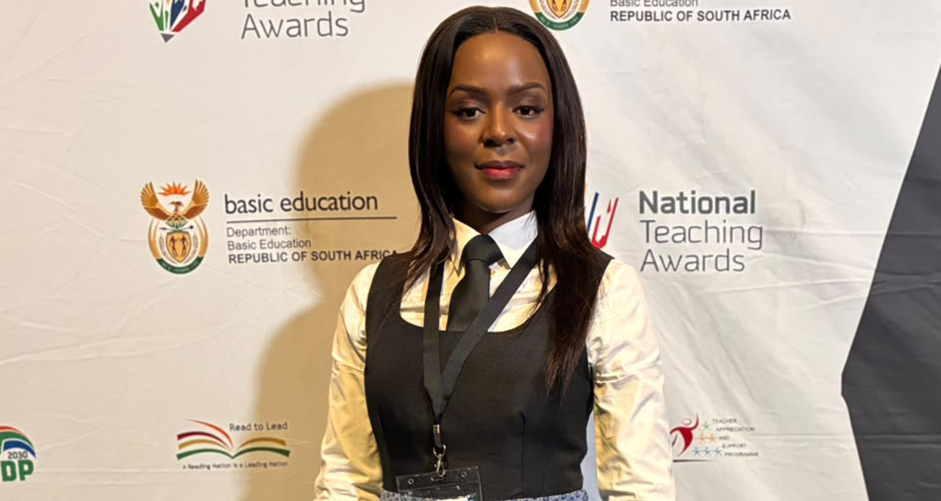
Unisa alumna and PhD candidate Nokuthula Zulu proudly displays her certificate after securing second place nationally in the Excellence in Secondary School Teaching category at the 2026 National Teaching Awards, held at the Birchwood Hotel in Boksburg on 1 October 2026.
For Unisa graduate Nokuthula Zulu, teaching is about more than helping learners pass examinations. It is about understanding their individual circumstances, identifying barriers to learning and creating opportunities for every learner to reach their potential.
This commitment to education has earned her national recognition at the 2026 National Teaching Awards, where she was named the second-place national winner in the Excellence in Secondary School Teaching category. The awards, hosted by the Department of Basic Education at the Birchwood Hotel in Boksburg on 1 October 2026, celebrated educators whose dedication, innovation and leadership are making a meaningful difference in South African schools.
For Zulu, who is currently pursuing a Doctor of Philosophy (PhD) in Psychology of Education at the University of South Africa (Unisa), the recognition represents an important milestone in a teaching career spanning 13 years. It also highlights the impact of combining academic research, evidence-based teaching and a commitment to improving educational outcomes. Zulu began her teaching career at Naledi High School in 2013, where she developed her passion for helping learners overcome academic challenges and achieve their goals.
In 2022, she joined Prudens Secondary School after securing a promotional appointment, taking on greater leadership responsibilities. She currently serves as a Departmental Head, overseeing curriculum delivery, coordinating Quality Management System processes, managing Grade 12 academic programmes and moderating assessments. She also contributes to the national examination process as a senior marker for the National Senior Certificate examinations.
These responsibilities have allowed her to influence teaching and learning beyond her own classroom, supporting fellow educators and helping strengthen academic performance across the school. At the heart of her approach is the belief that effective teaching begins with understanding learners’ needs and the circumstances that influence their ability to succeed.
Rather than relying solely on conventional classroom instruction, she uses learner performance data to identify academic gaps and develop targeted interventions. This enables her to provide additional support where it is needed and create opportunities for learners to improve their understanding and performance. The impact of Zulu's approach is reflected in the significant improvement in learner performance at Prudens Secondary School.
One of the strongest examples presented in her National Teaching Awards submission was the school's performance in Business Studies. In 2023, the subject recorded an 85% pass rate, with one distinction.
By 2025, the pass rate had increased to 100%, with 18 distinctions. The school's Grade 12 learners also achieved 18 distinctions in Life Orientation in 2025. Another notable achievement was recorded when a learner obtained a perfect score of 300 out of 300 in Business Studies, reportedly the first such result in the school's history. These achievements reflect the value of consistent academic monitoring, targeted learner support and teaching strategies informed by evidence.
For Zulu, the results demonstrate what can be achieved when educators move beyond simply delivering the curriculum and actively address the factors affecting learner performance. Her approach also places emphasis on developing critical thinking, problem-solving and practical knowledge that learners can apply beyond the classroom. In subjects such as Business Studies, these competencies can help prepare young people for further education, entrepreneurship and future participation in the economy.
Zulu credits Unisa with playing an important role in her development as an educator, researcher and academic leader. She obtained her Bachelor of Education Honours degree through the university before completing a master's degree in Psychology of Education. She is now pursuing a PhD in the same field, continuing her commitment to research and professional development. Her postgraduate studies have deepened her understanding of the psychological, social and environmental factors that influence teaching and learning.
This knowledge has helped shape an educational approach that considers not only what learners are taught but also their individual experiences, learning needs and circumstances. It has also strengthened her ability to develop interventions informed by research and evidence. "Unisa has provided more than academic credentials. It has contributed to my development as an educational leader, researcher, and lifelong learner committed to evidence-based practice and continuous professional growth," she said.
For Zulu, the decision to continue with doctoral studies reflects her belief that educators should remain learners throughout their professional careers. Her academic journey demonstrates how postgraduate education can strengthen classroom practice, educational leadership and the capacity of teachers to respond to changing learner needs. It also highlights Unisa's contribution to developing educators who combine professional experience with research-informed approaches to teaching.
Zulu's national recognition reflects the broader importance of investing in teachers and strengthening the quality of education in South Africa. Her work contributes to the objectives of the United Nations Sustainable Development Goal (SDG) 4, which promotes inclusive and equitable quality education and lifelong learning opportunities for all. By identifying learning barriers and implementing targeted interventions, she is helping improve educational outcomes and create opportunities for learners to succeed.
Her achievement also speaks to SDG 5 on gender equality, particularly the importance of women's participation and leadership in professional and educational institutions. As a woman in educational leadership, Zulu provides an example of how professional development, academic achievement and dedication can open opportunities for women to contribute to institutional improvement. Her work further supports the broader objectives of South Africa's National Development Plan (NDP) 2030, which identifies improved education, teacher development and stronger learner performance as essential to reducing inequality and building a skilled workforce.
Through her focus on academic excellence and learner support, she is contributing to the development of young people who will be better positioned to pursue further education, employment and entrepreneurship. Beyond its national significance, Zulu's achievement also reflects the aspirations of the African Union's Agenda 2063. The continental development framework places education, skills development, science, technology and innovation at the centre of Africa's long-term transformation. Its emphasis on developing well-educated citizens recognises the important role teachers play in preparing future generations to participate meaningfully in society and the economy.
By strengthening learner performance and encouraging critical thinking, Zulu contributes to the development of the knowledge and skills needed to support Africa's future growth. Her academic and professional journey also demonstrates the value of lifelong learning, particularly for educators whose work directly influences the development of young people. For Unisa, her recognition highlights the contribution its graduates continue to make in schools and communities across South Africa.
It also reinforces the importance of connecting university research with practical challenges in the education sector. Despite her national recognition, Zulu remains focused on the learners whose academic journeys she helps shape. Her teaching philosophy is grounded in the belief that education should build confidence, develop critical thinking and enable young people to recognise opportunities beyond their immediate circumstances. This approach has informed both her classroom practice and her responsibilities as an educational leader.
Her achievements at Prudens Secondary School demonstrate the difference that research-informed teaching, consistent academic support and effective leadership can make to learner performance. As she continues with her doctoral studies at Unisa, Zulu remains committed to strengthening her knowledge and applying it to improve teaching and learning.
Her recognition at the National Teaching Awards is therefore not only a celebration of individual excellence but also an acknowledgement of the important role educators play in shaping South Africa’s future.
For Zulu, the true measure of teaching excellence lies not only in awards or examination results, but in the opportunities education creates for learners to build better futures.
* By Dr Freddy Abilio Mlambo, Communication and Marketing Specialist, College of Education
Publish date: 2026-11-05 00:00:00.0

 Unisa KwaZulu-Natal Region promotes staff well-being through health and wellness day
 Unisa graduate wins national recognition for excellence in teaching
 Unisa's Prof Puleng Segalo elected to prestigious Academy of Science of South Africa
 Three Unisa students selected among Africa's top 20 student quality assurers
 Two Unisa professionals honoured for excellence in research and innovation management