

Producing over 40% of teachers in South Africa
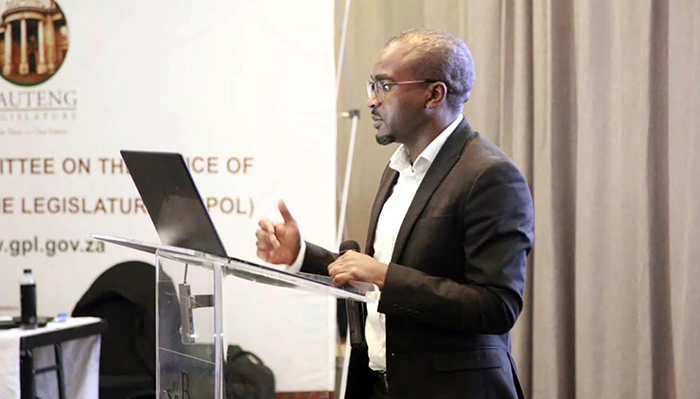
Prof Nathi Zongozzi
Professor Nathi Zongozzi from the Institute for Open Distance Learning in the College of Education recently contributed to the Gauteng Intergovernmental Oversight and Coordination Workshop hosted by the Oversight Committee on the Premier’s Office and the Legislature.
The workshop took place on 24 February 2026 at the Birchwood Hotel and OR Tambo Conference Centre in Boksburg and brought together senior leaders from the Office of the Premier (OTP), the Gauteng Department of Cooperative Governance and Traditional Affairs, the Gauteng Provincial Legislature, municipalities, oversight committees, South African Local Government Association Gauteng, and governance practitioners.
The Honourable Ntombi Mekgwe and the Honourable Dr Bandile Masuku chaired the session. In his opening remarks, Masuku highlighted that the purpose of the workshop was to strengthen oversight, to improve coordination between provincial and municipal spheres, and to address systemic service delivery challenges through collaborative governance, in line with the principles of cooperative government set out in Chapter 3 of the Constitution of the Republic of South Africa.
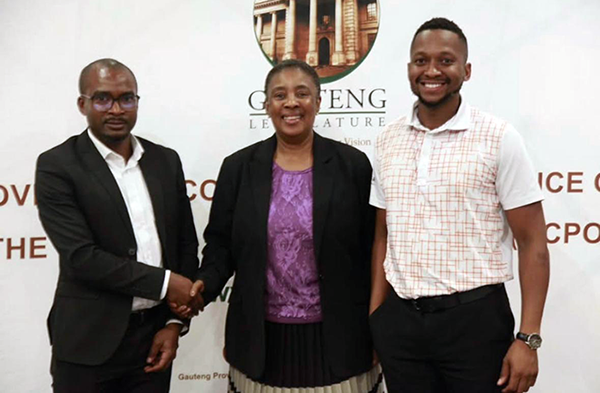
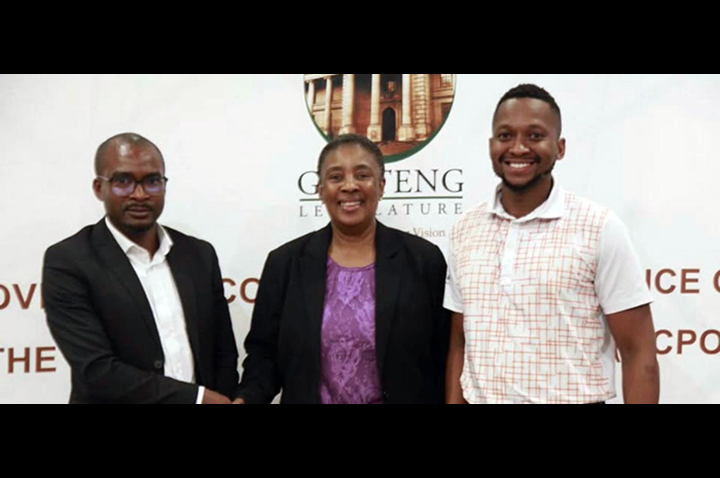
From left: Prof Nathi Zongozzi, Hon Ntombi Mekgwe, and Abiel Mahlatsi
Speaking on behalf of the Premier following the State of the Province Address, the Director-General in the Office of the Premier, Edward Mosuwe, emphasised the central role of the OTP in driving transversal coordination, aligning planning and performance systems, and strengthening monitoring and accountability across government to give practical effect to intergovernmental cooperation and integrated service delivery.
Against this backdrop of high-level deliberations on governance architecture, cooperative government, and service delivery alignment, Zongozzi presented a reflection on intergovernmental relations during the era of the Gauteng Provincial Unity. His contribution focused on how coalition governance places greater emphasis on institutional systems, administrative continuity and structured coordination mechanisms within a constitutional framework that requires the three spheres of government to exercise their powers in a manner that avoids encroachment and supports mutual accountability.
He argued that when executive authority is shared, stability depends on strong protocols, integrated monitoring, rigorous documentation, and professional administration rather than political uniformity. He further underscored that coalitions do not create coordination weaknesses but rather reveal existing gaps within governance systems, thereby creating opportunities for institutional strengthening and improved compliance with the constitutional prescripts of cooperative governance.
The workshop provided a platform for senior government leaders and oversight bodies to reflect collectively on improving accountability, coherence, and intergovernmental maturity in Gauteng. Zongozzi’s participation highlights the Institute for Open and Distance Learning’s engagement in governance discourse and its contribution to strengthening institutional resilience and coordinated service delivery within the framework of South Africa’s constitutional democracy.
* By Tshegofatso Moche, Administrative Assistant, Institute for Open and Distance Learning, College of Education
Publish date: 2026-03-25 00:00:00.0
 Unpacking the strategy behind positioning SA on the global stage
 Making sense of change
 Towards strengthening cooperative governance
 Unisa’s ICTVET2026 champions skills revolution and youth empowerment
 Newly launched Unisa centre to strengthen TVET beyond Africa