

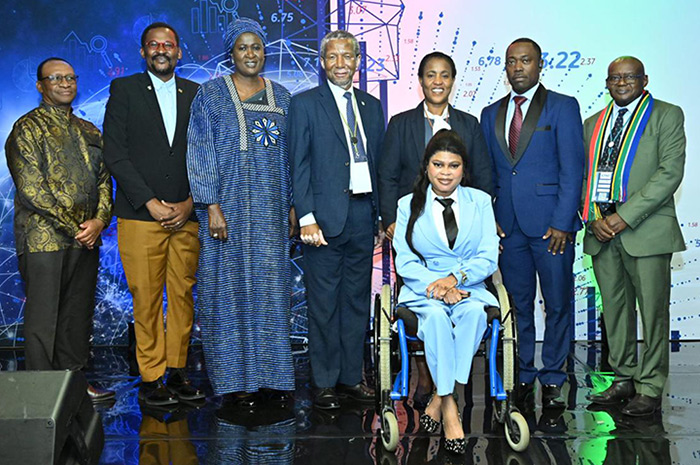
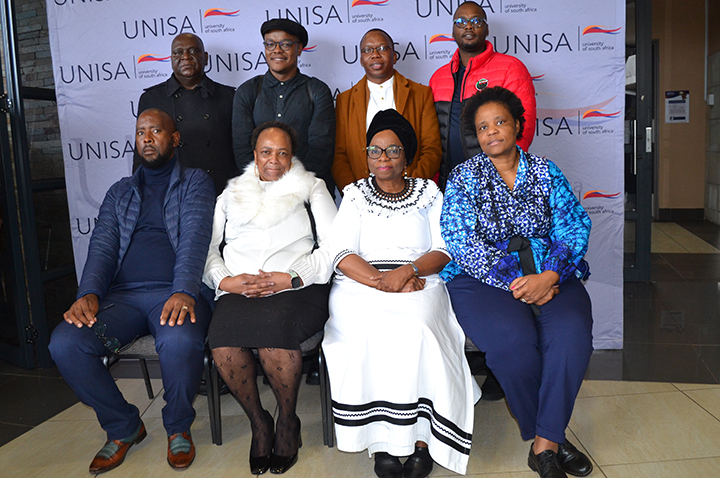
From left: Prof Sello Mokoena, Local Organising Committee Chair; Sanele Zondi, Technical Vocational Education and Training Governors’ Council (TVETCGC) Secretary-General, who represented Sthembiso Khanyile, TVETCGC President; Dr Jahou Samba Faal, ATUPA Secretary-General; Prof Solomon Magano, Vice-Principal: Institutional Development; Prof Edith Phaswana, Acting Executive Dean, Thabo Mbeki African School of Public and International Affairs; Olivier Pieume, Chief of the Technical Cooperation Unit: UNESCO-UNEVOC; Dr Azwinndini Tshivhase, Acting Vice-Principal: Teaching, Learning, Community Engagement and Student Support. Seated is Kgaogelo Chokoe, National President of the South African Technical Vocational Education Student Association (SATVETSA)
Unisa is hosting its second International Conference on Technical and Vocational Education and Training (ICTVET2026) from 24 to 27 March 2026. Held under the theme Innovative Pathways and Best Practices for the Promotion of TVET for Entrepreneurship and Youth Employment, this year’s conference focuses on the role of education in economic participation. It brings together policymakers, educators, industry leaders and development partners.
The conference is organised in close partnership with the UNESCO-UNEVOC International Centre for Technical and Vocational Education and Training (TVET), supported by the Association of Technical Universities and Polytechnics in Africa (ATUPA), the Education, Training and Development Practices Sector Education and Training Authority (ETDP SETA), and the Department of Higher Education and Training (DHET).
At the opening session, the Deputy Minister of Higher Education and Training, the Honourable Dr Nomusa Dube-Ncube, delivered the keynote address to a distinguished and diverse audience across Africa.
Dube-Ncube remarked: "This platform offers a valuable opportunity to share ideas, learn from one another, and engage in meaningful discussions". Dube-Ncube added that the DHET values interactions with thought leaders. She noted: "They help us sharpen our approach and ensure that we continue to strengthen and reform the post-school education and training (PSET) system. We see you as essential partners in this journey."
She explained: "The rapid evolution of technology demands seamless integration between education, industry and economic systems". However, she noted that this requires alignment between local impact and national relevance, while remaining globally competitive.
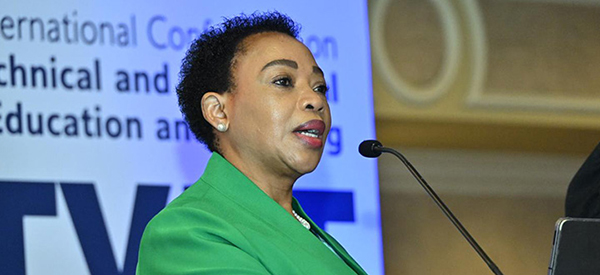
The Honourable Dr Nomusa Dube-Ncube, Deputy Minister of Higher Education and Training
Dube-Ncube highlighted Africa’s demographic advantage. She said the continent’s youthful population presents a unique opportunity, but that this requires aligning education outputs with labour-market demand.
Dube-Ncube further said that what the nation faces is not simply a skills gap, but a coordination failure between education, industry and policy. "We are operating in a fast-changing world shaped by technology and artificial intelligence," said Dube-Ncube, highlighting that change is constant and rapid. "We cannot afford to fall behind. We must act quickly, innovate and implement solutions effectively."
She urged institutions to better connect skills development with industrial zones, energy corridors and community needs. "Curriculum design must be developed together with industry to reflect real market demands," said Dube-Ncube. "Without structured industry placements and access to markets, finance and industrial integration, skills risk going underused."
Speaking on behalf of the DHET, Dube-Ncube said education should be a tool for justice and innovation, hence the department is working hard to align training with industry needs, strengthen TVET teacher development, and ensure effective policy implementation. Partnerships are essential. "Universities must support TVET colleges through shared resources, joint programmes and integrated learning pathways," she said. "We must also tackle systemic barriers by integrating business and financial support into our education systems. This ensures that young people are equipped not only with skills, but with real opportunities to use them."
She added, "We must think beyond our borders and position South Africa strategically within Africa. With a young population, growing cities and rising industrial demand, the continent offers historic opportunities." Dube-Ncube said South Africa can become a hub for skills development, supplying talent regionally and strengthening value chains.
"If we fail to align skills with the economy, we risk producing qualifications without jobs, potential without opportunity, and ambition without pathways," she continued. "But if we succeed, we can transform lives and reshape our economy. History will judge us by what we build, not by our intentions."
She concluded: "Countries that have industrialised successfully put skills at the heart of their economic strategy. South Africa must do the same by linking education, production and innovation."
During her welcoming remarks, Prof Puleng LenkaBula, Unisa Principal and Vice-Chancellor, said: "Education was never just an academic exercise for our liberation leaders. It was a powerful tool to dismantle oppression, tackle poverty, and ensure that no one is left behind."
"Today," she noted, "our education systems must evolve beyond traditional approaches to become engines of innovation, opportunity and enterprise development."
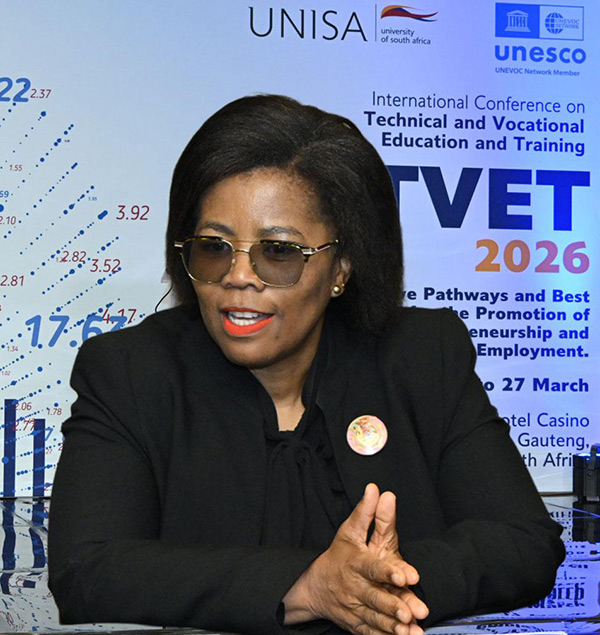
Prof Puleng LenkaBula, Unisa Principal and Vice-Chancellor
LenkaBula highlighted the crucial role of TVET colleges in connecting education to the labour market: "We must nurture entrepreneurial thinking, technological literacy and resilience so that young people are not just job seekers, but job creators," she said. She also challenged institutions to ensure inclusivity and that all systems reflect African philosophies.
Dr Jahou Samba Faal, Secretary-General of ATUPA, said that the conference is timely. "Today, we come together as partners committed to shaping Africa’s future through TVET to unlock youth potential, fostering innovation and creating pathways to meaningful employment," Faal said. "TVET must evolve beyond traditional training models; it must be a driver of innovation, a catalyst for entrepreneurship, and a bridge to sustainable livelihoods."
Faal highlighted the power of collaboration: "Through our network of over 260 institutions, we empower youth with practical skills, entrepreneurial mindsets and the confidence to lead. Africa’s greatest asset is its young people, and TVET must become a launchpad where they are trained not only for jobs, but to create them."
Faal also congratulated Unisa on the launch of its UNEVOC Centre. "This milestone reflects our shared commitment to strengthening TVET systems and advancing global collaboration," she said. "Together, we can unlock Africa’s potential and build a more inclusive, innovative, and prosperous future."
This year’s ICTVET2026 is more than a conference – it is a catalyst for change. By championing entrepreneurship, digital innovation and inclusive partnerships, it positions TVET as a powerful tool to turn education into opportunity and unlock the full potential of Africa’s youth.
* By Lesego Chiloane, Journalist, Department of Institutional Advancement
** Photography by Shooheima Champion, Multimedia Centre
Publish date: 2026-03-25 00:00:00.0
 Masterclass unpacks the power of glocalisation in global marketing
 Unisa and NPC expand partnership to promote the journalism profession
 Unisa's renowned scholars nominated for South Africa's Science Oscars
 Unisa celebrates the life and legacy of Miriam Makeba
 Unisa seminar examines cultural knowledge and language as key ingredients of ubuntu