

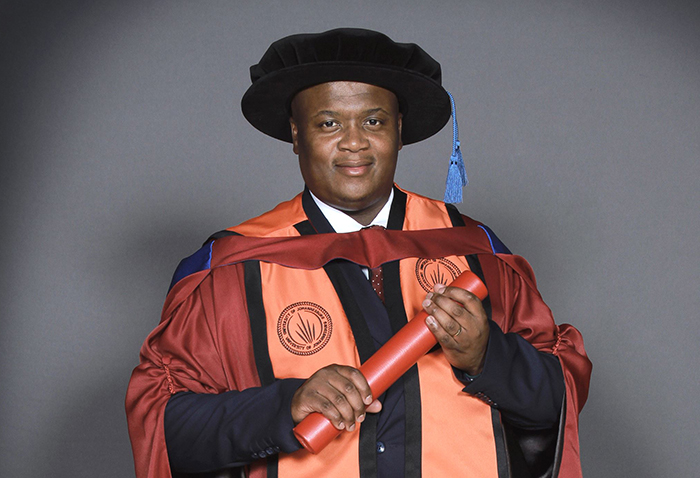
Dr Tlhogi Marumolwa
For Dr Letlhogonolo Mosimi Marumolwa II A’ Lekoto A’ Pula A’ Kelobonye A’ Marumolwa I A’ Letsatsi (la matlhaba-kae) A’ Dithamaga tsa ga MmaLeshaba le Pula, known simply as Tlhogi, completing his PhD was never just about earning another qualification. It was about carrying forward the values he had received, representing his community honestly, and demonstrating that one’s background and difficulties do not have to determine the end of one’s story.
Dr Marumolwa, an experienced IT and data professional, has a career that includes lecturing, software development, business intelligence and leadership. Since joining Unisa in 2020 as Director: Business Intelligence, he has advocated for data-driven decision-making. He has various qualifications in information technology, an MBA, industry certifications and he recently completed his PhD.
We sat down with Dr Marumolwa to learn more about the person behind the PhD, his research journey and what this means for his future contributions to the institution and beyond.
A: My PhD was about open data, and more specifically about how organisations can migrate or convert dark data into open data. The study explored the organisational, digital leadership, technical, legal and ethical capabilities required to make data more open and accessible for innovation and evidence-based decision-making.
My motivation was both professional and personal. Professionally, I felt that not enough was known about the practical and organisational challenges that limit innovation through data. Working in the data environment, I could see that the problem was not only technical. It was also about leadership, organisational readiness, governance, ethics and the ability to create mechanisms that allow data to be responsibly opened and used.
Personally, pursuing a PhD had been my dream for a long time. Having spent more than 20 years in the education space in one form or another, I felt that I had a scholarly contribution to make. I also wanted to honour my faith, family and community, and to show that adversity does not determine one’s future.
A: It was very challenging. My role is demanding, and the portfolio in which I work plays a critical role between the external environment and the institution. I therefore had to accept that the PhD would require sacrifice. Much of the work had to be done after hours, during evenings, weekends and personal time.
What helped me the most was to stop waiting for perfect conditions. Initially, I thought I needed large blocks of uninterrupted time – that was rarely possible. Over time, I adopted a more agile approach; even if I could change only one sentence a day, I made sure the wheel kept turning. That became my guiding principle.
Another important shift was to align my PhD with my work. The reading, thinking and insights from the PhD study began to shape how I approached some internal matters. Once I started treating the PhD as serious work in its own right, with a plan, deadlines and execution discipline, it became more manageable.
A: When I joined Unisa, I had already started my research journey, but in discovering the PRC as one of the biggest forms of support, I realised that there was a community of professional and administrative staff who were also engaged in research.
It was a major mental boost that helped me understand I was not an anomaly. There were colleagues outside the traditional academic space who were also producing research, thinking deeply about their work, and converting professional practice into scholarly output.
The PRC environment also helped me appreciate the value of documenting the work we do as professional staff. Much of our work requires investigation, benchmarking, alignment, analysis and evidence-based decision-making. When that work is converted into scholarly output, it helps the academic community understand our contribution in a language they value and understand.
I also benefited from the master's and doctoral support programme (MDSP), which covered research-related costs. This can be significant, especially for working professionals who already have financial obligations. For me, that support removed a major worry and allowed me to focus on completing the work.
A: I would encourage professional and administrative staff to use the services of the PRC because the Committee confirms that professional staff are not left behind in the research environment.
In many organisations, development opportunities for working professionals can be limited, especially when one is not in a formal academic post. My experience at Unisa has been different. The existence of the PRC shows that the institution recognises that professional and administrative staff also have a role to play in knowledge production, institutional improvement and scholarly contribution.
I would encourage colleagues to engage with the PRC because they have nothing to lose and everything to gain. The work we do in the professional spaces often has deep institutional value. The PRC helps us see that value, strengthen it and translate it into forms that can benefit the institution, the sector and the broader knowledge community.
On a personal note, I would like to express my sincere gratitude to the PRC and to everyone who contributes to the Committee's work. I am proud and honoured to have benefited from the support made available through the PRC and related initiatives. I also hope that more professional staff will realise the value of this support and make use of it.
A: Professionally, the PhD journey has deepened my appreciation of the research process. It has helped me better understand what academic colleagues go through. That understanding has made me more mindful of how I support colleagues in the academy.
It has also expanded my vision of impact. I am now more interested in how the work I do can contribute not only to Unisa but also to the sector, the country and society more broadly. I keep asking myself: Now that the institution has supported my education, how do I pay that back through meaningful contribution?
Personally, the eight-year journey has humbled me and taught me persistence, tenacity and the importance of visualising the end even when the path is difficult.
It also strengthened my gratitude to God, my family and to everyone who contributed in some way along my PhD journey. Completing the PhD was exciting, exhausting and deeply meaningful. The important question now is how to turn that achievement into impact.
A: Looking back, I would have adopted much earlier the mindset that the PhD itself was work, and not something to pursue only when time allowed. The biggest change came when I approached my PhD with the same seriousness as other work deliverables: planning for it, setting deadlines, monitoring progress and ensuring consistent execution.
One of the biggest lessons was realising that in a demanding work role, especially without RD leave, waiting for the perfect time can delay progress. I eventually realised that small, consistent movement is better than waiting for perfect conditions. Even changing one sentence, refining one paragraph, reading one article or clarifying one idea can keep the process alive.
The lesson was clear; I would have kept the wheel turning much earlier and much more deliberately.
A: My first advice would be to do it – but with your eyes open. Doctoral studies are demanding, and doing them while working in a professional or administrative role requires discipline, sacrifice and resilience.
Where possible, align your study with your work. This is one of the most practical decisions you can make. When your study is connected to your professional work, the knowledge domain becomes more focused. You write with more confidence because you have first-hand experience of the issues you are researching. The reading also becomes more meaningful because you are not only reading for academic purposes; you are also benchmarking, reflecting and learning in ways that can improve your work.
Professional staff should also learn to see their work as having scholarly value. Many of the challenges we face in practice are genuine research problems. If we identify the right gaps, especially gaps grounded in both practice and knowledge, we can make contributions that are academically sound and practically relevant.
My other advice is to manage the PhD like a project. As I have said before, keep the wheel turning. Some days the progress will be small, but small progress sustained over time becomes completion.
Also, use the available support structures. Speak to colleagues, engage the PRC, attend sessions where possible and do not isolate yourself. The journey is hard enough; it does not need to be done alone.
* By Rivonia Naidu-Hoffmeester, Professional Research Committee (PRC), Marketing and Communications Convenor
Publish date: 2026-06-02 00:00:00.0
 Unisa brings world's leading mission scholars together to tackle global challenges
 Unisa hosts workshop to empower postgraduate student support and quality assurance
 Learn how astronomy and space science are strengthening SA's research and innovation landscape
 From campus mailboxes to two million followers: The untold story of Unisa's digital revolution
 Working, studying, succeeding: Inside Unisa's life-changing employee education programme