

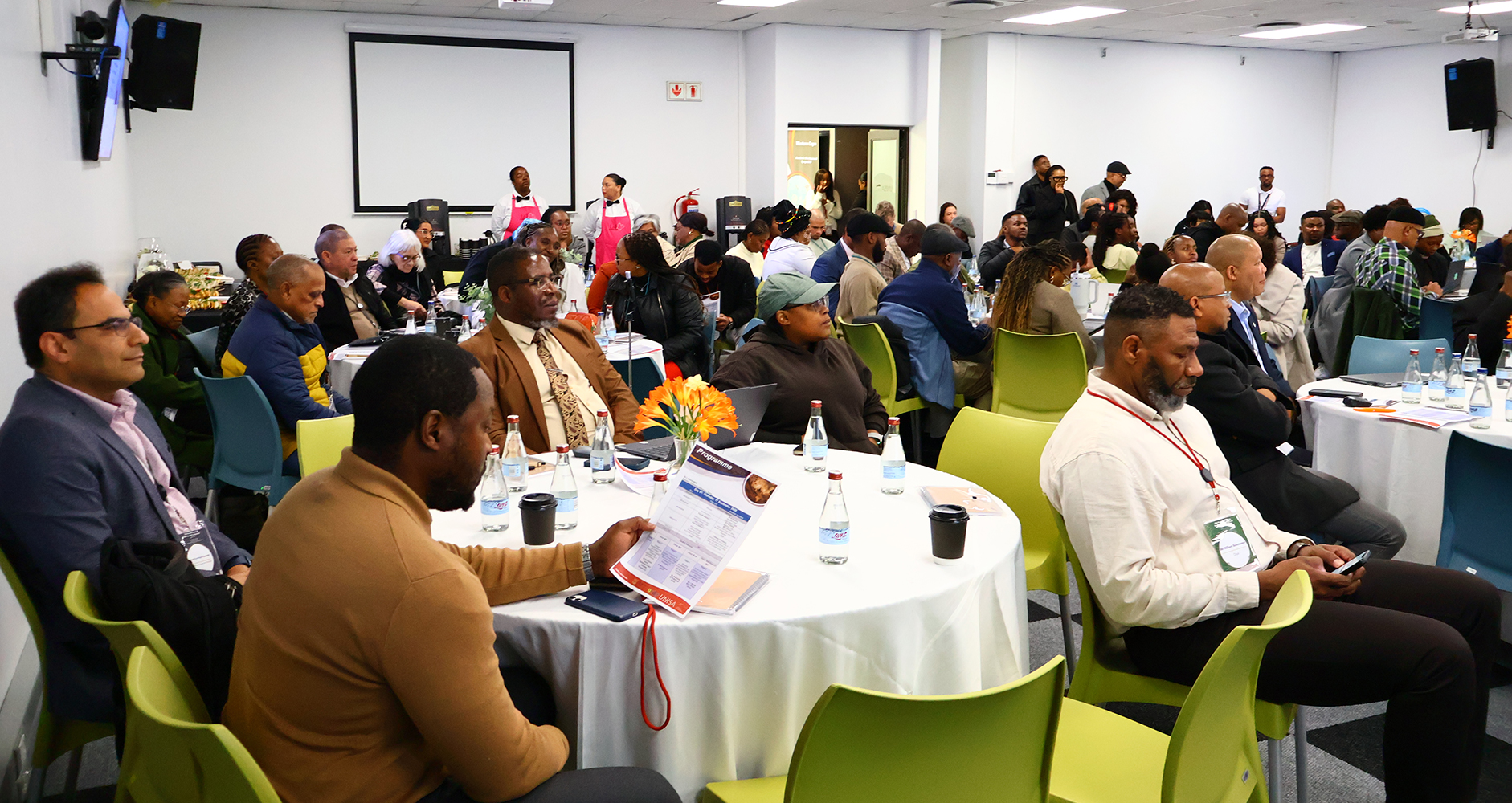
Academics, students and higher education stakeholders attend the 12th Unisa Western Cape Academic Development Symposium, which explored the role of artificial intelligence in shaping future-ready learning.
As artificial intelligence (AI) reshapes the way people learn, work and access information, higher education institutions face an increasingly urgent question: how can they embrace technological change while ensuring that students remain at the centre of the learning experience?
This question framed the 12th Unisa Western Cape Academic Development Symposium, which brought together academics, researchers, professional staff, students, industry representatives and other higher education stakeholders to explore the future of teaching, learning and student support in an AI-driven environment. Hosted at Unisa's Cape Town Campus in Parow, the annual symposium has, over the past 12 years, developed into a platform for exchanging ideas on issues shaping higher education. Initially focused on stakeholders in Cape Town, it has expanded to include participants and institutions from across South Africa and beyond.
The 2026 theme, "Higher education as catalyst for future-ready learning in a rapidly evolving technological landscape: building AI-responsive collaborative ecosystems for teaching, student support, employability and research", placed the focus on how universities can respond strategically, responsibly and inclusively to technological change. In his opening address, Unisa Western Cape Regional Director Motale Nkgoang said AI was no longer a future possibility but an existing reality influencing classrooms, research, administration, student support and the workplace.

Motale Nkgoang, Unisa Western Cape Regional Director, delivers the opening address at the 12th Academic Development Symposium.
"The central question is therefore no longer whether AI will influence higher education. It already does," he said. Nkgoang emphasised that technological transformation should be viewed from an African perspective. He challenged higher education institutions to move beyond being consumers of technologies developed elsewhere and become creators of solutions that respond to local and continental needs. He also stressed that student success depended on more than curriculum delivery. Academic preparation, digital literacy, financial circumstances, emotional wellbeing, mentorship, career guidance, access to technology and a sense of belonging all influenced students' ability to succeed.
Calling for students to be active participants in institutional transformation, he said their experiences should inform how universities design teaching, technology and support services. "Our students, you are not guests in this conversation. You are central participants," he said. Representing the Registrar, Richard Chauke reinforced the importance of collaboration across higher education and other sectors. He said partnerships were essential to serving students, strengthening communities and preparing graduates for a changing world. He linked the symposium theme to Unisa's strategic direction, particularly its commitment to technology-mediated learning, research and innovation, engaged scholarship, student support and future readiness.
Chauke cautioned that institutions could not afford to remain passive observers as technology evolved. Universities, he argued, needed to become architects of ethical, AI-responsive and collaborative ecosystems that protect and empower students, researchers and communities. He also called for stronger partnerships between universities and industry, with higher education institutions preparing future-ready graduates while industry contributes to developing institutional capacity. The relationship between AI, human judgement and student support was a major focus of the first day.
Liana Joubert, Unisa's Acting Chief Financial Officer, delivered a keynote address titled "Building a university that is digital by default, human when it matters". She explored how AI could help institutions manage high-volume, repetitive administrative and student-support processes without removing the need for human expertise. Joubert shared Unisa's early experience with its AI chatbot, which handled a high volume of student messages and conversations during its first few weeks of operation. The system reduced staff workloads and saved working hours while enabling students to access assistance beyond traditional office hours.
A significant proportion of enquiries were received outside normal operating times, demonstrating how technology could extend access to university services. As Joubert observed, access to the university "no longer stops when the office closes". Routine enquiries that previously took days or weeks to resolve could now be addressed within minutes or, in some cases, seconds. She stressed, however, that adopting AI should not be an end in itself. Technology should be used to address real institutional challenges and improve the student experience.
"The point is not to have AI. The point is to make the university better," she said. Her proposed approach involves automating repetitive tasks while leaving complex matters requiring judgement, empathy and professional expertise in the hands of people. She also highlighted the importance of retraining staff and redesigning roles as technology changes the nature of work, rather than simply displacing employees. She described the ambition as becoming "digital by default, human when it matters", adding that AI should ultimately "give us the capacity to become more human at scale".
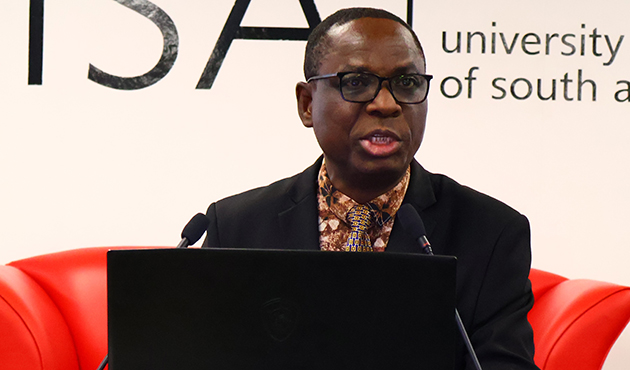
Prof Oludayo Olugbara, Executive Dean of the Faculty of Accounting and Informatics at Durban University of Technology, delivers a keynote address on practice-based learning.
The second keynote speaker, Prof Oludayo Olugbara, Executive Dean of the Faculty of Accounting and Informatics at Durban University of Technology, focused on transforming student learning through the Engineering Practice Innovation Project (EPIP) approach. He challenged conventional teaching models in which students first receive theoretical knowledge and are then expected to apply it in practice. "Theories are useless if they cannot be translated into practice," he said. Olugbara argued that universities needed to create learning environments in which students solve real-world problems, develop products, test ideas and learn through practical experience. Rather than treating students as passive recipients of information, this approach recognises the knowledge and experience they already bring into the classroom.
Lecturers and students become partners in the learning process, with theory informing practical work and students’ experiences enriching academic understanding. As he put it: "They are learning theories from lecturers. Lecturers are learning practice from students." The symposium's parallel sessions were organised around six interconnected themes: pathways for future-ready graduates and careers; AI and the future of work; student support and success in AI-responsive learning environments; local knowledge and research hubs; innovation in technology-enhanced teaching and learning; and collaborative research ecosystems. Presenters from different institutions shared research, practical experiences and emerging approaches to teaching, student support, employability, curriculum innovation and the use of AI in higher education.
Discussions examined how universities could rethink curricula, assessment and graduate preparation while strengthening AI literacy. Participants also considered the importance of human capabilities such as critical thinking, adaptability, creativity, empathy and ethical judgement. A central concern was ensuring that emerging technologies support rather than replace human-centred approaches to student success. The sessions provided opportunities for participants to engage with presenters and consider how emerging practices could be adapted to their own institutional contexts.
The afternoon workshop, "From prompt to persona: designing reusable system prompts for AI-responsive higher education", facilitated by Richard Wright, moved the discussions into practical application. Participants were guided through creating an AI persona, establishing clear rules and safeguards, and using retrieval augmentation to keep responses aligned with the purpose for which the system was designed. The workshop demonstrated how AI platforms could be adapted for specific functions and introduced practices for obtaining more reliable results from generative AI. The programme director described the session as practical and thought-provoking, noting that delegates left with steps they could apply in their own work.
The second and concluding day shifted the focus from understanding AI and technological change to institutional collaboration, student support, employability and practical implementation. The discussions emphasised that universities, technical and vocational education and training (TVET) colleges, skills development organisations, industry and students needed to work together to build future-ready learning ecosystems. Prof Oupa Mashile, Acting Deputy Registrar: Student Administration and System Integration, spoke about strengthening academic development through partnerships and AI-enabled student support.
He highlighted the importance of connecting central institutional frameworks with the different realities across Unisa's nine provinces. In his closing remarks, he summed up the vision: "we have one university, we have nine provinces", with the aim of creating a collaborative working environment in which every learner is supported. Mashile said academic development initiatives needed to take account of provincial student demographics, language diversity, access barriers, staffing constraints and differences in digital infrastructure. "What is key for me is that there needs to be co-designed programmes," he said.
Rather than relying solely on centralised approaches, he called for programmes developed jointly by central and regional offices, as well as stronger collaboration among regions. The changing world of work was addressed by Mr Mabu Raphotle, Chief Executive Officer of the Education, Training and Development Practices Sector Education and Training Authority (ETDP SETA). Raphotle explained that the Covid-19 pandemic had accelerated changes in employment and increased the importance of digital skills, data management, e-learning and e-teaching. The pandemic had not only changed employment but "also changed how we respond in terms of programmes and how we prepare graduates", he said.
He explained that ETDP SETA had used research to understand how technology could support teaching, learning and workplace-based learning. One area of focus was ensuring continuity in workplace-based learning as technology and employment requirements changed. The organisation had subsequently strengthened programmes aimed at improving graduate employability and responding to emerging labour-market needs. The importance of partnerships was further explored by Lungisa Mbulawa, Principal of West Coast College, and Mr Sulaiman Maeresera, Deputy Principal: Corporate Services at the college.
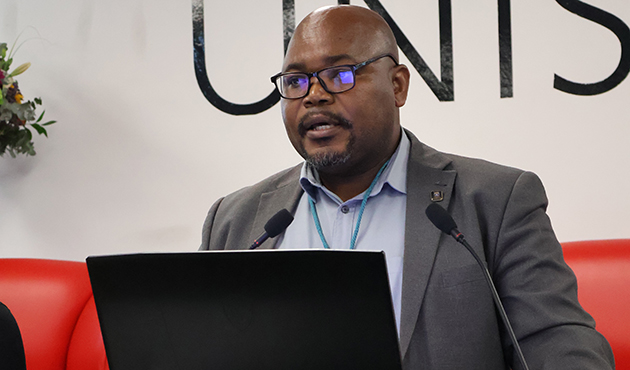
Lungisa Mbulawa, Principal of West Coast College, shares perspectives on building AI-responsive collaborative ecosystems for teaching, student support, employability and research.
Their presentation focused on building AI-responsive collaborative ecosystems for teaching, student support, employability and research. Mbulawa argued that institutions needed to move beyond treating technology as a compliance requirement and instead develop the capacity of staff and students to use it effectively. He highlighted the gap that can exist between institutional policies and what actually happens in classrooms. He also pointed out that students were already using AI, making it unrealistic for institutions to respond simply by attempting to prohibit its use. Universities and colleges needed to understand the technology and develop appropriate ways of incorporating it into teaching and learning while maintaining academic standards.
Maeresera reinforced the need for institutions to strengthen their digital capabilities and use technology to improve institutional processes. His contribution emphasised the importance of moving from policy development and compliance towards practical implementation. The symposium then brought together representatives from the Cape Peninsula University of Technology (CPUT), UWC, the University of Cape Town (UCT), Stellenbosch University and North-West University (NWU) for a two-hour roundtable discussion on the practical implications of AI adoption.
The session was chaired and facilitated by Dr Chetty of Unisa's Academic Development and Open Virtual Hub (ADOVH), with Prof Anné Verhoef from NWU and participating students also taking part. Rather than asking whether AI should form part of higher education, the discussion focused on what responsible and effective implementation looks like once policies have been developed and institutions must translate them into practice. Prof Verhoef, Professor of Philosophy and Director of the NWU Artificial Intelligence Hub, opened the discussion with a case study of developments at NWU. The contributions that followed showed that institutions were at different stages of AI integration and faced different opportunities and challenges.
CPUT foregrounded questions of social justice, access and student agency, sharing the experience of a student-led AI Club through which students are developing AI capabilities and solutions. UWC representatives highlighted practical AI and digital literacy development for students and staff, as well as the need to translate institutional guidelines into clear practices that users can understand and apply. Contributions from UCT and Stellenbosch University raised further questions about assessment, privacy, institutional capacity, technology providers and the extent to which universities themselves, rather than the technology industry, were determining the direction and pace of change.
The discussion covered six areas: institutional implementation, teaching and learning, student support, research, employability and the industry interface, and collaboration. Rather than seeking a single solution, the roundtable created space for institutions to challenge assumptions, share emerging practices and consider approaches suited to their particular circumstances. The facilitator emphasised that the intention was to move beyond a "ceremonial" conversation towards concrete actions that participants could take back to their institutions. Students were deliberately included in the discussions, reinforcing the importance of developing responses to AI not simply for students, but with them.
Prof Muhammad Nakhooda of CPUT highlighted the value of student-led innovation, observing that "the value of students driving the technology at your institution is immense". He described how students were increasingly driving AI learning and innovation through the university's Student AI Club. One of the symposium's clearest challenges also came from a student. A Unisa Regional Student Representative Council representative pointed out that AI use already cut across disciplines and qualifications. "In every course, students use AI," the representative said, challenging institutions to consider whether lecturers and students were being adequately equipped to use the technology effectively.
The intervention reinforced a central message of the symposium: students should not be treated merely as recipients of institutional decisions about technology. Their experiences, needs and ideas must inform how AI is introduced into teaching, learning and student support. The discussions at the symposium have direct relevance to Unisa's institutional priorities, particularly Catalytic Niche Area 6: Fourth Industrial Revolution and Digitalisation. The focus on AI, digital capabilities, technology-mediated learning and innovation speaks to the need for the university to engage critically with emerging technologies and develop solutions that respond to the needs of its students and society.
The discussions also connect with Catalytic Niche Area 10: Student Support and Co-Curricular Activities. The emphasis on digital access, student agency, inclusive support, mentorship and co-designed academic development programmes reinforces the importance of placing student success at the centre of technological transformation. The symposium’s focus on preparing graduates for changing employment requirements also supports Sustainable Development Goal 4: Quality Education, particularly the development of relevant skills for employment, decent work and lifelong learning. Its attention to digital skills, innovation and partnerships is also relevant to SDG 8: Decent Work and Economic Growth, SDG 9: Industry, Innovation and Infrastructure and SDG 17: Partnerships for the Goals.
At continental level, the discussions reflect the ambitions of the African Union's Agenda 2063, particularly its vision of an Africa whose development is driven by its people, supported by education, science, technology and innovation. Nkgoang's call for African institutions to become creators of contextually relevant technological solutions is especially important in this regard. It speaks to the need for the continent to build its own technological capabilities and ensure that innovation responds to African realities. The symposium also aligns with South Africa's National Development Plan Vision 2030, which identifies education, skills development, innovation and improved employment prospects as important foundations for a capable and inclusive society. By examining how universities can prepare students for changing labour-market demands, the discussions highlighted the role higher education must play in developing the skills and capabilities needed for the future economy.
These priorities also raise important questions about sustainability. AI adoption requires more than purchasing technology or introducing new systems. Institutions must invest in digital infrastructure, staff development, ethical governance, data protection and accessible support. They must also ensure that technological progress does not deepen existing inequalities or exclude students who face barriers to digital access. For Unisa, the challenge is to ensure that its approach to AI strengthens, rather than compromises, its open distance e-learning mission. This means combining technological innovation with human judgement, inclusive student support and collaboration across regions, institutions and sectors.
The symposium concluded with closing reflections and acknowledgements from Ms Lesego Mothowagae, Finance and Operations Manager for Unisa Western Cape. She thanked the speakers, panellists, facilitators, partners, students and participants whose contributions had made the 12th Academic Development Symposium possible. Across the two days, a consistent message emerged: AI is changing higher education, but technology alone will not determine the future of universities. Their ability to respond will depend on how effectively they combine innovation with human expertise, ethical responsibility, collaboration and a sustained commitment to student success.
* By Thabo Dayeni, Acting Digital Learning Advisor, Western Cape.
Publish date: 2026-11-12 00:00:00.0

 Unisa calls for stronger partnerships to expand access to affordable healthcare
 Unisa symposium explores how AI can shape the future of higher education
 Unisa celebrates Comrades runners at Athletics Club recognition dinner
 Unisa Choir's remarkable rise earns third place at choral competition
 Unisa advances African languages and inclusive teaching through Ubuntu Translanguaging Pedagogy