

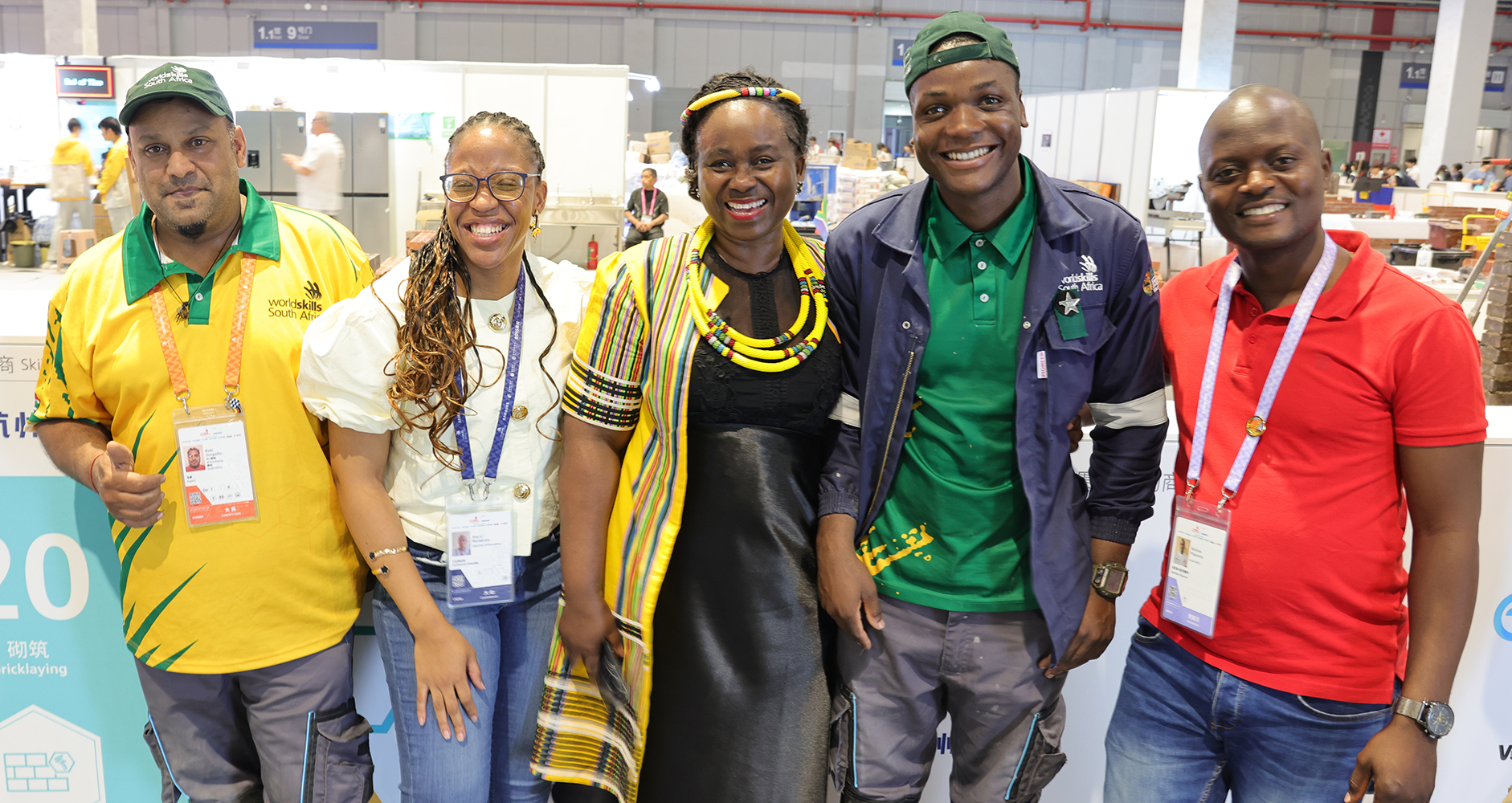
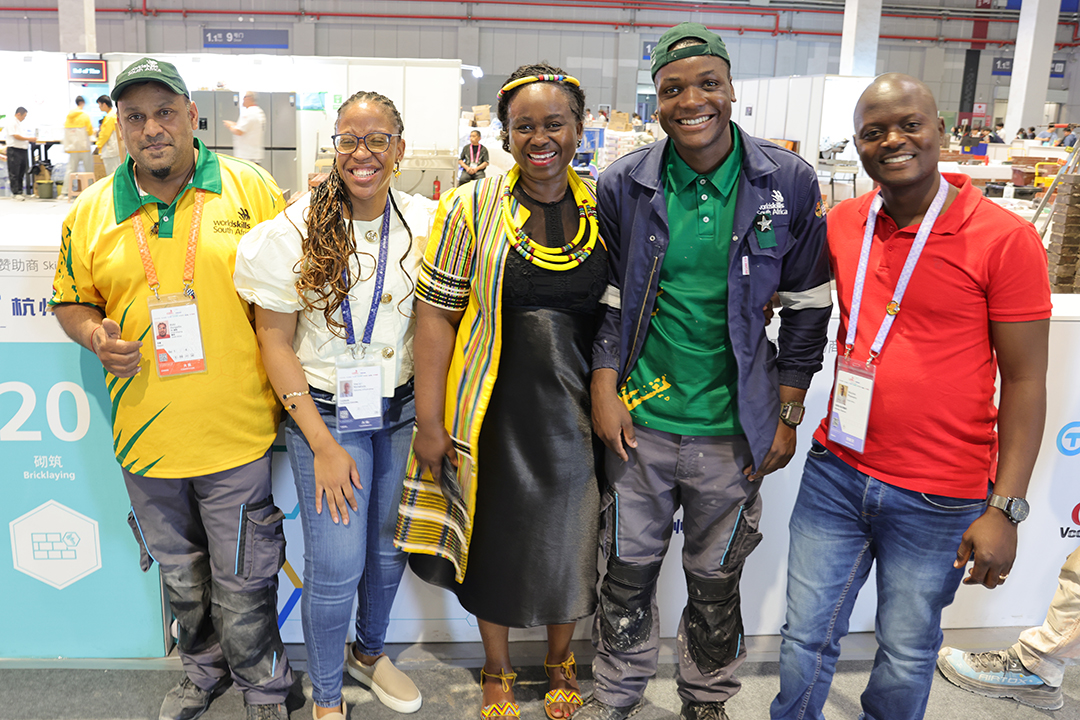
From left: South African Bricklaying Expert Rishi Durgadin; UNEVOC Centre at Unisa Secretary Sheila Manamela; Vhembe TVET College Deputy Principal Muvhulawa Booi; Vhembe TVET College student and South African Bricklaying competitor Ndialivhuwa Netshirembe; and Musiiwa Moses Phaswana, Senior Education Specialist: Civil Engineering and Building Construction at Vhembe TVET College.
The University of South Africa (Unisa) showcased its contribution to technical and vocational education and training (TVET) at the WorldSkills Conference in Shanghai, China, where global leaders explored how skills development can respond to technological change, economic demands and the future of work.
Held at the National Exhibition and Convention Center from 23 to 25 September 2026 under the theme "Shaping a skills-driven future", the conference brought together representatives from government, business, industry and education to share experiences and discuss global trends in skills development. Four members of the UNEVOC Centre at Unisa, Prof Sello Mokoena, Prof Vaola Sambo, Mamonare Mahlo and Sheila Manamela, attended the event. The conference took place alongside the WorldSkills Competition and the WorldSkills Shanghai 2026 Expo, which featured skills demonstrations, practical activities and exhibitions.
More than 1 400 young people from over 60 countries and regions competed in 64 skills categories, including intelligent security technology, painting and decorating, joinery, landscape gardening, visual merchandising, mobile applications development and hotel reception. The opening address was delivered by Chinese Premier Li Qiang, who described skills development as a foundation of the country’s economic achievements and a priority for future growth. "Investing in skills is investing in the future, and empowering workers is empowering development," he said.
His address highlighted the importance of lifelong learning, stronger cooperation between education institutions and industry, preparing workers for technological changes such as artificial intelligence (AI), and expanding international cooperation in skills development. The message linked skills development to industrial competitiveness and improved livelihoods, while emphasising the need for training systems that allow workers to adapt to economic change and benefit from new opportunities. South Africa recorded a significant achievement at the closing ceremony of the 48th WorldSkills Competition, winning a silver medal in Aircraft Maintenance.
Matthew Bowen, from Intelek Training and Consultation in Germiston, secured second place in the category. WorldSkills South Africa described the achievement as historic, noting that the country was the first African member country to win a medal in Aircraft Maintenance in the 75-year history of WorldSkills International. The first day of the conference included a panel discussion titled "Skills for the future of work: Scaling impact through partnerships in AI-driven economies", presented in collaboration with the UNESCO Global Skills Academy (GSA). The GSA is a global initiative that works through strategic partnerships to provide free mentorship and skills training in areas such as digital literacy, entrepreneurship and green technologies.
Learners who had participated in the initiative shared how the programme had supported their personal and professional development. Christian McPherson, a hospitality student from Jamaica studying in China on a fully funded scholarship through the China POCY Group Scholarships Programme, spoke about the opportunities it had created for her. The China POCY Group is a partner of the GSA. "It has helped me to build my confidence and it has also given me new ideas and experiences to take back to the motherland," she said.
Another scholarship recipient, Bigwi Eric Patrick, an e-commerce student in China, described the academy as "a bridge for youth to achieve their goals". He said the programme had helped him develop practical e-commerce skills, including livestreaming, understanding customer needs and promoting products online. On the second day, the Unisa delegation was invited to participate in a UNESCO-UNEVOC session titled "TVET as a driver of social and economic progress: The role of green and digital skills". The session allowed the university to outline its contribution to skills development and highlight the work of its UNEVOC Centre in supporting digital skills development in South Africa's TVET sector.
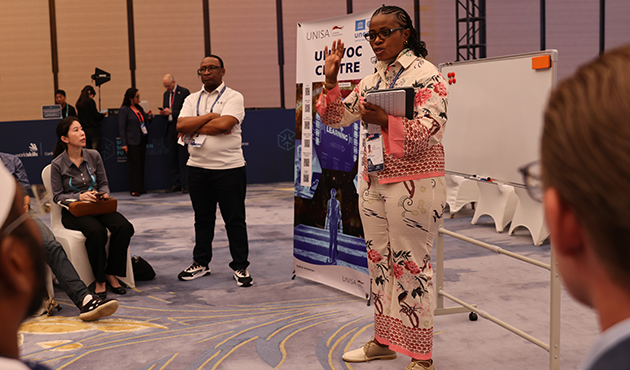
Prof Sello Mokoena, UNEVOC Centre Coordinator at Unisa (left), and Prof Vaola Sambo, UNEVOC Centre Manager at Unisa.
Prof Mokoena opened the session with an overview of Unisa's history and reach. "Our university was established in 1873, it is the oldest and largest on the continent," he said. Mokoena noted that, with more than 420 000 students worldwide, technology plays a central role in the university's approach to teaching, learning and student support. Prof Sambo then outlined the UNEVOC Centre's role in supporting TVET institutions and contributing to the development of the sector. "We will be supporting AI readiness in our TVET institutions, using the technological capabilities that our university has," she said.
Sambo also explained how Unisa draws on its Catalytic Niche Areas (CNAs) to support TVET colleges offering green technology programmes, including solar installation. This work draws on the capacity and expertise of the university's College of Science, Engineering and Technology. The university's engagement reflects two of its strategic research and development priorities: Fourth Industrial Revolution and Digitalisation, and Energy Studies. The former focuses on building capacity in emerging technologies and digital transformation, while the latter addresses areas such as renewable energy and the development of sustainable energy solutions.
By supporting AI readiness in TVET institutions and drawing on its expertise to assist colleges offering green technology programmes, Unisa is contributing to the development of skills needed in a changing economy.
The final day's panel brought together representatives from the World Bank, UNESCO, the China Association for Labour Studies, LIXIL Corporation, the WorldSkills Champions Trust and the United Nations Industrial Development Organization (UNIDO). The discussion considered how TVET can support social and economic development as the world of work changes. Speakers also stressed the importance of ensuring that people from different backgrounds have equal opportunities to acquire relevant skills. Borhene Chakroun, Director of UNESCO's Division for Policies and Lifelong Learning Systems, emphasised the need for inclusion.
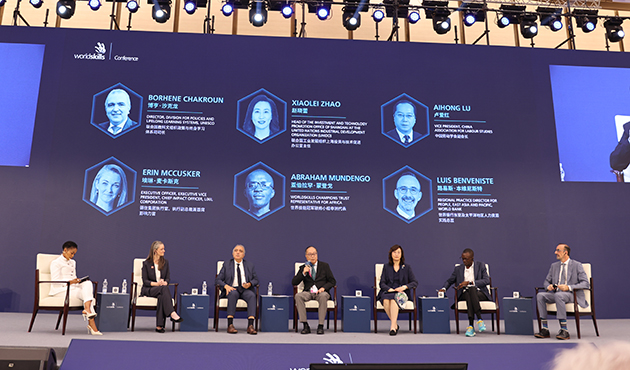
From left: Nozipho Tshabalala, Erin McCusker, Borhene Chakroun, Xiaolei Zhao, Aihong Lu, Abraham Mundengo and Luis Benveniste.
"No matter what your colour is, no matter where your country is, no matter where you come from, we stand to leave no one behind. And that’s what WorldSkills is about. That’s why we are coming here," he said. Aihong Lu, Vice-President of the China Association for Labour Studies, outlined the scale of China's vocational education system, which has approximately 10 000 vocational schools serving 30 million students. He said the system had contributed to the country's industrial development, employment stability and improved livelihoods.
"This system has contributed to the transformation and upgrade of China's manufacturing industry, to the stability of China's employment situation, and to the improvement of people's livelihoods," he said. The remarks were translated from Mandarin. Luis Benveniste, Regional Practice Director for People, East Asia and Pacific at the World Bank, said workers would need to continue developing their skills throughout their careers as technology, climate change and demographic trends reshape economies. "In a world like today where technology is changing, where climate change brings about a wide variety of changes, where demography is changing, people will need to reinvent themselves. The world of work is rapidly changing, so upskilling and reskilling is more and more important. So in that way, again, we need to think about the life cycle as a whole and not skilling as a once-off intervention," he said.
Chakroun said technical education also needed to develop broader human capabilities alongside occupational skills, particularly as new professions emerge. "We need to rethink technical education practices. We cannot think about apprenticeship in the same way we have been looking at it. If these are new occupations, apprenticeship cannot be about learning how to do it; it has to be about human capabilities, how we develop critical thinking, how we develop communication and problem-solving," he said.
Erin McCusker, Executive Officer, Executive Vice-President and Chief Impact Officer at LIXIL Corporation, called for stronger partnerships between industry, government and other stakeholders. She said businesses should work alongside governments to identify relevant skills, assess and certify them, and ensure that training responds to changing workplace requirements. "Now, this idea of co-development and partnership, we're not waiting for government. We are working alongside government. We want to be coming in and seeing how we can work alongside all of the stakeholders together to identify what the relevant skills are. How do we assess those skills together? How do we certify them? And how do we really make sure that we’re all building towards skills that can be used and can be adapted in this very rapidly changing environment?" she said.
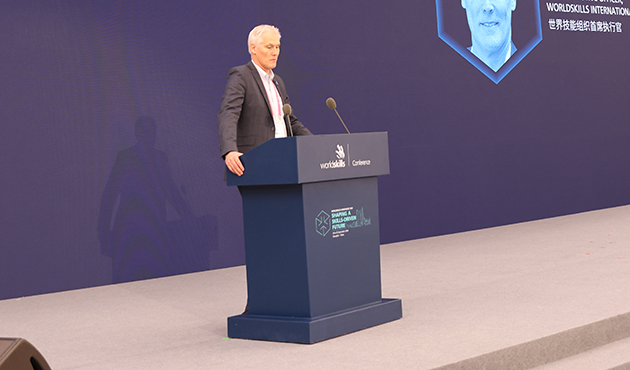
David Hoey, CEO of WorldSkills International
In his closing address, WorldSkills International chief executive David Hoey returned to the importance of building a global community committed to skills development and occupational excellence. "And so this week is about building champions. We see them competing, and we saw them share great insights as speakers throughout the conference. We hope that you have been further inspired to be champions of skills development and excellence," he said. Unisa's participation at WorldSkills Shanghai 2026 highlighted the role universities can play in connecting higher education, vocational training and the changing needs of the economy. Its contribution to AI readiness and green technology training also demonstrates the value of collaboration between universities and TVET colleges.
The work speaks directly to Unisa's Catalytic Niche Areas of the Fourth Industrial Revolution and Digitalisation and Energy Studies. Through the first, the university seeks to build capacity in emerging technologies and digital transformation. Through the second, it focuses on renewable energy and sustainable energy solutions. Supporting TVET colleges with AI readiness and green technology programmes provides a practical link between these institutional priorities and skills development beyond the university. The initiatives also align with several United Nations Sustainable Development Goals (SDGs). SDG 4, Quality Education, is particularly relevant because it calls for greater access to technical, vocational and tertiary education, as well as relevant skills for employment and entrepreneurship. The focus on solar installation and green technologies connects with SDG 7, Affordable and Clean Energy, while the emphasis on workforce preparation and economic participation supports SDG 8, Decent Work and Economic Growth. The development and application of technology in industry also relate to SDG 9, Industry, Innovation and Infrastructure. Partnerships between universities, colleges, governments and industry reflect the objectives of SDG 17, Partnerships for the Goals.
At the continental level, the work supports the African Union's Agenda 2063, particularly Aspiration 1, which envisions a prosperous Africa based on inclusive growth and sustainable development. Its emphasis on well-educated citizens and a skills revolution underpinned by science, technology and innovation is closely connected to the need to equip young people and workers with relevant technical and digital capabilities. In South Africa, the National Development Plan 2030 identifies education, skills development, economic growth and employment as important priorities for addressing poverty and inequality. Strengthening the TVET sector and improving the relevance of training to workplace needs are important parts of building a skilled workforce capable of supporting the country's development.
The green skills dimension is equally significant. As economies respond to climate change and the need for more sustainable energy systems, training in renewable energy technologies can help prepare workers for emerging occupational opportunities. Unisa’s engagement with TVET colleges in this area provides a basis for contributing its academic and technical expertise to wider skills development. The conference reinforced that skills development cannot be treated as a once-off intervention. It requires lifelong learning, inclusive access to training, responsive education systems and sustained cooperation between educational institutions, governments and industry. For Unisa, these priorities provide an opportunity to extend the reach of its teaching, research and expertise while contributing to South Africa’s and Africa’s long-term development.
* By Mamonare Mahlo, Communication and Online Officer, UNEVOC Centre at Unisa.
Publish date: 2026-11-13 00:00:00.0

 Tourism strategist Hulisani Thabela to share destination development insights at Unisa Innovation Festival
 Dr Nduduzo Makhathini to headline 2027 Unisa Decoloniality Summer School
 Unisa showcases its TVET contribution at WorldSkills Shanghai 2026
 Unisa promotes disability inclusion and sign language accessibility ahead of International Day of Persons with Disabilities
 Unisa calls for stronger partnerships to expand access to affordable healthcare