
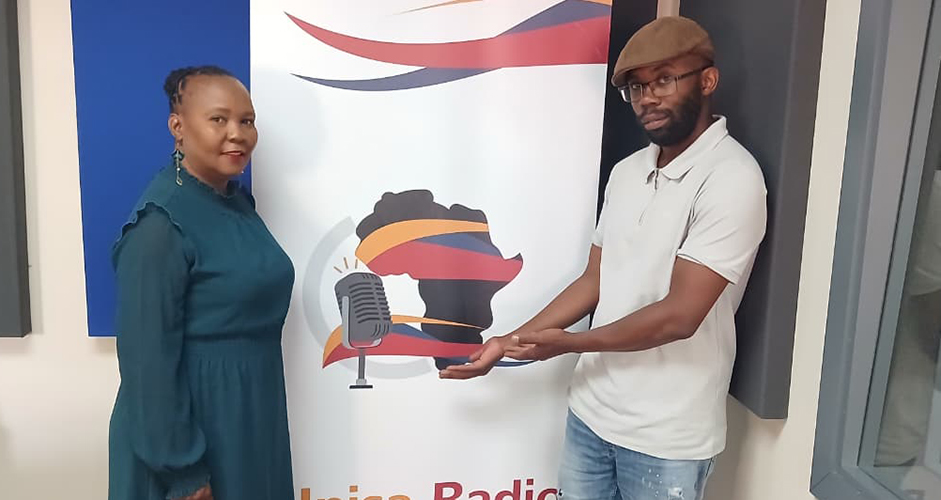
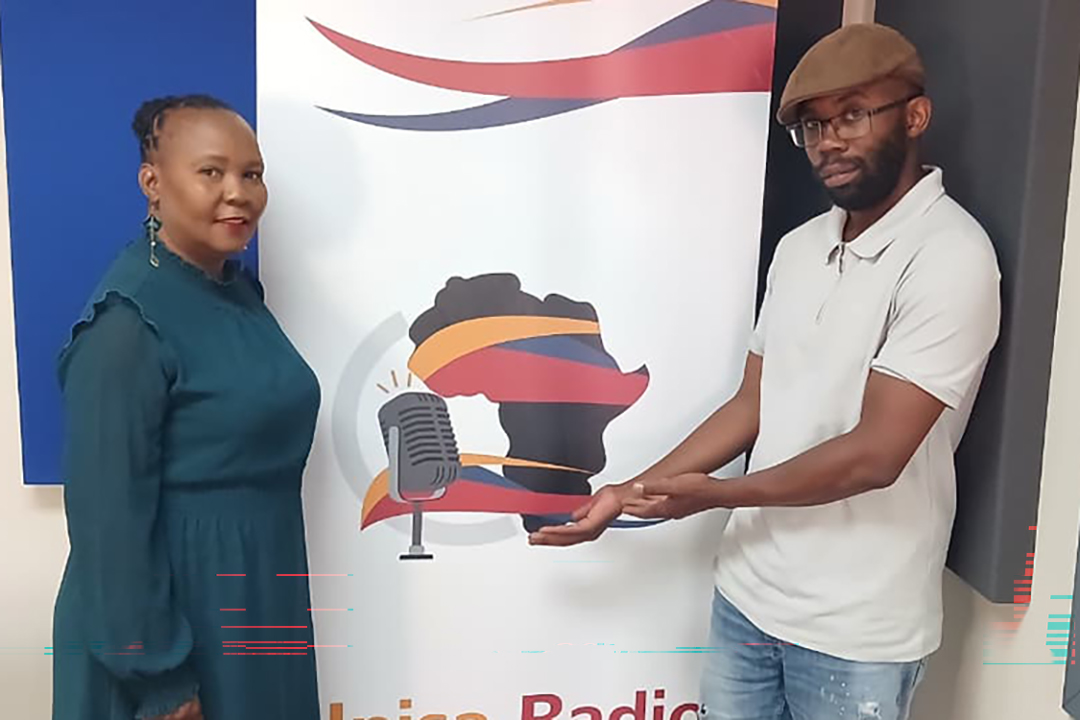
Sophy Mabaso, Sign Language Interpreter, ARCSWiD and Godfrey Madibane from Unisa Radio.
As the University of South Africa (Unisa) marks Disability Rights Awareness Month, its Advocacy and Resource Centre for Students with Disabilities (ARCSWiD) is highlighting a fundamental aspect of inclusion: the right to communicate and participate without barriers.
Under the campaign theme "Beyond silence: Advancing sign language accessibility and inclusion for all", ARCSWiD is using awareness initiatives and public engagements to promote South African Sign Language (SASL), respect for Deaf culture and the communication rights of students with disabilities. One of these engagements took place on Unisa Radio, where Sophy Mabaso, a sign language interpreter at ARCSWiD, discussed the important but often overlooked work of facilitating communication between Deaf and hearing people in higher education.
During the interview, Mabaso explained that sign language interpreting involves much more than translating spoken words into signs. It requires an understanding of meaning, context and specialised terminology to ensure that information is conveyed accurately. Interpreters working in lectures, orientation sessions, meetings and university events need access to programmes, presentations and relevant material well in advance. This preparation enables them to familiarise themselves with the subject matter and accurately communicate technical concepts, names and other information.
Mabaso also highlighted the emotional demands of interpreting, particularly during engagements involving sensitive information or personal experiences. Adequate preparation, appropriate working conditions and consideration for interpreters’ well-being are therefore essential to providing effective communication support. However, accessibility cannot rest on interpreters alone. Lecturers, event organisers and presenters also have a responsibility to make communication possible. This includes providing presentation material early, ensuring appropriate lighting and visibility, allowing sufficient preparation time and considering accessibility when planning events.
The recognition of South African Sign Language as South Africa's 12th official language marked an important step towards advancing social justice, equal access and human dignity. Language is more than a means of communication. It is central to identity, culture, community and belonging. Greater awareness and understanding of SASL can help hearing South Africans break down communication barriers and create a culture in which Deaf and hard-of-hearing people are not merely accommodated, but are heard, respected and included. Accessibility, however, requires an understanding that people with different disabilities have different communication needs.
Some hard-of-hearing students communicate primarily through spoken language and may benefit from captions, speech-to-text services, hearing technologies, clear acoustics, written information or appropriate seating arrangements. Speech-reading may assist some individuals, but it should not be treated as a reliable substitute for accessible communication. For deafblind people, communication support may include tactile signing, haptic communication, accessible electronic devices or Braille information, depending on individual preferences and needs. The starting point should always be consultation with the person concerned. There is no single solution that meets everyone’s needs.
For a comprehensive open distance and e-learning institution such as Unisa, this responsibility extends beyond physical spaces. Accessible online lectures, video content, digital platforms, consultations and assessment-related communication are equally important. Accessibility must be considered throughout the student journey, from registration and orientation to teaching, assessment and graduation. It should not be limited to major institutional events or occasional awareness campaigns. Disability Rights Awareness Month runs from 3 November to 3 December 2026. During this period, Unisa is using various institutional platforms to raise awareness, encourage dialogue and promote practical measures to address barriers faced by persons with disabilities. The university's campaign is being implemented collaboratively by the Department of Leadership and Transformation (DLT), ARCSWiD, the Disability Centre of Excellence, regional offices and Unisa Radio.
Through these partnerships, the university aims to challenge exclusionary attitudes, promote disability rights and encourage changes that enable persons with disabilities to participate fully in academic and institutional life. The campaign will culminate on 3 December, when Unisa joins the international community in commemorating the International Day of Persons with Disabilities (IDPD). At the Muckleneuk Campus in Pretoria, DLT will host a Disability Indaba from 09:00 to 14:00 at the former Protea Restaurant in the OR Tambo Building.
Held under the theme "Beyond disability: How I thrive and what society must change", the Indaba will provide a platform to reflect on lived experiences, institutional barriers and the changes needed to advance meaningful inclusion. In Polokwane, ARCSWiD, in collaboration with the College of Education's Inclusive Education UCDP Project and the North-Eastern Region, will coordinate a three-day programme from 1 to 3 December. The programme will begin on 1 December with World AIDS Day and disability-inclusive health awareness activities at the Unisa Polokwane Campus. On 2 December, the focus will shift to disability advocacy and community engagement in Polokwane.
The programme will conclude on 3 December with the official IDPD commemoration at the Unisa Polokwane Campus, under the theme "Beyond silence: Advancing sign language accessibility and inclusion for all." Across these engagements, the focus will be on accessible communication, disability rights, the experiences of students and communities, and collaboration that extends beyond the commemorative period. The significance of Disability Rights Awareness Month lies not only in the conversations it generates, but also in the changes that follow. Accessible information, timely reasonable accommodation, inclusive digital learning environments and the direct involvement of persons with disabilities in decisions affecting them are practical ways of turning institutional commitments into action.
These efforts also speak to broader development priorities. They support the objectives of Sustainable Development Goal 4, which calls for inclusive and equitable quality education, and Goal 10, which seeks to reduce inequalities. They are consistent with the African Union's Agenda 2063 commitment to an inclusive Africa in which no one is left behind, as well as South Africa's National Development Plan 2030 emphasis on social inclusion and equal opportunities. Within Unisa, the work connects with the university's Catalytic Niche Area on Student Support and Co-Curricular Activities, particularly its focus on creating an environment in which students can access support and participate meaningfully in university life.
As Mabaso's contribution highlights, effective communication requires professional expertise, preparation and an institutional commitment to accessibility. It also requires listening to Deaf, hard-of-hearing and deafblind people and responding to the barriers they identify. By making accessibility part of its everyday operations, Unisa can help build a learning environment in which all students are able to participate with dignity, have their communication needs recognised and contribute fully to university life.
* By: Kefiloe Tshabalala, Bheki Nxumalo, Gugu Mngadi, Romeo Gavhi, Maria Mohlala and Bareng Madubanya.
Publish date: 2026/11/13
 Tourism strategist Hulisani Thabela to share destination development insights at Unisa Innovation Festival
 Dr Nduduzo Makhathini to headline 2027 Unisa Decoloniality Summer School
 Unisa showcases its TVET contribution at WorldSkills Shanghai 2026
 Unisa promotes disability inclusion and sign language accessibility ahead of International Day of Persons with Disabilities
 Unisa calls for stronger partnerships to expand access to affordable healthcare