

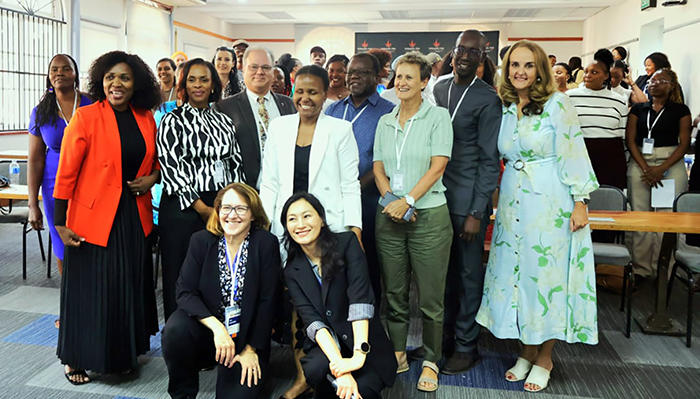
Speakers, Inhlanyelo Hub management, and guests
Unisa’s Inhlanyelo Hub NPC, in collaboration with the Public Diplomacy Section of the Embassy of the United States of America in South Africa, hosted a roundtable discussion featuring women leaders in the world of technology to strengthen women-led innovation in South Africa. The engagement, under the theme "Technology transfer and startup incubation", was held on 17 February 2026 at the Unisa Sunnyside Campus.
In his introduction and welcome remarks, Prof Raphael Mpofu, Chief Executive Officer of Inhlanyelo Hub NPC, briefly explained what the hub is about. "Our mission is to drive African innovation, and we also have a vision to not only ignite entrepreneurship spirit but also equip those who participate in our programmes to grow sustainable businesses," he said.
Mpofu further stated that the Hub’s exclusive programmes target Unisa students and women, especially those under the age of 40. He emphasised: "In addition to the programmes, we try to provide an environment that offers mentorship, support and coaching. Where possible, we create a pathway for our participants to try and get funding for their startups."
In his opening remarks and introduction of delegates attending the TechWomen Conference currently taking place in South Africa, John Goshert, Assistant Cultural Affairs Officer at the Embassy, praised the global impact of the TechWomen Programme. "Women from across the world have travelled through this programme to the United States, where they received mentorship and guidance, and they have collaborated on growing themselves professionally," he said.
TechWomen is an initiative of the United States Department of State's Bureau of Educational and Cultural Affairs. It is a high-impact mentorship and exchange programme that bolsters mentors’ and participants’ professional capacity, increases mutual understanding between key networks of professionals, expands girls’ interest in science, technology, engineering and mathematics (STEM) careers by exposing them to female role models, and strengthens the technology sector by connecting professionals and companies with emerging women leaders in STEM from Africa, Central and South Asia, Europe and the Middle East.
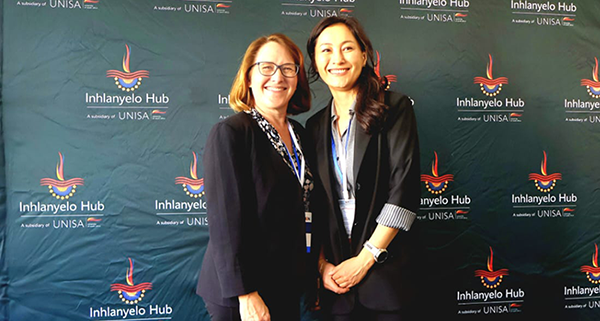
Speakers (from left): Jill Finlayson and Aisuluu Kozhomkulova
Delivering the keynote address, Jill Finlayson, TechWomen Conference delegate and Managing Director of the CITRIS Innovation Hub at the University of California, Berkeley, noted the approach to innovation used by her institution, highlighting key aspects such as detailing an innovation roadmap, developing critical thinking as a new core to better interact with artificial intelligence (AI), forming a new pedagogy amid technological advancements, setting up incentives for startup founders, encouraging peer-to-peer mentoring, incubating and launching startups, and creating a clear innovation pipeline, among others.
Finlayson further explored effective strategies to advance inclusion within the South African innovation ecosystems. "We need to broaden our definition of innovation, recognising that creating a dance or a play is also innovative," she stated. "We must, therefore, promote an interdisciplinary approach to innovation and focus on impact rather than just how we innovate. Bringing in new people should be our priority."
In addition, she urged South African women to master drafting professional proposals for funding their startups. "We need to show not only what we are doing, but the economic impact, the shift in skill, and the challenges, such as using AI with caution," she emphasised. "We must learn how to pitch. We must tell compelling stories that connect with people’s hearts as well as their minds."
Focusing on the importance of designing sustainable AI-driven startup ecosystems, Aisuluu Kozhomkulova, TechWomen Committee Lead and development and technology expert, highlighted the need to recognise and adopt emerging trends. "AI trends like Physical AI, Spatial AI, and Agentic AI are expected to improve and replace some human jobs in the coming years," she highlighted.
Amid South Africa's financial challenges, Kozhomkulova further urged the country to catch up with the trends used in developed countries. "As an emerging country, South Africa should try to introduce AI in its education systems, the homes, and everywhere possible, as AI cannot be ignored," she said.
For strategic positioning, she suggested that local startups should strongly engage with countries of the Gulf Cooperation Council, such as the United Arab Emirates, to secure support and scalability.
During the question-and-answer session, attendees raised concerns about the use of AI, alternative funding pathways, intellectual property issues in Africa, and the scalability of innovation startups.
* By Victor Malatji, Communication Intern, Department of Institutional Advancement
** Photography by Thembeka Mpapama, Manager: Communication and Marketing, Unisa Gauteng Region
Publish date: 2026-02-19 00:00:00.0

 Unisa roundtable focuses on empowering SA women to lead in innovation
 Unisan recognised for web excellence
 Office of the Dean of Students participates in leadership camp
 Unisa project fosters digital and pedagogical innovation in Limpopo schools
 Unisa student wins prestigious national leadership award