
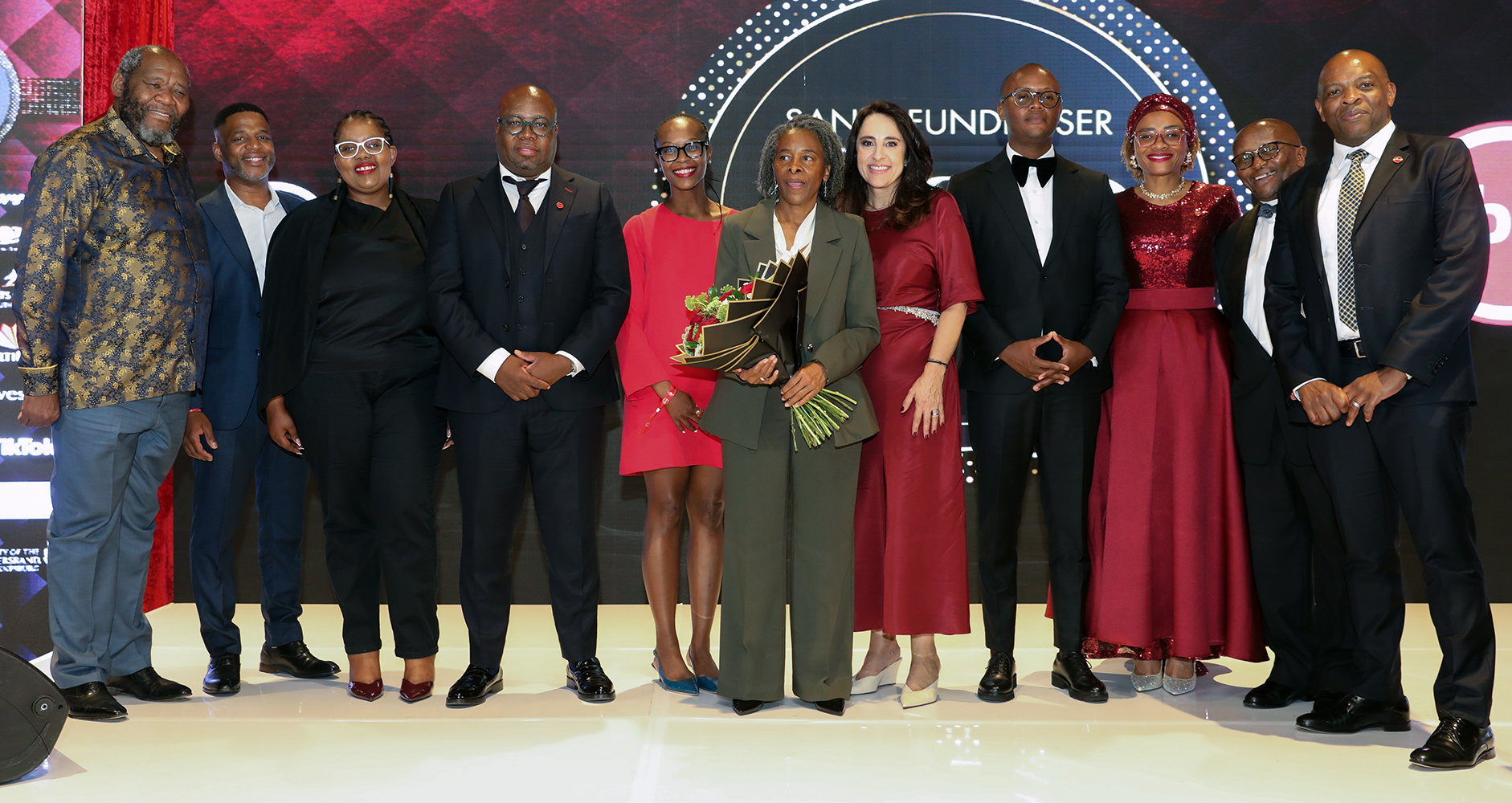
Advocate Sesi Baloyi SC with dignitaries at the SANEF annual fundraising gala dinner
The University of South Africa (Unisa) has reaffirmed its commitment to protecting media freedom, advancing independent journalism and strengthening democratic accountability through its participation in the South African National Editors' Forum (SANEF) annual fundraising gala dinner.
Held at The Venue, Houghton Hotel, in Johannesburg, the event brought together journalists, government representatives, corporate leaders and civil society organisations to reflect on the importance of a free press in safeguarding South Africa's constitutional democracy. The gathering also commemorated Black Wednesday, 19 October 1977, when the apartheid government banned The World and Weekend World newspapers and intensified its crackdown on journalists and media organisations. The gala, established in 2016, raises funds to support SANEF's media freedom initiatives, including legal interventions, journalist development and advocacy for independent journalism.
SANEF Chairperson Katy Katopodis reminded delegates that the sacrifices made by journalists during apartheid created a responsibility for today’s media professionals to defend the freedoms secured through democracy.
"As journalists, we are not simply observers of South Africa's democracy but its chroniclers who document its successes, expose its failures and tell the stories of its people," she said. Katopodis expressed concern about threats and intimidation directed at journalists, particularly women journalists who face threats of sexual violence. She appealed to political parties, community leaders and the public to recognise journalists as essential contributors to democracy rather than adversaries. "A democracy in which journalists are afraid to report is a democracy in trouble," she warned.
Highlighting SANEF's achievements, Katopodis pointed to journalist training and the organisation's efforts to advance discussions about independent journalism internationally through the Media20 initiative. "SANEF cannot simply be an organisation whose name appears at the bottom of media statements; it has to be an organisation whose presence is felt and supports its country's journalists," she said. Speaking on behalf of Unisa, Principal and Vice-Chancellor Prof Puleng LenkaBula congratulated SANEF on its enduring contribution to journalism, public accountability and democratic development.
She described the organisation as a community of practice, leadership and knowledge whose work contributes to an informed society. LenkaBula reaffirmed Unisa's commitment to supporting journalism through education, research, digital innovation and collaboration. She highlighted the growing importance of artificial intelligence and digital technologies, encouraging journalists to embrace these developments as tools for strengthening their professional capabilities rather than replacing their essential role in society. Against a backdrop of geopolitical tensions and technological change, she urged journalists to remain committed to truth-telling and ensuring that African perspectives receive meaningful representation.
"We also undertake as a partner to maintain that Unisa and SANEF co-create constructive futures of communication that ensure Africa's civilisation, philosophies, sciences, students and citizens of our country are projected and that their work remains indelible in the hearts of Africa," she said. The partnership reflects Unisa's broader commitment to advancing knowledge, developing professional capacity and supporting institutions that contribute to an informed and accountable society. It also resonates with Sustainable Development Goal 16, which promotes peaceful, inclusive societies, accountable institutions and public access to information.
Delivering remarks on behalf of sponsor Absa, Group General Counsel Francisco Khoza reflected on Black Wednesday as a defining moment in South Africa's struggle for media freedom. He recalled how the apartheid government's suppression of newspapers and detention of journalists, including editor Percy Qoboza, sought to prevent the public from learning about state brutality and injustice. Khoza emphasised that the attack on the press was also an attack on society's right to information. He acknowledged the contribution of courageous journalists who exposed apartheid abuses and helped bring international attention to South Africa's struggle for freedom.
Looking ahead to the country's local government elections, Khoza stressed that democracy requires more than the opportunity to vote. Independent courts, accountable institutions, informed citizens and a free media capable of scrutinising those in power are equally essential. Without independent journalism, he argued, corruption can remain hidden, disinformation can flourish and powerful interests can dominate public understanding of events. Delivering the keynote address under the theme Empowering the local voice: Authoring democracy's next chapter, Advocate Sesi Baloyi SC, Senior Counsel and Commissioner on the Madlanga Commission, called for stronger community journalism and greater public participation in democratic processes.
Reflecting on Black Wednesday, Baloyi described the apartheid government's attempt to suppress press freedom as a failed effort to conceal injustice. "We live in a constitutional state, with constitutionally enshrined rights and freedoms, which includes freedom of the press and media and freedom to receive and impart," she said. Drawing on SANEF's founding principles, Baloyi identified four essential responsibilities of the media: investigating wrongdoing, informing citizens, facilitating public debate and drawing attention to important societal issues. She emphasised that journalists must provide reliable information enabling communities to understand government policies, assess political candidates and participate meaningfully in democratic decision-making.
Baloyi also cautioned against biased reporting and urged journalists to recognise how their assumptions and editorial choices can influence public understanding. She stressed that media platforms should accommodate diverse perspectives, including views with which journalists or audiences strongly disagree. Baloyi placed particular emphasis on community radio, newspapers and television, describing these platforms as vital connections between ordinary citizens and the institutions responsible for serving them. She argued that local journalists are often best positioned to identify emerging problems, investigate service delivery failures and raise concerns before they become national crises.
Using an example involving increases in chlorine prices, she illustrated how community media could identify and report developing problems long before they attract mainstream attention. She encouraged journalists to amplify marginalised voices and ensure that communities have access to information affecting their daily lives. Baloyi also called for more effective use of digital platforms to encourage informed public participation, while stressing that shrinking newsrooms should not diminish society’s commitment to accessible journalism. Her address reinforced the importance of journalism that reaches beyond national political debates to examine the practical concerns of communities.
For Unisa, the gala reaffirmed the value of partnerships that connect higher education, journalism and democratic development. As the media industry navigates technological disruption, financial pressures and threats to press freedom, the message emerging from the gathering was clear: independent journalism remains indispensable to protecting citizens' rights, holding power accountable and shaping South Africa's democratic future.
* By William Thubakgale and Moleboheng Mpafa, Department of Institutional Advancement
Publish date: 2026-10-26 00:00:00.0

 Unisa joins SANEF in renewed call to defend media freedom and strengthen democracy
 Reclaiming African heritage through geographical names
 From research to real-world impact: Unisa-linked project explores new ways to advance LGBTQIA+ rights
 Unisa hackathon winners develop AI solution to support students at risk of falling behind
 Beyond Black Wednesday: Unisa lecture calls for urgent action to protect media freedom and public broadcasting