

Unisa has made a significant move toward transforming students’ learning experience by officially incorporating translanguaging into its teaching and learning strategy to facilitate sense-making pedagogy. This action reinforces the university’s commitment to inclusive, equitable and socially responsive education, particularly in a linguistically diverse country like South Africa.
Translanguaging refers to the dynamic practice in which multilingual speakers utilise their full linguistic repertoire to create meaning, learn and communicate. Rather than restricting students to a single "dominant" language in academic settings, translanguaging acknowledges the fluidity with which students naturally draw on multiple languages to understand complex concepts.
For Unisa, this means embracing the reality that students often think, reason and interpret information in more than one language, whether IsiZulu, Sesotho, Afrikaans, English, Setswana, or others. This pedagogical approach values these linguistic resources as assets in the learning process.
At the heart of this initiative is the principle of multilingual sense-making pedagogy, an approach designed to support deeper learning by allowing students to access and process knowledge in the languages most cognitively meaningful to them.
Through translanguaging, Unisa aims to
Unisa’s adoption of translanguaging is not limited to language courses. Instead, it is being embedded across various disciplines as a practical teaching strategy. Examples include
Academic staff are being supported through professional development programmes that help them integrate translanguaging strategies into course design and student engagement practices. To ensure smooth implementation, academic staff have already undergone targeted training on how to integrate translanguaging into their modules. This training equipped lecturers with practical techniques, such as incorporating multilingual learning resources, facilitating bilingual discussions and designing activities that encourage students to apply their full linguistic repertoire during sense-making.
The strategy is now being embedded across various disciplines, strengthening Unisa’s drive towards multilingual sense-making pedagogy and contributing to the broader transformation of higher education. By validating linguistic diversity as a learning asset, Unisa seeks to enhance student engagement, comprehension and overall academic success.
The training aimed at enhancing the teaching and learning experience for lecturers by promoting the use of translanguaging pedagogy during teaching sessions.
Unisa’s Directorate of Language Services hosted Multilingual Sense-Making Pedagogy Seminars for academics across several colleges to further promote the use of translanguaging pedagogy.
The programme was facilitated by Prof Leketi Makalela, founding Director of the Hub for Multilingual Education and Literacies (HuMEL) at the University of the Witwatersrand. A globally recognised scholar in translanguaging and language-in-education policy, Makalela pioneered the Ubuntu Translanguaging Model. This decolonial and justice-oriented framework positions language and education as tools for liberation and epistemic justice.
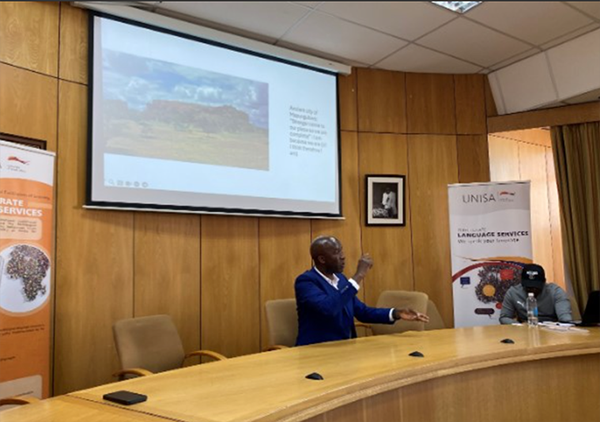
Prof Leketi Makalela facilitated a seminar
The sessions explored how multilingual translanguaging sense-making pedagogy can be applied within a comprehensive, open and distance e-Learning (CODeL) environment to enhance students’ critical thinking and sense-making. Academics discussed challenges related to lesson planning, integrating multilingual strategies into teaching and learning, and developing multilingual approaches in research and engaged scholarship.
The programme reaffirmed Unisa’s commitment to multilingualism through strong collaboration between academic and support departments, highlighting the university’s dedication to inclusive pedagogies that reflect South Africa’s rich linguistic diversity.
Dr Rakwena Monareng, Director of Language Services at Unisa, emphasised the need for a student-centred approach that promotes innovation and critical thinking in students’ own languages. He added that as a national leader in open distance education, Unisa is uniquely positioned to model a transformative multilingual pedagogy.
Monareng further postulated that traditional monolingual teaching practices have historically contributed to low student engagement and high dropout rates. "Embedding multilingual strategies across faculties therefore supports curriculum relevance, improves student retention and fosters greater student success," he said.
The introduction of translanguaging aligns closely with Unisa’s mission to widen access to higher education. Many students arrive at university with strong content knowledge, but lack confidence in academic English. Translanguaging bridges this gap by reducing linguistic barriers without lowering academic expectations. By validating linguistic diversity as a legitimate part of academic knowledge-making, Unisa is contributing to the decolonisation of learning and dismantling the historic marginalisation of African languages in higher education.
Unisa’s shift towards translanguaging represents an innovative step in reimagining pedagogy for a multilingual society. It positions the university as a leader in adopting contemporary, research-based approaches that empower students to learn authentically and effectively.
Through this strategy, Unisa is not only improving academic outcomes but also affirming the cultural identities and linguistic assets of its students, advancing an educational environment where all languages and ways of knowing are valued.
* By Babalwa Resha, Language Practitioner, Directorate of Language Services
Publish date: 2025-12-11 00:00:00.0
 Imbizo targets fraud and corruption on a national scale
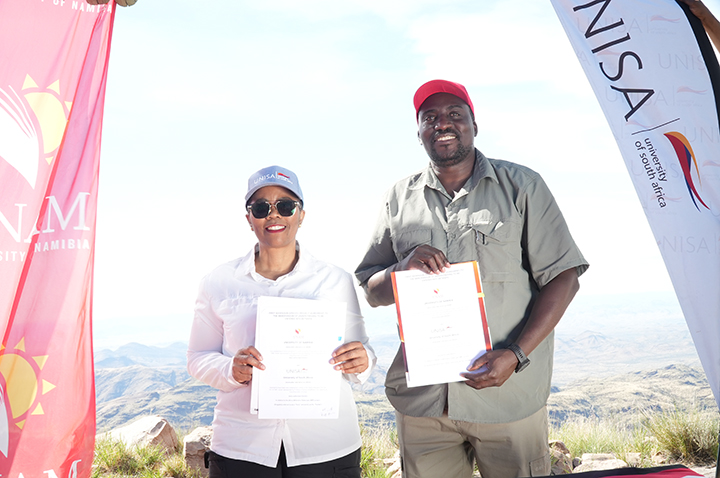 Unisa and UNAM partnership advances Africa Millimetre Telescope project
 Unisans reflect on the 2026 Principal and Vice-Chancellor's Lekgotla
 Lekgotla panel discussion rethinks the modern university
 Unisa redefines student support through Inhlanyelo Hub NPC