

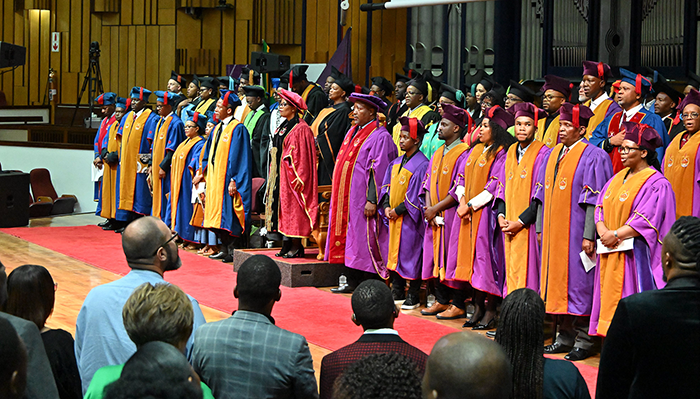
Unisa’s dignitaries at the 2026 Official Academic Opening Ceremony
Charting Africa’s future in terms of thought and innovation, Unisa’s Official Opening Ceremony of the 2026 Academic Year marked a decisive moment for the university, as leaders, portfolio heads and scholars set out a renewed Africa-centred intellectual vision. The ceremony signalled a commitment to shaping Africa’s intellectual trajectories, and grounding future scholarship in history, innovation and purpose.
Held at the ZK Matthews Great Hall on 12 February 2026, the opening ceremony articulated an Africa-centred scholarly vision under the theme Reclaiming Africa’s Intellectual Futures for the Next 150 Years and Beyond.
The official opening of the academic year is a statutory annual event held to, amongst other purposes, rally the university community around a common objective, reflect on past achievements and challenges, and outline the university's strategic direction for the year.
This year’s ceremony gave portfolio heads an opportunity to share their plans for the year and present excellence awards to high achievers in their portfolios, showcasing outstanding and impactful performance.
Delivering his address at the ceremony, Dr Dan Mosia, Unisa Council Chairperson, said that the theme is both inspirational and developmental, as it views education as a producer of knowledge, science and ideas, actively shaping societies through teaching and learning.
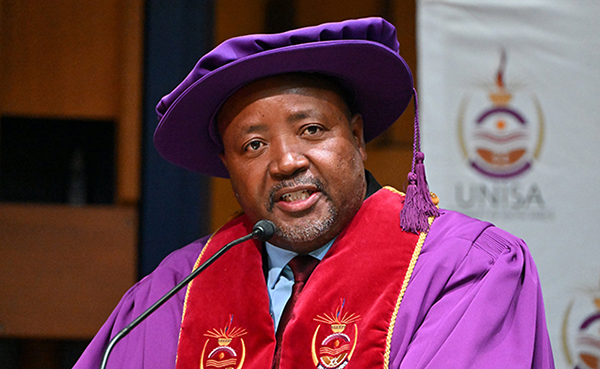
Dr Dan Mosia
"Today’s ceremony is significant considering the turbulent events that are rapidly changing the landscape of higher education," Mosia added. "Leadership is designed for such times as one needs to be decisive and act with courage during challenging times."
Mosia mentioned that, in addition to the importance of transformation within the university, the Unisa Council viewed governance and financial sustainability as important markers of the university’s progress, and that it is important to note that all universities rely on the continuity of quality governance. "These kinds of improvements will enable Unisa to invest in its academic project, hence Council remains committed to pursuing a clean audit outcome," he said. "In addition, academic excellence remains at the heart of the university’s strategy."
Mosia said that the positive outcomes experienced reflect the dedication of Unisa’s academics and the university’s drive to deepen its research culture, and reclaim and nurture talent. He continued: "Social purpose remains a powerful source, and our catalytic niche areas are critical to Africa’s future. Our task is to continue the culture of keeping excellence, relevance, and competitiveness at the centre of what we do as credible and ambitious academics who are curious."
In her opening address, Prof Puleng LenkaBula, Unisa Principal and Vice-Chancellor (VC), introduced the university’s leadership and emphasised the importance of collective contributions to advance the standard of quality education and student support.
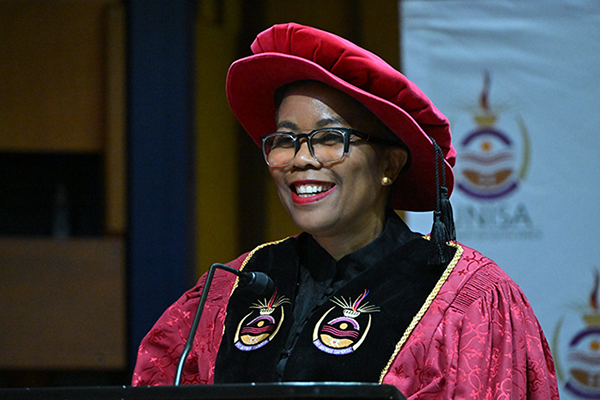
Prof Puleng LenkaBula
Sharing her journey as the first woman at the helm of the institution, the VC reflected on how, at times, fighting for justice can be undermined. Citing from the novel The Beautyful Ones Are Not Yet Born by Ayi Kwei Armah, she said that the novel bemoans the fact that in the aftermath of fighting for liberation from colonialism, many Africans, and also others who have fought oppression, exploitation and especially colonialism, sometimes negate or undermine the struggle when they take leadership roles. "We take for granted the roles we have to play," said the VC. "What I found here at Unisa was an invitation to state that we will work together with anyone who is committed to making sure that we don’t become the very stereotypes that Ayi Kwei Armah speaks about."
She stressed the importance of ensuring that those on the economic margins are not trampled upon but are supported to emerge and thrive with the talents they bring to society.
The VC encouraged Unisans, especially the leadership corps, not to focus on those who dislike them, but to give attention to those who want to work with them, and to ensure that the work at hand is supported by the principles of transformation to chart Africa’s intellectual and innovative futures beyond the next 150 years.
Commenting on the appointment of adjunct academics to support teaching, assessment and curriculum development, the VC said that it is the university’s responsibility to strengthen its academics to ensure quality teaching and learning.
She added that the university should reflect on its strengths and areas for improvement. "Last year’s words belong to last year's language," said the VC, quoting Cornell West. "We should continuously rethink our scholarship as it will help our society to achieve the Africa we want and realise the continent’s 2063 aspirations."
Looking to the year ahead, the VC said: "We, as the leadership of Unisa, have non-negotiables this year. We expect all Africans to treat each other with respect, as we all belong in Africa." She also encouraged Unisans to use their time, talent and resources to advance the institution and support its students.
"We are promising a listening management, and are looking forward to a university that is agile and competitive, and our desire is to see Unisans carry out the same vision," she concluded.
This year’s academic ceremony, graced by Dr Winnie Mashaba, South African gospel artist, reflected on the plans, achievements and progress of the university community, and the incredible energy from all the speakers set the tone for the 2026 academic year.
* By Lesego Chiloane, Journalist, Department of Institutional Advancement
** Photography by Shooheima Champion, Multimedia Centre
Publish date: 2026-02-13 00:00:00.0

 Unisa's Political Sciences Department celebrates 80 years of shaping political thought
 Unisa symposium explores Africa's aviation future through innovation and collaboration
 Second Annual CNA Indaba signals a new phase of implementation at Unisa
 Unisa symposium puts aviation at the centre of Africa’s economic growth
 Unisa leads global records management research output