

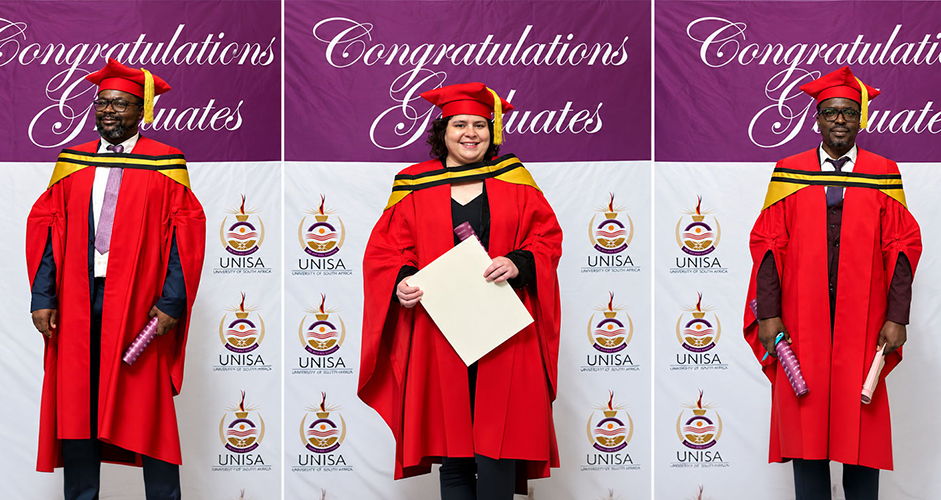
From left: Dr Nety Sol Sauna, Dr Judith van der Linde and Dr Kumi Ebenezer Nyarko.
Research rarely follows a straight line. For three doctoral graduates who crossed the stage during Unisa's Spring Graduations, earning the title "Doctor" meant changing direction, working late into the night, balancing careers with research and, at times, finding reasons to keep going.
Dr Nety Sol Sauna, Dr Judith van der Linde and Dr Kumi Ebenezer Nyarko were among the doctoral graduates celebrated during the University of South Africa's fifth Spring Graduation ceremony at the Muckleneuk Campus.
About 320 degrees and postgraduate qualifications were conferred during the ceremony, which was officiated by Acting Vice-Principal: Institutional Development and Transformation Prof Magano.
Prof Pandelani delivered the Chancellor's address on behalf of Unisa Chancellor and former President Dr Thabo Mbeki, encouraging graduates to remain open to change, continue learning and persevere when their plans do not unfold as expected.
For the university's new doctors, those words reflected experiences they knew well.
For Sauna, completing his doctorate required accepting that the research he finished would look very different from the project he initially imagined.
His thesis, Characterisation of Naphthenic Acid Species in Crude Oil by Comprehensive Two-Dimensional Gas Chromatography with Time-of-Flight Mass Spectrometry and Their Removal Using Ionic Liquid, investigated the characterisation and removal of naphthenic acid species found in crude oil.
"It was a long journey. My initial proposal was totally different from what the end result was. About 70% of it was left," Sauna said.
Instead of seeing those changes as a failure of the original plan, he learnt to adapt as the research developed.
"As you work through it, changes are going to occur, and you need to adapt and keep pushing through, find new ideas and solutions on how to move forward," he said.
His experience illustrates a reality familiar to many researchers: questions change, evidence challenges assumptions and methods sometimes have to be reconsidered before meaningful answers emerge.
Sauna's advice to other postgraduate students is to recognise their strengths while building a strong support network around their research.
"When you're good at what you do, you just do it. And that's it. And find yourself a good team that will support you throughout," he said.
His research into crude-oil composition and treatment also sits within wider scientific efforts to improve industrial processes and understand their environmental implications, an area that intersects with Unisa's work on energy and sustainability and the broader ambitions of Sustainable Development Goal 12 on responsible consumption and production.
For Van der Linde, doctoral study was as much a personal journey as an academic one.
Her thesis, Towards a Framework for Managing Business Capability Stability Using Enterprise Architecture, explored how enterprise architecture can be used to manage the stability of business capabilities.
Enterprise architecture helps organisations understand how their technology, processes, information and strategic objectives fit together, an increasingly important consideration as organisations adapt to rapid technological and operational change.
That places Van der Linde's work within conversations central to Unisa's Fourth Industrial Revolution and Digitalisation Catalytic Niche Area, where the challenge is not simply adopting new technologies, but understanding how organisations can remain resilient and effective as their operating environments change.
For Van der Linde, however, the doctorate also revealed things about herself.
"Not only does it open up a lot of doors for your career, but it also takes you on a personal journey of discovery," she said.
The demands of doctoral research exposed both strengths and weaknesses and changed the way she viewed the experiences of people around her.
"You learn so much about your strengths and weaknesses when you become a doctor, and you also learn how to appreciate what’s happening in the world and how to interact with other people who might be struggling along the way," she said.
Nyarko's journey involved another challenge: completing doctoral research while working and adapting to life in a different region of the continent.
Originally from West Africa, he moved to Southern Africa for his studies.
His thesis, Thermodynamic Optimisation of ORC Systems Using Hybrid Renewable Energy Sources and Nanofluid-Zeotropic Mixtures, investigated ways of optimising Organic Rankine Cycle systems using hybrid renewable energy sources.
Organic Rankine Cycle technology can convert lower-temperature heat into useful energy, making research into its efficiency relevant to the broader search for more effective renewable and sustainable energy systems.
Nyarko's work therefore connects naturally with Unisa’s research focus on energy and with SDG 7: Affordable and Clean Energy, which seeks to expand access to reliable, sustainable and modern energy.
Getting to the end of the doctorate, however, was not easy.
"It’s been an interesting one. A very tough one," he said.
At one stage, Nyarko considered stepping away from the programme.
"A PhD is not a joke, but it teaches you a lot. It made me learn a lot about myself," he said.
One of the greatest challenges was finding enough time and energy for research while continuing with his regular job.
"PhD means that you are doing most of the work by yourself. You would have to stay up late, learn a lot of things. In addition to your regular job, putting all these things together was a difficult one," he said.
But he persevered, and looking back after graduation, Nyarko said the effort had been worthwhile.
Sauna, Van der Linde and Nyarko worked in markedly different disciplines, but their experiences reveal much of what lies behind a doctoral qualification.
One watched most of his original research proposal change as the project developed. Another discovered that doctoral study could reshape not only a career, but also her understanding of herself and others. The third crossed regions, balanced employment with research and continued even after considering stepping away.
Their research also shows the breadth of knowledge emerging from Unisa's postgraduate community, from analytical chemistry and enterprise architecture to renewable energy.
That diversity is part of the significance of doctoral education. A PhD is an individual academic achievement, but the knowledge produced along the way can reach far beyond the person receiving the qualification.
For these three graduates, the title "Doctor" therefore represents more than the end of years of research.
It represents the questions they pursued, the plans they had to change, the nights spent working and the decision, when the journey became difficult, to keep going.
By Noxolo Miya, Journalist, Department of Institutional Advancement
Publish date: 2026-10-07 00:00:00.0

 Unisa hackathon winners develop AI solution to support students at risk of falling behind
 Beyond Black Wednesday: Unisa lecture calls for urgent action to protect media freedom and public broadcasting
 Unisa celebrates 25 new PhD graduates advancing research and innovation
 From Maramanzhi to master's: Unisa graduate champions Tshivenda through scholarship
 Unisa students help shape digital complaints system to improve accountability and service delivery