
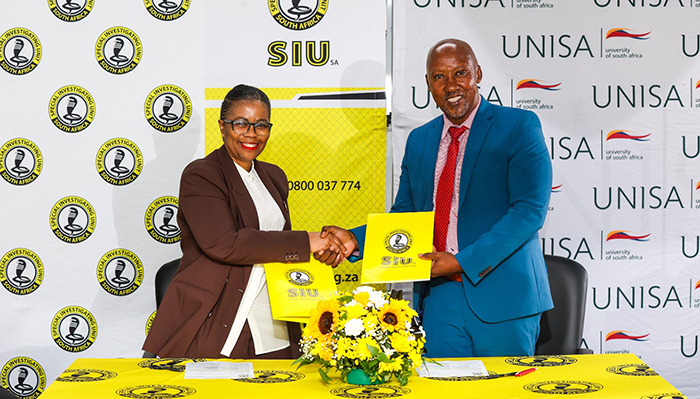
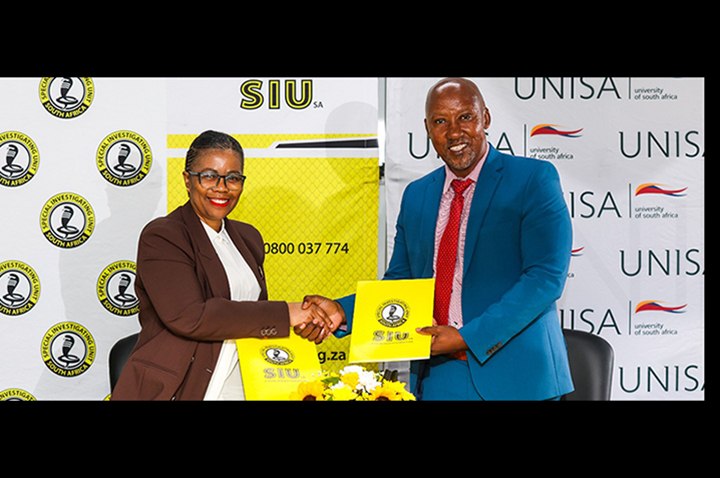
Signing the MoU on behalf of their respective organisations were (from left) Prof Puleng LenkaBula, Unisa Principal and Vice-Chancellor, and Leonard Lekgetho, Acting Head of the SIU
A significant step towards strengthening South Africa’s capacity to battle financial crime was marked in February when Unisa, through its College of Accounting Sciences (CAS), and the Special Investigating Unit (SIU) officially signed a memorandum of understanding (MoU). The engagement took place at the SIU offices in Pretoria.
According to Professor Audrey Legodi, Chair of the Department of Auditing in CAS, the partnership will focus on collaboration in critical areas such as research, training, and academic programme development, with a particular emphasis on building specialised skills to address fraud, corruption, and other financial crimes in South Africa.
She added that the agreement follows nearly a year of engagement between Unisa’s Department of Auditing and the SIU, reflecting a shared commitment to national priorities in skills development, ethical governance, and the professionalisation of the anti-corruption environment. A key outcome of the collaboration is the development of a Master of Accounting Sciences degree with a Forensic Auditing application, designed to equip professionals with advanced investigative and analytical skills.
Dr Moses Hlongoane, Executive Dean of CAS, stated that universities must respond to the needs of their communities and that Unisa’s mandate aligns with national priorities for skills development.
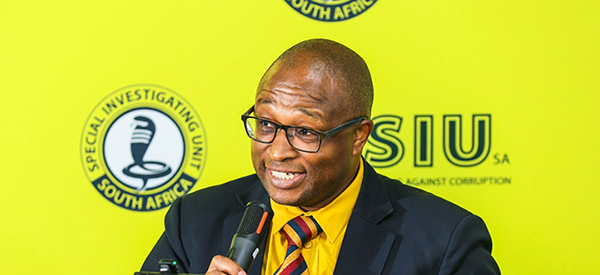
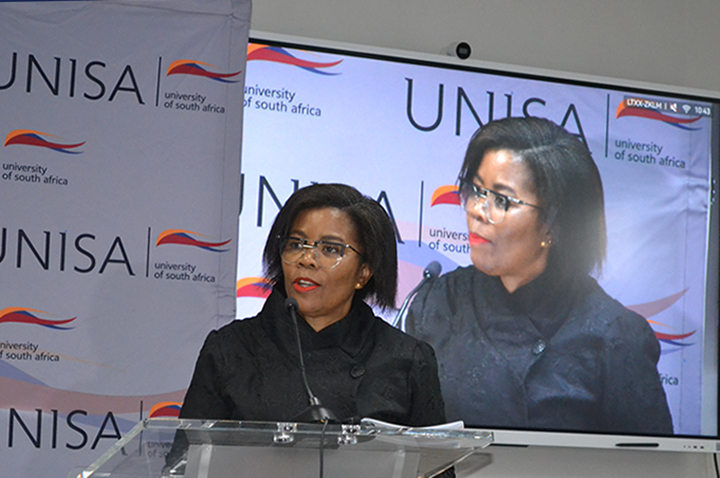
Dr Moses Hlongoane, Executive Dean of the College of Accounting Sciences
He added that universities play an important role in responding to evolving societal challenges. Hlongoane further noted that the landscape of financial crime has changed significantly, with fraud, corruption, cyber-enabled offences, and complex financial schemes becoming increasingly sophisticated. “Addressing these challenges requires intellectual depth, analytical precision, and ethical clarity, and Unisa is well-positioned to contribute to this effort,” he said.
Hlongoane emphasised that universities support this work through rigorous research, postgraduate education, and interdisciplinary engagement that strengthen the intellectual foundation of investigative practice.
South Africa continues to face a shortage of specialised professionals capable of detecting, investigating, and preventing financial crime. Skills in areas such as forensic auditing, forensic accounting, digital forensics, and investigative litigation remain in high demand. Through this partnership, Unisa and the SIU aim to strengthen national capacity through training, research collaboration, and knowledge exchange, while supporting effective investigations into corruption, malpractice, and maladministration within state institutions.
A defining feature of the collaboration is its focus on linking academic knowledge with operational practice. Graduates will benefit from exposure to real investigations and access to vocational pathways and internship opportunities within the anti-corruption environment.
This approach supports the development of professionals who understand both theoretical frameworks and the realities of investigative work.
In his keynote address, Leonard Lekgetho, Acting Head of the SIU, described the MoU as a symbol of shared purpose that builds bridges of knowledge, innovation, and mutual growth.
Professor Puleng LenkaBula, Unisa Principal and Vice-Chancellor, noted that the institutions are strategic partners in the fight against corruption and fraud. “The partnership seeks to develop a pipeline of qualified professionals who can strengthen investigative capacity, respond to the demand for scarce skills, and narrow the gap between academic research and investigative practice,” she explained. “The collaboration is grounded in a shared commitment to institutional integrity, social responsibility, and good governance.”
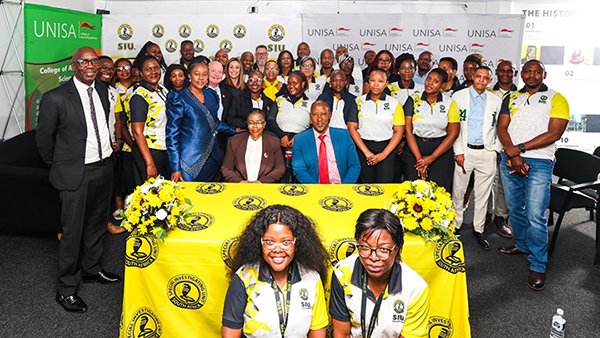
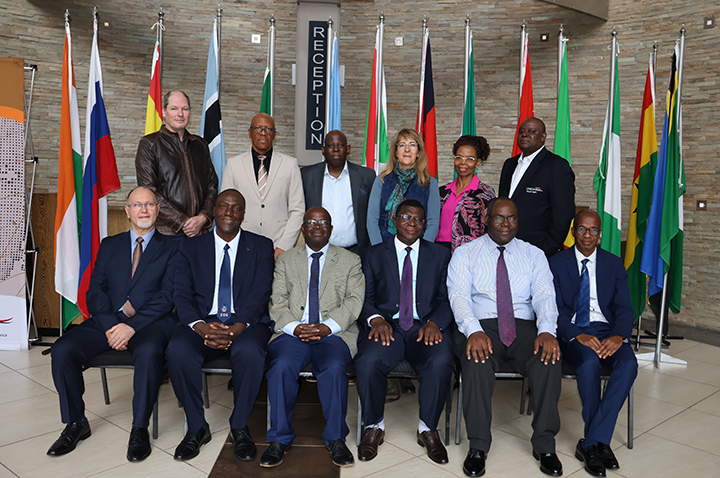
The Unisa and SIU delegations at the signing ceremony
Neptune Masombuka, Chief Human Capital Officer of the SIU, underscored the initiative's strategic intent, noting that the SIU has deliberately chosen to professionalise the anti-corruption ecosystem and institutionalise excellence.
The partnership between Unisa and the SIU represents an important step in strengthening anti-corruption practice in South Africa. By integrating research, professional development, and practical investigative experience, the initiative aims to cultivate a new generation of professionals committed to transparency, ethical leadership, and institutional integrity.
* Submitted by the Department of Auditing, College of Accounting Sciences
Publish date: 2026-03-23 00:00:00.0
 Unisa and SIU to build specialised skills to address fraud and corruption
 Unisan’s research reveals the intricate interaction between soil and environment
 Scaling success: Unisa reflects on leadership, academic excellence and growth
 Unisa welcomes students during Orientation Week 2026
 Unisa hosts the Zimbabwe Open University to exchange research know-how