

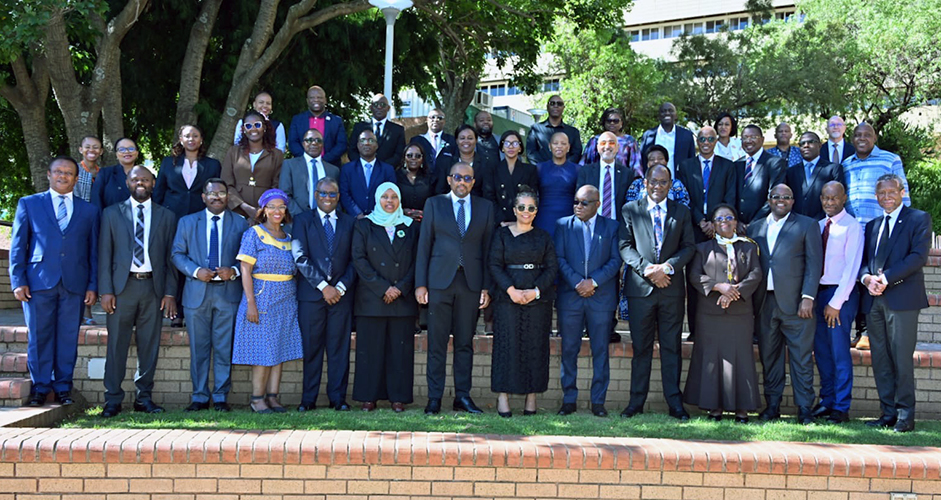
Members of Unisa's Management Committee (MANCOM) and the Tanzanian higher education delegation gather for a group photograph at Unisa's E-gardens during the benchmarking visit.
The University of South Africa (Unisa) has strengthened its engagement with African higher education institutions after hosting a high-level delegation from Tanzania for a three-day benchmarking visit focused on open distance e-learning, institutional governance and student success.
Held from 20 to 22 October 2026, the visit brought together representatives from the Open University of Tanzania (OUT), the Tanzania Commission for Universities (TCU) and Tanzania's Ministry of Education, Science and Technology (MoEST). Led by Prof Alex Makulilo, Vice-Chancellor of OUT, the delegation included Prof Charles Kihampa, Executive Secretary of TCU, and Prof Daniel Mushi, Permanent Secretary at MoEST, alongside other senior representatives. The delegation engaged with Unisa's Management Committee (MANCOM) to examine how the university manages large student populations, maintains academic standards, delivers student support and ensures financial sustainability.
The visit also provided an opportunity to exchange institutional experiences and explore areas of cooperation in teaching, research and academic development. Welcoming the delegation at Unisa's Muckleneuk Campus in Pretoria, Principal and Vice-Chancellor Prof Puleng LenkaBula emphasised the importance of maintaining quality across the university's academic and administrative operations. "Quality is the fabric and the texture of what we do," she said.
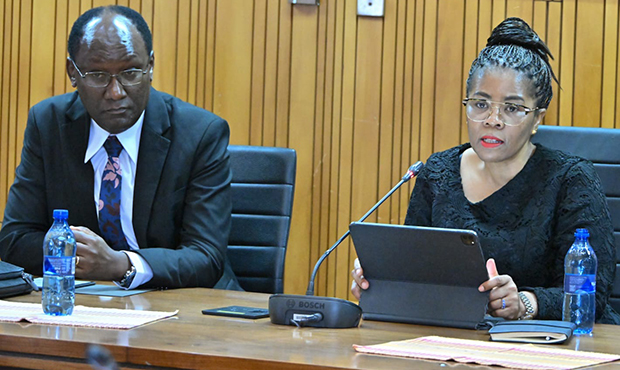
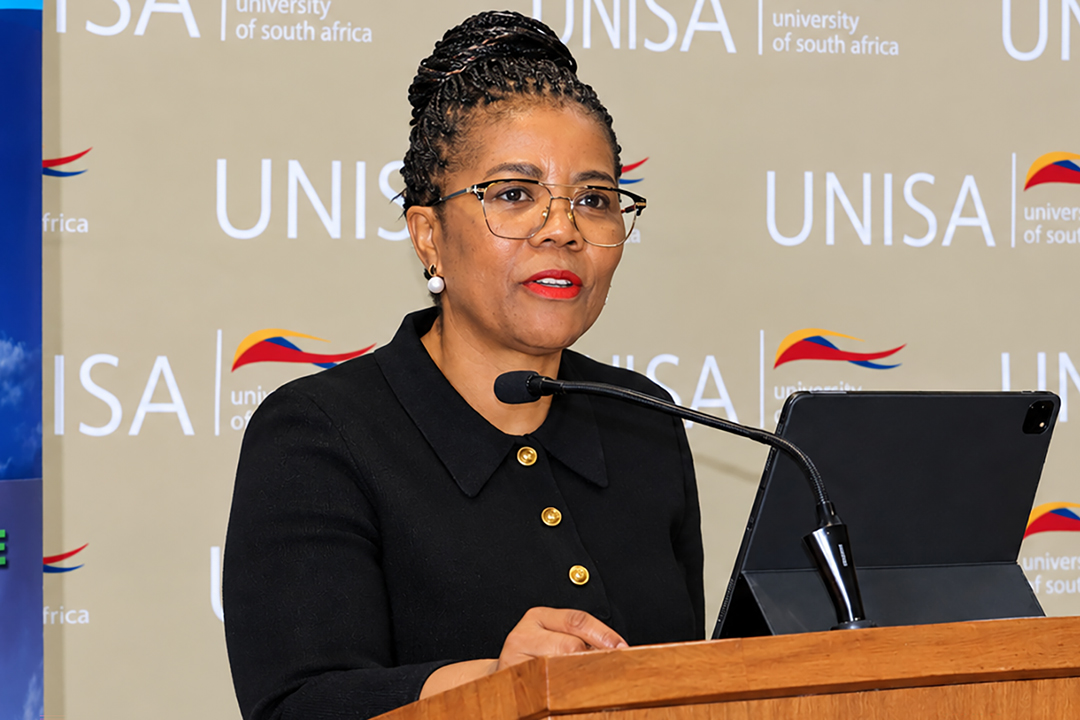
From left: Prof Daniel Mushi, Permanent Secretary in Tanzania's Ministry of Education, Science and Technology, and Unisa Principal and Vice-Chancellor Prof Puleng LenkaBula.
Her remarks reflected Unisa's commitment to embedding quality assurance in teaching, learning, student support and institutional governance. As a comprehensive open distance e-learning (CODeL) university, Unisa serves students across different geographical and socioeconomic backgrounds, making effective academic support, technology and administrative systems essential to its operations. For the Tanzanian delegation, the engagement offered an opportunity to examine how these systems work together to support access to higher education while maintaining academic standards.
Unisa Registrar Prof Moloko Sepota outlined the university's student administration processes, covering applications, registration, assessment and academic support. He explained that Unisa combines digital learning platforms with regional facilities and services to assist students throughout their studies. "Students are supported through Unisa's regional offices and hubs, computer labs and ICT services throughout the year," Sepota said. These facilities provide important access points for students who require technological assistance, learning resources and administrative support. Sepota also highlighted academic interventions designed to help students navigate their studies.
"Academic support includes tutorial services, discussion groups and academic support programmes designed to assist students with their studies," he explained. His presentation demonstrated the importance of coordinated institutional support, particularly in a distance-learning environment where students often balance academic responsibilities with employment and family commitments. Unisa Vice-Principal for Teaching, Learning, Community Engagement and Student Support Prof Mpho Ngoepe expanded on the university's student-centred approach. He highlighted how institutional systems and student data can help universities identify learning challenges, understand students' needs and develop more responsive interventions.
The discussions reinforced the importance of integrating student support into institutional planning to improve retention, progression and qualification completion. This approach also reflects Unisa's Catalytic Niche Area of Student Support and Co-curricular Activities, which promotes student development and success beyond formal academic instruction. Financial management formed another important part of the benchmarking programme.
Unisa Acting Chief Financial Officer Liana Joubert outlined South Africa's public university funding framework and the factors influencing resource allocation. Her presentation examined the relationship between government subsidies, student success and research outputs, highlighting how funding arrangements affect universities' ability to sustain academic programmes, infrastructure and student services. Joubert also addressed the challenge of balancing institutional priorities against available resources, particularly as universities seek to expand access while maintaining educational quality.
She encouraged the delegation to work closely with their government and relevant stakeholders to explore funding opportunities and strengthen institutional sustainability. The discussions highlighted the importance of sound financial planning in supporting long-term academic development and effective student services. Beyond the formal engagements with MANCOM, the delegation visited Unisa's libraries, Sunnyside Campus and Science Campus in Florida, Johannesburg. These visits provided practical insights into the university's academic environment, infrastructure and the facilities supporting teaching, learning and research.
The delegation also learnt about the work of the Unisa-UNEVOC Centre in technical and vocational education and training (TVET), including its contribution to policy, development and practice. The programme offered a broader understanding of how Unisa combines academic expertise, physical infrastructure and technology-enabled services to support its institutional mandate. It also allowed delegates to consider approaches that could be adapted to Tanzania's higher education environment. The benchmarking visit highlighted the value of cooperation among African universities, regulators and government departments in addressing shared higher education challenges.
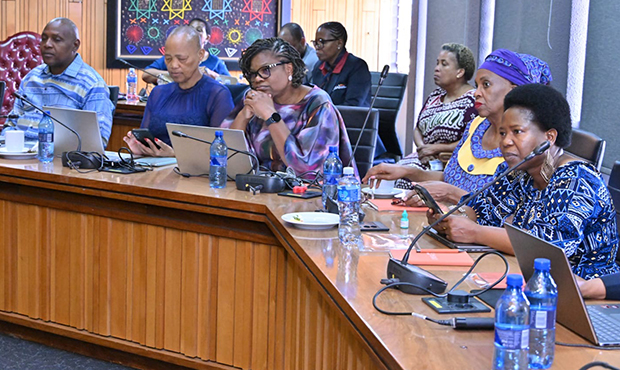
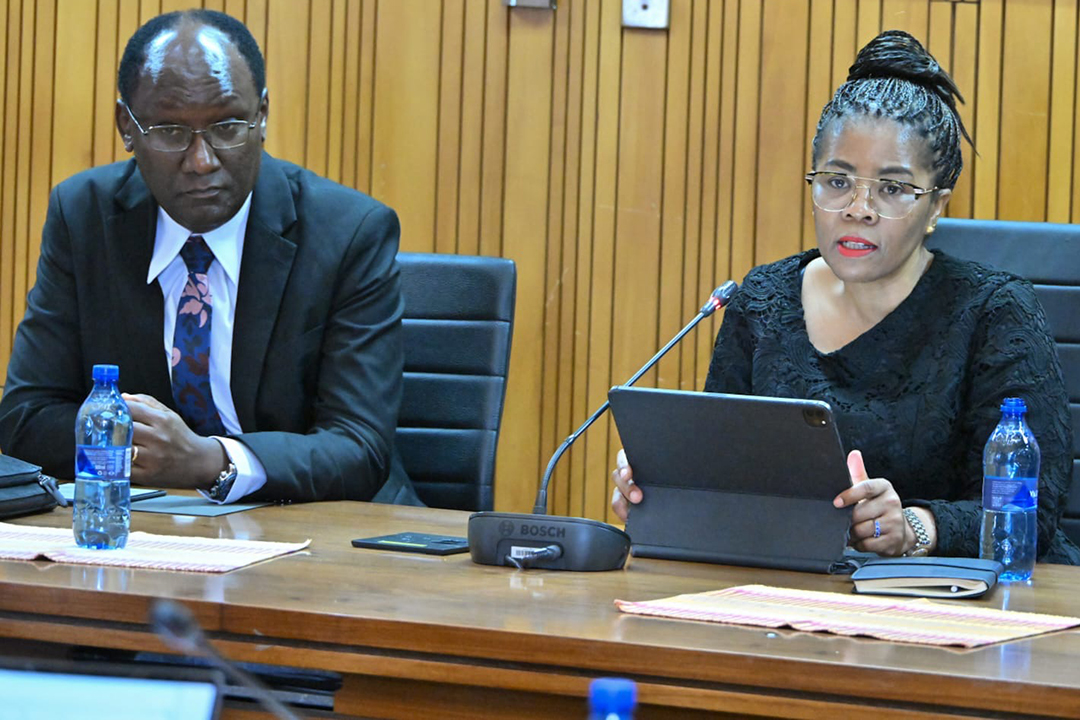
Unisa MANCOM members and representatives of the Tanzanian higher education delegation during discussions in the Council Chamber at Unisa’s Muckleneuk Campus in Pretoria.
Both South Africa and Tanzania face the need to expand educational opportunities while maintaining quality, improving student success and ensuring that institutions remain financially sustainable. Open distance e-learning provides opportunities to reach students who may otherwise be excluded from conventional university education because of geographical, financial or personal circumstances. However, its effectiveness depends on reliable technology, responsive student support, appropriate academic systems and effective institutional governance. The engagement aligns with the African Union's Agenda 2063 aspirations for improved education, skills development and stronger African institutions. It also supports Sustainable Development Goal 4, which promotes inclusive and equitable quality education, and SDG 17, which encourages partnerships for sustainable development.
For Unisa, the visit reinforced its role in advancing African higher education through institutional cooperation and knowledge-sharing. The three-day visit created opportunities for further engagement between Unisa and its Tanzanian counterparts, particularly in open distance learning, teaching, research, student support and academic development. While no formal agreements were announced, the discussions provided a foundation for exploring future partnerships and sharing practices that could strengthen higher education provision in both countries.
The engagement reaffirmed the importance of African institutions working together to expand access to quality education, improve student outcomes and build sustainable universities capable of responding to the continent's development needs.
* By Noxolo Miya, Journalist, Department of Institutional Advancement
Publish date: 2026-10-27 00:00:00.0

 Unisa Law Clinic helps students dress for success through Legal Wardrobe initiative
 Tanzanian higher education delegation benchmarks Unisa's distance-learning model
 Unisa calls for stronger scientific collaboration to build South Africa's climate resilience
 Unisa students triumph at national risk challenge with innovative AI solution
 Unisa College of Law strengthens student support through Vaal Regional Student Indaba