
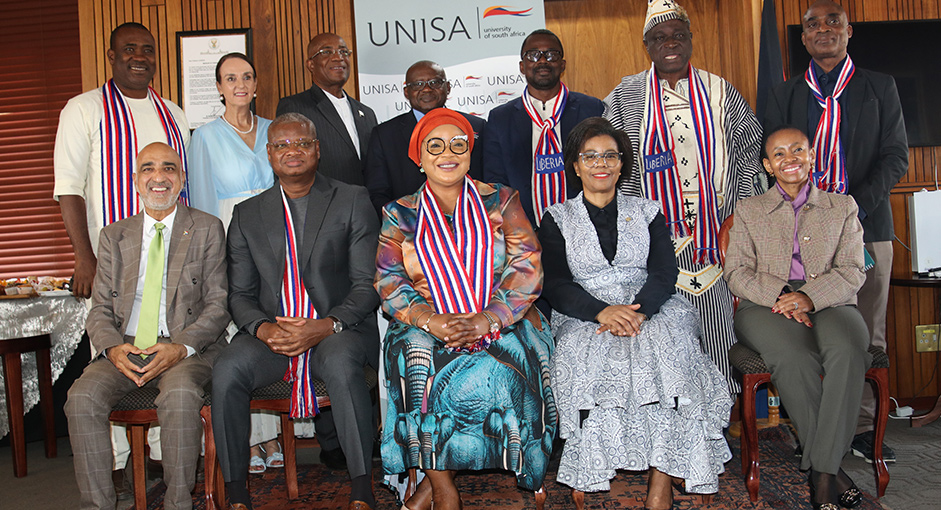
Unisa Principal and Vice-Chancellor, Prof Puleng LenkaBula, and members of the executive management with Minister of State Without Portfolio, Hon. Hadja Mamaka Bility, and the Liberian delegation.
The Government of Liberia is seeking to deepen its collaboration with the University of South Africa (Unisa) and the United Nations Development Programme (UNDP) as it moves forward with plans to establish a Peace and Reconciliation Memorial Museum.
A Liberian government delegation, led by Minister of State Without Portfolio, Honourable Hadja Mamaka Bility, visited Unisa as part of a study tour aimed at strengthening cooperation and drawing on South Africa's experience in memorialisation, reconciliation and nation-building.
The proposed museum is central to President Joseph Boakai's vision of fostering reconciliation and rebuilding national unity following years of civil conflict that left a profound mark on Liberian society.
For Bility, the engagement with Unisa is about turning that vision into a sustainable institution capable of preserving Liberia's history while contributing to the country's future.
"We hope to collaborate in the area of training, financing and basically as a technical partner as well," she said.
She said Unisa could provide expertise across several areas of the project, including the museum's design and conceptual development, the skills needed to establish and operate it, and broader capacity building.
"How the museum could be designed, the concept, the expertise required to build the capacity," Bility said, outlining areas in which the university could support Liberia.
She added that there was also potential for collaboration on financing the ambitious project.
The delegation's visit formed part of a broader study tour designed to examine established approaches to memorialisation and reconciliation and identify lessons that could be adapted to the Liberian context.
"This is the President's vision. He is committed to reconciliation. He is committed to nation-building," Bility said.
She said the study tour provided an opportunity for Liberia to learn from experiences that could strengthen its plans for the Peace and Reconciliation Memorial Museum and ensure that the institution serves both current and future generations.
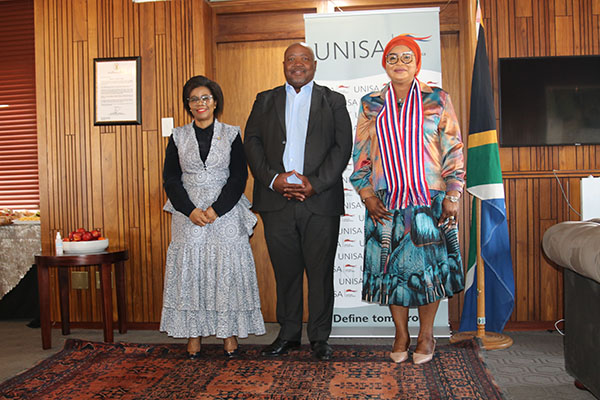
Unisa Principal and Vice-Chancellor, Prof Puleng LenkaBula, Unisa Chairperson of Council, Dr DD Mosia, and Minister of State Without Portfolio, Hon. Hadja Mamaka Bility.
Unisa Principal and Vice-Chancellor, Prof Puleng LenkaBula, said the proposed collaboration offered an opportunity to connect Liberia's reconciliation ambitions with South Africa’s own experience of confronting, documenting and memorialising its past.
"The government of Liberia is building a large-scale memorialisation of their history, but for the benefit of the future and for the benefit of peace and reconciliation," LenkaBula said.
South Africa has developed a range of institutions and heritage sites dedicated to documenting its history and liberation struggle in the post-apartheid era. LenkaBula highlighted institutions and sites such as Freedom Park, the Apartheid Museum, the Nelson Mandela Foundation and the broader heritage landscape associated with the Cradle of Humankind.
She said Unisa's contribution could extend beyond academic knowledge to include practical technical expertise aimed at ensuring that Liberia's museum is sustainable, relevant and grounded in the African context.
"How do you think about financing such a system and how do you make it enduring? What are the critical skills for memorialising and futures thinking?" she asked.
The proposed partnership could also create opportunities for students, academics and professionals from a range of disciplines.
These could include librarianship, archaeology, heritage management, conservation, digital technologies, architecture and infrastructure development.
LenkaBula said the project could also provide a platform for the digitisation of historical materials, the preservation of artefacts and the development of architectural and infrastructure systems appropriate to Africa’s built environment.
"This will imply opportunities for our students, academics and professionals, informing partnerships with the University of Liberia, UNDP and the government of Liberia in this grand project," she said.
Such collaboration could bring together expertise from different fields while strengthening institutional links between Unisa and Liberian partners.
The proposed partnership also draws on a long history of solidarity between Liberia and South Africa.
LenkaBula highlighted Liberia's support for South Africa during the struggle against apartheid, including the country’s role in providing Nelson Mandela with a Liberian passport that enabled him to travel internationally.
For Unisa, she said, the engagement with Liberia reinforces the university's commitment to working with institutions across Africa to advance development through research, knowledge and science diplomacy.
"We remain one of the leading universities because we partner with countries, with universities, with science councils, for the benefit of science diplomacy in our country," LenkaBula said.
Unisa's engagement with Liberia also builds on the university's broader history of contributing to capacity development across the continent, including partnerships aimed at strengthening professional and public-sector expertise.
LenkaBula said the proposed collaboration would further position Unisa as a continental institution capable of contributing to Africa’s development through research, policy engagement and knowledge exchange.
"I'm hopeful that we will contribute to research, will contribute to policy, resourcing or reforms, and will contribute to how our society in Liberia, South Africa, but also in the continent, join to build the Africa that we want in alignment with Agenda 2063," she said.
As Liberia advances its plans for the Peace and Reconciliation Memorial Museum, the collaboration with Unisa provides an opportunity for the two countries to draw on their shared history while exchanging knowledge about how societies can preserve difficult memories, confront their past and use history to help build a more peaceful future.
* By Noxolo Miya, Journalist, Department of Institutional Advancement
Photographer: Victor Malatji, Journalist Intern, Department of Institutional advancement
Publish date: 2026-09-04 00:00:00.0
 Reclaiming African heritage through geographical names
 From research to real-world impact: Unisa-linked project explores new ways to advance LGBTQIA+ rights
 Unisa hackathon winners develop AI solution to support students at risk of falling behind
 Beyond Black Wednesday: Unisa lecture calls for urgent action to protect media freedom and public broadcasting
 Unisa celebrates 25 new PhD graduates advancing research and innovation