

The African college of excellence in the social and human sciences
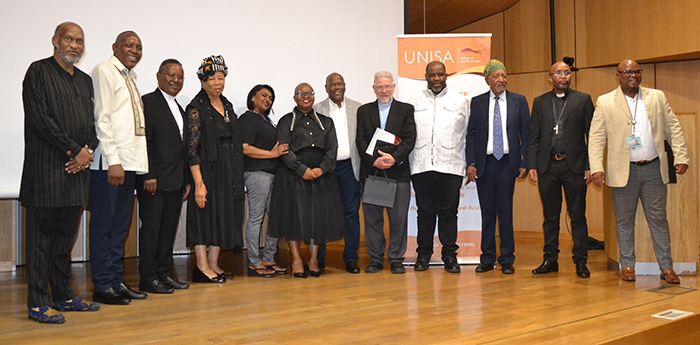
Paying tribute to Jackson’s legacy, from left, Archbishop Modiri Shole; Prof Thinandavha Mashau (CHS Executive Deputy Dean); keynote speaker, Rev Dr Frank Chikane; Prof Madipoane Masenya (Ngwan’a Mphahlele): Executive Director: Office of the Principal and Vice-Chancellor; Dr Linda Naicker; Prof Fundiswa Kobo, Chair of the Department of Christian Spirituality, Church History and Missiology; Prof Mokhele Madis; Rev Paul Verryn; Rev Mzwandile Molo; Prof Takatso Mofokeng; Dr Thembelani Jentile; and Dr Lephoto Mokone
On 30 March 2026, Unisa’s Department of Christian Spirituality, Church History and Missiology, in the College of Human Sciences, hosted a tribute for the late Rev Jesse Jackson Sr., led by keynote speaker, Rev Dr Frank Chikane, to honour Jackson’s monumental legacy and contributions during his lifetime in strengthening the bond between the American civil rights movements and South Africa’s struggle against the apartheid regime.
Jackson passed away on 17 February 2026 and was laid to rest on 7 March 2026 at a homegoing (funeral) attended by many civil rights activists, including South African President Cyril Ramaphosa, who stated that Jackson’s activism proved that the pursuit of dignity and justice knows no borders.
Throughout the ceremony, church leaders from various houses of faith paid their tributes and respect toward Jackson. They hailed him as an unshakeable wall, the epitome of the audacity of hope, who, throughout his lifetime, sought to shatter the glass ceilings that instilled segregation and apartheid, both in the United States and in South Africa.
They said his ministry stretches far beyond sanctuary walls, carrying the Gospel into the streets, courtrooms, classrooms and communities hungry for dignity. In unison, the eulogists agreed that Jackson embodied a conviction shared by a generation of prophetic leaders: that justice is not separate from faith, but one of its clearest expressions.
In his keynote address titled Faith, Justice and the Prophetic Legacy of Rev Jesse L. Jackson Sr., charismatic mediator Chikane described Jackson as the product of the struggles of descendants of formerly enslaved African Americans who continuously fought against a racist white supremacist regime that denied African Americans equal rights and the privileges that come with democracy.
In describing Jackson’s upbringing, which started his faith and political journey, Chikane explained that Jackson was brought up by his stepfather, who raised him in the church, which instilled a traditional focus on Black political resistance since the time of American slavery.
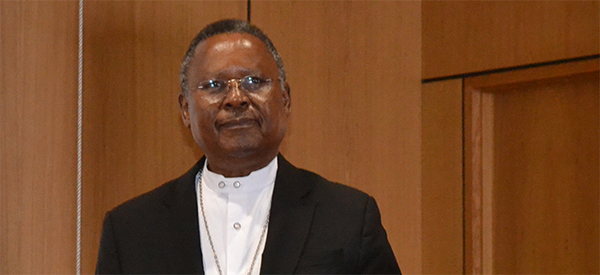
Keynote speaker, Rev Dr Frank Chikane
"Jackson,” said Chikane, "was a protégé of Martin Luther King Jr. and James Bevel, who were both major role-players in the culmination of the 1960s civil rights movement. Later, Jackson joined the Southern Christian Leadership Conference (SCLC), which was established after 'Bloody Sunday' in 1965, inspired by a culmination of events and marches to ensure that African Americans could exercise their constitutional right to vote amidst a segregationist system that wanted to make it impossible."
Continuing, Chikane said Jackson led protests and organised movements, including Operation Breadbasket, to fight segregation, economic discrimination and voting rights continuously. "Later on," he said, "Jackson established Operation Push (People United to Save/Serve Humanity), which was focused more on economic boycotts and lobbying to improve economic opportunities for black people and the poor. Afterwards, between 1983/84, he established the National Rainbow Coalition (NRC) to bring together diverse people to advocate for human rights."
Chikane said that Jackson, through his oratorical brilliance, allowed his faith to fuel his fight, and that Jackson "remains a towering figure of the Civil Rights Movement, a son of the Black Church and a relentless advocate for justice rooted in faith".
Concluding his tribute, Chikane described Jackson as the epitome of equality, whose vision was to see Black people enjoy equal rights enshrined in the Constitution, while still serving as a church leader and often intertwining his sermons with political activism inspired by the numerous liberation movements he led. "In essence, Jackson stood firmly in the tradition of a church that sings while marching and prays while organising. His life testified to a theology with feet – a faith that shows up whenever people struggle to breathe."
* By Godfrey Madibane, Acting Journalist, Department of Institutional Advancement
Publish date: 2026-03-31 00:00:00.0
 Too few vets, too many outbreaks: South Africa's FMD challenge
 Unisa sparks critical conversation on South Africa's unfinished land question
 From Unisa graduate to global fraud intelligence investigator
 Studying at Unisa was the right decision
 More than a game: Unisa is building health, teamwork and lasting connections through sport