

The African college of excellence in the social and human sciences
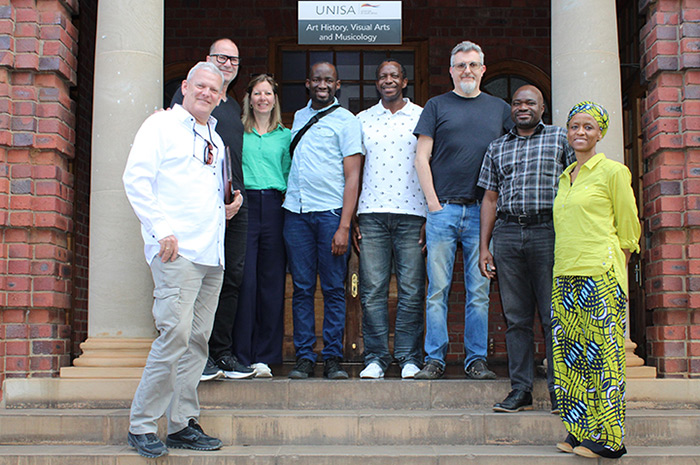
Beets Alexander, Hans van den Hurk, Postma Machteld, Thapelo Khumisi, Daniel Rankadi Mosako, Christopher Jeffery, Evans Netshivhambe and Christine Msibi
Held on 2 April 2026, Unisa’s Department of Art and Music (DAM) held a strategic meeting to explore a tripartite collaboration between the university, IKS Cultural Consulting Africa and Fontys University of Applied Sciences’ Academy of the Arts (Rockacademie), aimed at building sustainable, practice informed and globally connected music education. The engagement focused on cross‑cultural collaboration, music curriculum innovation and the integration of musicology, performance and music technology within Unisa’s music programmes.
Opening the proceedings, Dr Christopher Jeffery, Senior Lecturer at Unisa’s DAM, provided an overview of the department, including its staff’s fields of specialisation such as ethnomusicology, African music and film music, underscoring the breadth of its academic and stylistic scope. He noted that Unisa’s music programmes are delivered online through the Moodle learning management system, using semester‑based modules assessed through multiple formative tasks and a portfolio examination model that promotes continuous engagement.
Jeffrey linked the system to the South African Music Technology, Innovation and Capacity-building initiative, which is funded by the Erasmus+ Knowledge Exchange Programme. He also indicated that visiting scholars will, in this semester, focus on music technology curriculum structures, technology‑driven knowledge exchange and curriculum transformation.
Delegates were briefed on the Bachelor of Music’s structure, which gives students a comprehensive creative music foundation and ensures that they develop robust analytical and interdisciplinary competencies. Jeffrey also unpacked what the Music in History and Society stream offers, which foregrounds social, cultural and economic dimensions of musical practice.
Further, DAM’s postgraduate profile with master’s and PhD candidates drawn from South Africa, the broader African continent and globally, reflects its established research capacity and international reach. During the engagement, Unisa also highlighted that DAM’s scholarly focus plays a vital role in the music ecosystem, and that new partnerships create opportunities to better integrate performance without sacrificing academic rigour.
Prof Hans van den Hurk, Fontys Rockacademie’s Director of Arts Studies, articulated the academy’s ambition to support and strengthen music performance at Unisa. He also highlighted that diversifying and contextualising performance in relation to global developments would significantly enhance students’ artistic opportunities.
Additionally, Dr Alex Beets, Fontys Rockacademie’s Head of the Business Department, outlined its model as a paradigm that embraces the full spectrum of music professions and components. He also elaborated on artistic development trajectories and opening opportunities for joint curriculum design.
Dr Evans Netshivhambe, Music Specialist at Unisa’s Music Directorate, accentuated the importance of formally incorporating African instruments into structured curricula, rather than leaving them solely to intuitive, informal learning traditions. He also emphasised the need for dedicated production of African instruments for teaching purposes, given that most are historically transmitted through embodied community knowledge.
Essentially, the planned Unisa music and multimedia studio will integrate the university’s African musical instruments collection into a creative output hub and expand its multimedia studio capabilities, demonstrating the strong presence of African music across DAM’s undergraduate and postgraduate offerings. Such initiatives advance a consciously African‑centred and decolonial approach to music education.
In closing, Christine Msibi, IKS Cultural Consulting Africa’s seasoned cultural curator, framed the engagement as a critical data‑collection exercise that will inform the next phase of collaboration between the partners. Insights into programme architecture, technological needs, performance ambitions and instrument production will feature in project proposals, mobility schemes and co‑developed curricula under the Erasmus+ programme and related frameworks.
For participants, the session laid a foundation for a cross‑continental partnership linking musicology, performance, technology and African musical heritage. Follow‑up workshops and planning meetings are envisaged to refine roles, timelines and deliverables, with the shared goal of creating a dynamic platform for reciprocal, technologically enabled and culturally grounded music education.
* By Dr Daniel Rankadi Mosako, Chair of Department (acting) and Dr Christopher Jeffery, Senior Lecturer, Department of Art and Music
Publish date: 2026-04-16 00:00:00.0
 Unisa attends KZN Legislature's rural career expo
 NRF awards two new research chairs to Unisa
 Bridging the communication gap through Sign Language inclusivity
 Unisa hosts City of Tshwane's 2026 SoCA
 Unisa Mining Engineering team earns prestigious industry recognition