

The African college of excellence in the social and human sciences
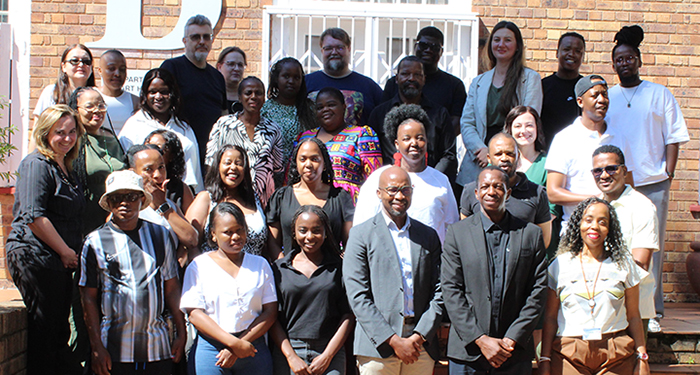
School of Arts Director, Prof Siyasanga Tyali, with Department of Art and Music staff
A recent visit by the School of Arts Director, Prof Siyasanga Tyali, to Unisa’s Department of Art and Music (DAM) on 3 February was a pivotal moment for reaffirming alignment with Strategy 2030 and streamlining DAM’s contribution to the university’s long-term goals.
More than a courtesy call, the visit addressed throughput, research output, student recruitment, student support, and master’s and doctoral (M&D) supervision to completion, with a particular focus on institutional observations about DAM’s performance.
As the first speaker during a full staff and strategic planning meeting, Tyali effectively levelled the terrain. By opening the engagement, he framed the conversation within the context of Strategy 2030 and clarified expectations for DAM’s role within the school and the wider institution. This ensured that subsequent presentations spoke to shared priorities: student success, academic excellence, and impactful research and creative work.
Tyali’s address translated institutional ambitions into clear departmental implications, reminding staff that DAM is a central contributor to the university’s identity, transformation agenda and key performance areas, as a creative arts department.
Following the Director’s opening remarks, several key speakers enriched the discussion with insights that were directly connected to DAM’s future trajectory. Dr Phumza Makgato‑Khunou, together with Prof Hendrik Smit, presented on AI interactions in a comprehensive open and distance e‑learning (CODeL) institution. Their contribution highlighted both the opportunities and ethical responsibilities of integrating artificial intelligence into teaching, learning and research in the arts.
They illustrated how AI tools can support flexible learning, timely feedback and creative experimentation for DAM students, while stressing the need for critical engagement so that technology enhances rather than replaces human responses to assessments. They also underscored staff development on AI as essential, enabling lecturers and students alike.
Dr Tapiwa Muzata focused on the availability and importance of Unisa’s Inhlanyelo Hub for the arts disciplines and DAM graduates. He presented the Hub as a strategic institutional resource for enhancing student and graduate employability, entrepreneurship and professional readiness in the cultural and creative industries.
By supporting project funding, innovation and the incubation of arts-based initiatives, this platform strengthens the bridge between DAM’s academic programmes and the workspace. It demonstrates the value of DAM’s qualifications in shaping the creative economy.
Within this broader strategic frame, Tyali highlighted the importance of focused student recruitment. For DAM, recruitment is about attracting students who can thrive both academically and artistically, thereby improving throughput and completion rates. The discussion underscored the need to enhance DAM’s visibility through open days, school visits, digital showcases of student work and strong institutional branding, while aligning admission criteria with both talent and academic readiness. The use of AI-supported platforms and CODeL infrastructure was identified as a way to extend access, especially for students who may not have easy access to campus-based programmes.
The visit also highlighted DAM’s role in driving creative outputs aligned with Strategy 2030. The Director and speakers emphasised that creative scholarship must be recognised and supported as part of the institution’s broader research portfolio. This includes appropriately recognising performances, exhibitions and compositions as accredited research outputs where policy allows, and encouraging interdisciplinary projects that connect the arts with technology, academic citizenship and social responsibility. Academic and support staff were encouraged to publish, present and curate work that strengthens institutional research metrics and enhances DAM’s profile.
Institutional concern about throughput made student support a central theme. Tyali stressed that improving completion rates is a shared responsibility, supported by coherent structures. Attention was given to strengthening academic advising, early warning systems and targeted interventions for students who are struggling, while recognising the specific pressures faced by art and music students, such as performance demands, portfolio deadlines and financial constraints. Enhancing psychosocial support and integrating career-focused initiatives into the student journey were highlighted as critical to promoting holistic success and a smoother transition into professional practice.
For master's and doctoral students, Tyali reaffirmed the expectation of supervision to timely completion, backed by effective institutional systems. He called for structured supervision plans, clear milestones and regular progress reviews, alongside co-supervision and mentorship to build supervisory capacity within DAM. Connecting postgraduate research to institutional priorities, AI-enhanced methodologies and distance-learning opportunities were presented as essential to simultaneously strengthening postgraduate throughput and research output.
Collectively, the Director’s visit and the strategic presentations by Makgato‑Khunou, Smit and Muzata served as a catalyst for more focused progress at DAM. The engagement clarified how DAM’s work in teaching, research and creative practice is expected to intersect with Strategy 2030, technological innovation, student support and graduate success, positioning the department as a leading hub of artistic and scholarly excellence within the university.
* By Daniel Rankadi Mosako, Department of Art and Music
Publish date: 2026-02-13 00:00:00.0

 From waste tyres to shoe polish: Unisa Professor turns waste into opportunity
 Beyond barriers: Dr Nozuko Langa's decade-long journey to a PhD
 Unisa students take top honours at 2026 HEQAF Student Paper Presentation Competition
 Young KZN photographers explore the ocean through Unisa lens
 Prof Brendon Barnes champions climate justice through psychology