

Equipped with state-of-the-art laboratories that provide students with hands-on experiences to bridge theory and practice
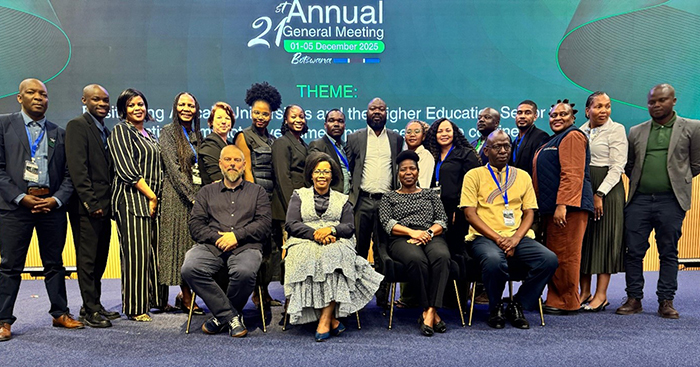
Seated, from left: Prof Ashley Gunter, Acting Deputy Executive Dean, CAES; Prof Puleng LenkaBula, Principal and Vice-Chancellor, Unisa; Prof Ndanganedzeni Olivia Mapholi, Acting Executive Dean, CAES; and Prof Sogolo Lebelo, Director, School of Agriculture and Life Sciences
Standing, from left: Prof Julius Tjelele, Dr Sekobane Daniel Kolobe, Matuba Legodi, Masai Mathole, Dr Elsabe Janse van Rensburg, Dr Dikeledi Malatji, Prof Aluwani Tagwi (CoD Department of Agriculture and Animal Health), Dr Richard Netshirovha, Dr Frans Phiri, Dr Yonela Maziko, Tshiamo Gaetsewe, Dr Lucky Nesengani, Dr Emmanuel Malematja, Ellen Mofokeng, Dr Portia Moshidi and Dr Piet Monegi
The University of South Africa (Unisa) strengthened its continental footprint through its participation in the 21st Regional Universities Forum for Capacity Building in Agriculture (RUFORUM) Annual General Meeting (AGM), held from 1 to 5 December in Gaborone, Botswana.
The AGM was co-hosted by the Government of Botswana and the Botswana University of Agriculture and Natural Resources (BUAN), and brought together leaders from academia, government, industry and development partners to reflect on the role of higher education in advancing Africa’s development agenda.
In his opening address, Botswana’s Minister of Higher Education, The Honourable Prince Maele, emphasised that Africa’s future depends on robust scientific capacity and universities that actively embrace the green economy and climate adaptation.
BUAN Vice-Chancellor, Prof Ketlhatlogile Mosepele, called on institutions to deepen partnerships with industry and government, while embedding entrepreneurship and practical pathways that enable young people to transition meaningfully into the workforce.
RUFORUM Board Chair, Prof Theresia Nkuo-Akenji, reflected on the network’s progress towards Vision 2030, highlighting gains in research excellence and community engagement, while acknowledging the persistent structural challenges that require collective action.
The AGM provided a basket of activities and focused on positioning African universities to influence development outcomes across the continent more effectively; an agenda closely aligned with Unisa’s strategic priorities in innovation, agricultural transformation, environmental resilience and inclusive education.
Against the backdrop of persistent challenges, including youth unemployment, food insecurity, climate change and low investment in research and development, discussions highlighted the urgent need for universities to reassess their approaches to teaching, research and societal engagement.
For Unisa, the meeting reaffirmed the university’s role as a continental knowledge producer operating on a large scale. As Africa’s largest open and distance eLearning institution, Unisa is uniquely positioned to contribute to a more inclusive, responsive and innovation-driven higher education ecosystem. The participation of the College of Agriculture and Environmental Sciences (CAES) further underscores the university’s commitment to addressing food insecurity, strengthening agricultural systems and advancing research that directly responds to societal needs.
During leadership engagements, Prof Puleng LenkaBula, Unisa Principal and Vice-Chancellor, was accompanied by Prof Ndanganedzeni Olivia Mapholi, Acting Executive Dean of CAES, and Prof Ashley Gunter, Acting Deputy Executive Dean of CAES, as they participated in a RUFORUM leadership task team tasked with establishing and driving thematic research areas. The discussions focused on strengthening RUFORUM’s research ecosystem through the creation of thematic hubs that bring together universities, research institutions, industry actors and Consultative Group on International Agricultural Research (CGIAR) centres to address Africa’s priority development challenges. The establishment of these thematic areas follows a structured framework designed to ensure quality, relevance and measurable impact.
A major outcome of the AGM was Unisa’s appointment as the convenor of the RUFORUM Thematic Hub on Bio-Innovation, Agri-Biotechnology and One Health. This positions the university at the centre of collaborative, transdisciplinary research addressing food security, biotechnology and the interconnected health of humans, animals and the environment. Unisa will also participate in other priority thematic hubs, with implementation processes extending into 2026.
Unisa further strengthened its regional and continental partnerships through bilateral engagements. In discussions with BUAN, the university agreed to expand the existing memorandum of understanding to support enhanced joint research initiatives, student and staff exchanges, postgraduate co-supervision, and shared access to training and research facilities.
Engagements with the Centre for Coordination of Agricultural Research and Development for Southern Africa (CCARDESA) focused on advancing regional agricultural research coordination within the SADC region, with particular emphasis on translating research into innovation and aligning regional priorities with Unisa’s catalytic niche areas.
In a further demonstration of research excellence, Dr Dikeledi Malatji presented a poster entitled "Genome-Wide Association Study of Seropositivity to Tick-Borne Diseases in Cattle", showcasing findings from Masego Gaorekwe’s PhD research. The poster received an award at the conference and generated significant interest among scientists and agricultural experts, further positioning CAES as a hub for innovative, solution-oriented agricultural research. This achievement reflects the college’s sustained commitment to postgraduate research excellence, capacity development and the generation of knowledge that responds to pressing continental and global challenges.
The Unisa exhibition marked a significant milestone in the University’s continental recruitment and branding strategy, enhancing pan-African visibility and consolidating Unisa’s strategic positioning as a university of choice in Africa.
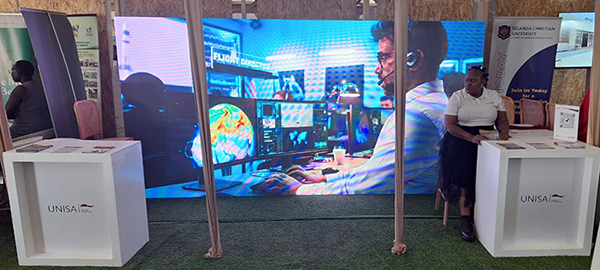
The Unisa exhibition stand
Science diplomacy formed an integral part of Unisa’s engagements in Botswana. The delegation met with South Africa’s High Commissioner to Botswana, Her Excellency Thaninga Shope-Soumah. During the engagement, the Vice-Chancellor outlined key milestones in teaching and learning, research and innovation, and Unisa’s catalytic niche areas, highlighting the experimental farm as a flagship institutional achievement.
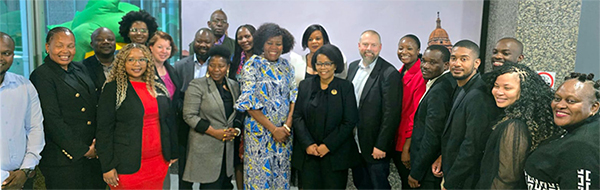
The Unisa delegation with the South Africa’s High Commissioner based in Botswana, Her Excellency Thaninga Shope Soumah (centre left), and Prof Puleng LenkaBula, Unisa Principal and Vice-Chancellor (centre right)
Both parties emphasised the importance of higher education that is grounded in patriotism and has a developmental impact. The High Commissioner expressed particular interest in how Unisa translates its academic capacity into improved graduate employability. In response, the Vice-Chancellor acknowledged the country’s unemployment challenges. It highlighted ongoing efforts through industry-linked research projects, internships and targeted career development programmes aligned with national and international economic priorities.
Collectively, these engagements affirm Unisa’s commitment to impactful partnerships, research excellence, skills development, and sustainable development across Africa, reinforcing the university’s role as a leading institution shaping the continent’s higher education and development trajectory.
* Article compiled by the Unisa delegation to the 21st RUFORUM AGM
Publish date: 2025-12-17 00:00:00.0

 Unisa Law Clinic strengthens clinical legal education through UMP benchmarking visit
 Tony Kgoroge to headline launch of Unisa African Languages International Film Festival
 Department of Health Studies strengthens postgraduate research capacity in Ethiopia
 Unisa brings SARS services closer to employees
 Three structures, one college: Unisa CHS takes a united approach to student leadership in KwaZulu-Natal