
Matsiababa Motebele
On 29 April 2026, Unisa hosted its annual commemoration of the World Day for Safety and Health at Work at the university’s Science Campus in Florida. The event provided a platform for reflection and a forward-looking dialogue on how workplaces, particularly academic institutions, can evolve to meet both physical and psychological safety needs.
Observed on 28 April annually, this international campaign is spearheaded by the International Labour Organization (ILO) to promote the prevention of occupational accidents and diseases worldwide. It brought together academics, industry professionals, health experts and institutional leaders under the theme Good psychosocial working environments: A pathway to thriving workers and strong organisations.
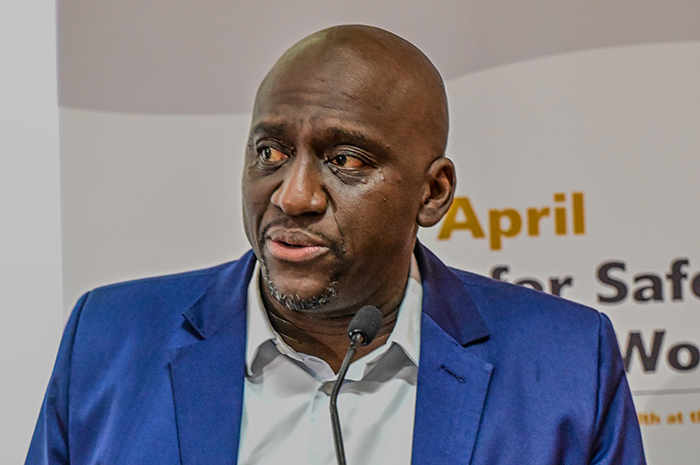
Delivering the opening and welcome address, Matsiababa Motebele, Unisa’s Vice-Principal of Operations and Facilities, reaffirmed the university’s commitment to safer and healthier workplaces. He emphasised that workplace safety must be understood beyond physical terms to psychological wellbeing as it is equally perilous. Motebele further noted that toxic work environments can erode trust, limit creativity and weaken institutional effectiveness.
He further condemned conventional approaches that reduce safety and health to compliance checklists and policy frameworks. Motebele framed organisations as complex, interconnected systems where failures are often entrenched in unmeasured workloads, unmodelled pressures and a tendency to design systems around human limits rather than for them. He asserted that human being, like physical systems, fail when they are pushed beyond their limits. "High performance environments," Motebele argued, "must account for human endurance, adaptability and recovery, which are factors that most organisations have historically overlooked."
For him, good psychological working environments require intentional design. Motebele explained: "This includes engineering workflows that reduce burnout, fostering cultures that promote psychological safety, and building resilient systems that support employees holistically." He also remarked that for Unisa, this involves actively rethinking institutional conditions, aligning digital transformation with human-centred design, embedding psychological wellbeing as core infrastructure, and ensuring that leadership acts as a stabilising force.
Additionally, Motebele highlighted that the focus must shift from a mere operational capability to optimal configurations that support human health. He elaborated: "When employees feel heard, validated and mentally supported, they are more likely to contribute meaningfully; thus, driving innovation and organisational strength." Motebele added: "Research within the university reflects this approach through integrated support systems and digital environment frameworks designed to structure work more sustainably."
He also reminded attendees that safety is a system outcome reflected in how work is designed, time is managed and human limits are respected. With an estimated 2.3 million lives lost annually to work-related causes, Motebele mentioned that alongside invisible challenges such as burnout and disengagement, there is an urgent need to prioritise psychological wellbeing. He continued that investing in psychological wellbeing is an ethical and strategic process, further enabling universities to thrive in an era of rapid change.
The discussion highlighted that safety should not be reduced to regulatory compliance, but it should instead be understood as an outcome of well-designed systems that prioritise human capacity, recovery and resilience.
Other speakers also emphasised that modern workplace safety frameworks are built on the resilience and advocacy of past generations, making it essential to continue advancing these efforts in contemporary contexts.
Simphiwe Mabhele
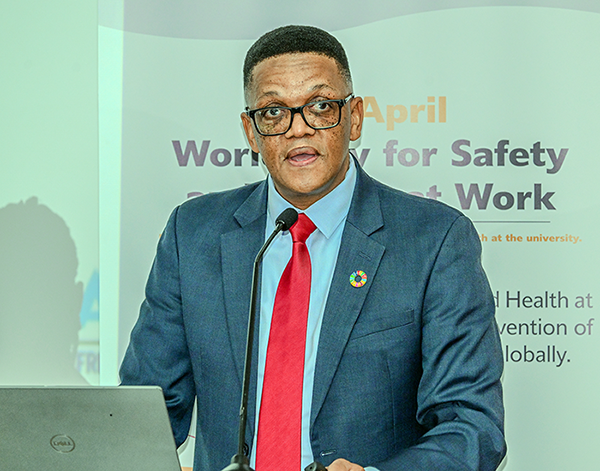
Keynote speaker, Simphiwe Mabhele, ILO’s Technical Specialist on Health and Wellness for East and Southern Africa, reinforced the global relevance of the theme, and he highlighted the need for countries and institutions to adopt integrated approaches to occupational health.
Mabhele also noted that mental health challenges are increasingly becoming a leading concern worldwide, affecting productivity, workplace relationships and overall societal wellbeing. He said: "Despite the growing awareness, access to mental health support remains limited, with most individuals navigating stress and psychological strain without adequate assistance."
Additional contributions from other guest speakers expanded on ideas around occupational safety and health. They addressed issues such as digital fatigue, workplace culture, leadership responsibility and the importance of accessible support systems. Moreover, Zielly Twala, Key Account Manager at First National Bank, presented on financial literacy, providing attendees with strategies to address financial challenges.
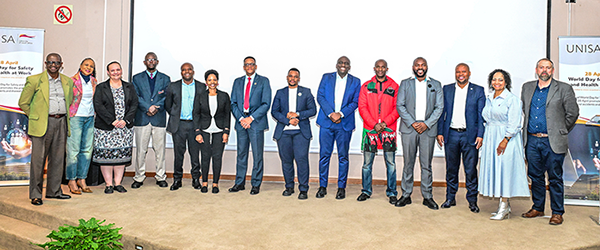
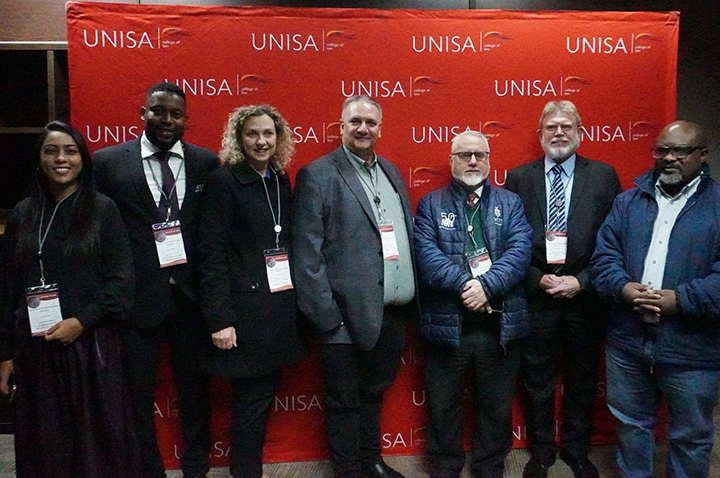
Dignitaries at Unisa's World Day for Safety and Health at Work
In their addresses, the guest speakers accentuated a persistent message that "prevention is key". Line managers were also cautioned to identify risk factors to safe and healthy workspaces, such as unrealistic workloads, unclear roles and exclusionary environments. They maintained that identifying such would enable universities to intervene before problems escalate.
The presentations also spotlighted that the creation of safe spaces include open dialogues where employees feel comfortable discussing challenges without fear of judgment. They further emphasised that leadership plays a crucial role in shaping workplace environments. Accordingly, they urged leaders to lead by example through their actions, communication, promoting balance, decision-making and modelling healthy behaviours by demonstrating empathy to foster a culture of trust and openness.
Nonetheless, the discussions highlighted that responsibility does not rely solely on leadership, but every individual within the organisation must contribute to the overall safe and healthy environment. Effortless actions such as supporting colleagues, communicating respectfully and prioritising self-care were mentioned as means to collectively create a healthier workplace.
In conclusion, participants were encouraged to reflect on a fundamental question: Are we creating workplaces where people are merely coping, or where they are truly thriving? The event demonstrated that achieving safe and healthy workplaces go beyond policies to a mindset shift. By prioritising psychosocial wellbeing, institutions can build resilient systems that support both individuals and organisational success.
* By Lesego Chiloane, Journalist, Department of Institutional Advancement
** Photography by the Unisa Multimedia Centre
Publish date: 2026-05-05 00:00:00.0
 Unisa project empowers the community through digital skills training
 Unisa workshop empowers nearly 2 000 students for the world of work
 Unisa drives community-centred water sustainability dialogue
 Unisa advances clinical legal education and meaningful access to justice
 Unisa Midlands commemorates Freedom Day