
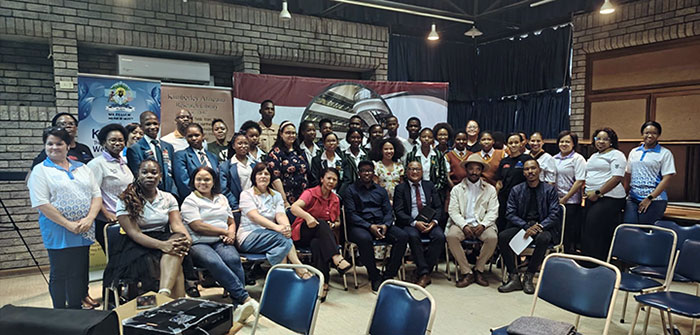
Attendees at the community engagement event
On Thursday 26 March 2026, Unisa Library and Information Services (LIS), in collaboration with the Kimberley Public Library, hosted a literacy-focused community engagement to help address South Africa’s declining reading culture and to promote the use of indigenous languages in reading and writing.
The event formed part of South African Library Week, held under the national theme "Reclaiming Knowledge, Empowering Futures". Stakeholders used the platform to highlight concerns about learners’ poor reading comprehension, the underutilisation of library services, and the limited promotion of indigenous languages in the education and publishing sector.
The programme was facilitated by Letitia Lekay, the Unisa Midlands Regional Library Manager, who welcomed the participants and emphasised the value of partnerships between academic institutions and public libraries in broadening access to knowledge.
Lekay emphasised that Unisa’s partnership with the Kimberley Public Library continues to play a vital role in supporting students in the region by providing access to study spaces, internet connectivity and library resources.
In her opening address, Maanda Hough, Manager: Libraries (Kimberley), reminded attendees that libraries remain freely accessible public resources, yet are often overlooked by the very communities they serve.
"The information is yours; the libraries are yours," Hough stated, encouraging learners and community members to take ownership of library spaces and make full use of the learning materials available to them.
The speakers also noted that although libraries offer free access to books, research tools and educational support, many young people still do not use these facilities regularly. This lack of engagement contributes to declining reading habits and limited exposure to literature.
Presenting the event's purpose, Calvin Mosekare from Unisa’s Department of Art and Music outlined the university’s commitment to promoting literacy beyond formal learning environments. He introduced the Unisa Midlands Book Club, describing it as a long-term initiative aimed at encouraging consistent reading, meaningful conversations and knowledge-sharing within communities.
Mosekare emphasised that literacy development must also include reading and writing in indigenous languages, arguing that language is central to cultural identity and enhances comprehension.
Offering a message of support, the Chairperson of the Unisa Midlands Regional Representative Council, Katlego Motepe, encouraged learners to view libraries as essential tools for academic development and personal growth.
Motepe said reclaiming knowledge begins with building a strong reading culture and actively participating in educational spaces that empower communities.
The keynote address was delivered by acclaimed author Sabata-Mpho Mokae, who challenged the dominance of English in education and publishing. Mokae argued that African writers often lose cultural meaning and authenticity when required to translate their ideas into English.
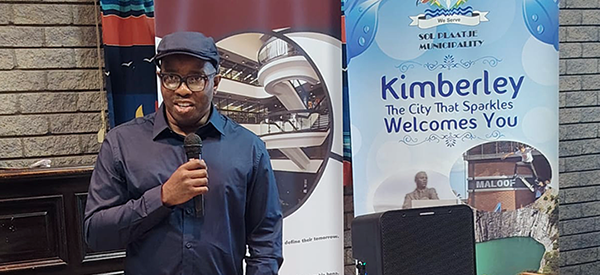
Keynote speaker Sabata-Mpho Mokae
"Languages see the world differently," Mokae said, urging aspiring writers to embrace indigenous languages as powerful vehicles for storytelling and self-expression.
He further shared that his decision to write in Setswana expanded his reach internationally, demonstrating that writing in one’s mother tongue does not limit global recognition.
Also speaking at the event, Prof Victor Teise encouraged community members to write and publish in Afrikaans, emphasising that languages can only grow when they are actively used in literature and creative writing.
Both speakers expressed concern about the ongoing decline in learners’ reading comprehension, describing it as a national challenge that requires sustained and coordinated intervention.
Learners from various schools in Kimberley participated in readings and discussions, demonstrating enthusiasm while also revealing the need for stronger foundational literacy support. This involvement reinforced the importance of creating platforms where young people can confidently engage with literature in both English and their home languages.
While the event reaffirmed libraries' role as inclusive community knowledge hubs, stakeholders cautioned that its long-term impact would depend on continued engagement beyond South African Library Week.
Without consistent reading habits, greater support for indigenous languages and increased community participation, efforts to improve literacy may remain symbolic rather than transformative.
As South Africa continues to grapple with educational inequality, initiatives such as the Unisa Midlands Book Club are expected to contribute to lasting change by encouraging communities to return to libraries – not only as places of access, but as spaces of empowerment, learning and sustained growth.
* By Itumeleng Mpete, Marketing Coordinator, Library and Information Services
Publish date: 2026-04-10 00:00:00.0
 Masterclass unpacks the power of glocalisation in global marketing
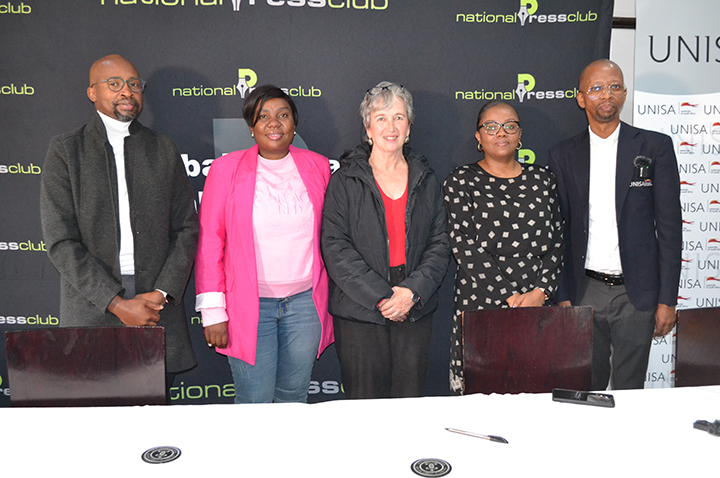 Unisa and NPC expand partnership to promote the journalism profession
 Unisa's renowned scholars nominated for South Africa's Science Oscars
 Unisa celebrates the life and legacy of Miriam Makeba
 Unisa seminar examines cultural knowledge and language as key ingredients of ubuntu