

Image: Times Higher Education
Led by Prof Puleng LenkaBula, Principal and Vice-Chancellor, a Unisa delegation recently participated in the Times Higher Education (THE) Africa Universities Summit in Nairobi, Kenya. Held on 30 and 31 March, and themed Powering Africa’s future through talent development, innovation and inclusion, the summit brought together delegates from more than 150 organisations and universities across the continent.
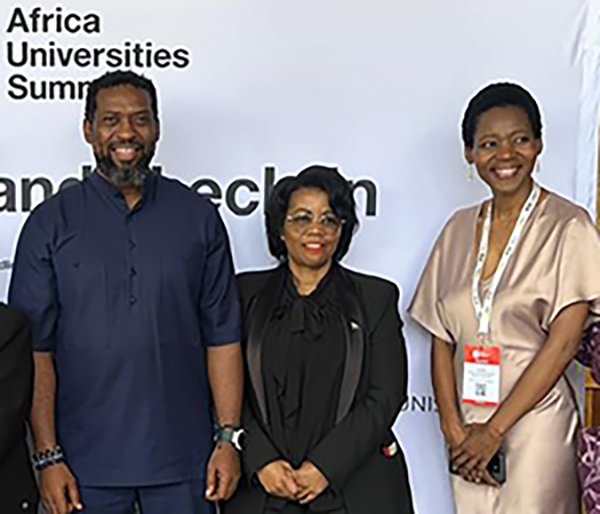
At the summit: Prof Puleng LenkaBula, Unisa Principal and Vice-Chancellor (centre), flanked by the Honourable Buti Manamela, Minister of Higher Education (left) and Prof Puleng Segalo, incumbent of the Chief Albert Luthuli Research Chair at Unisa (right)
Delivering the keynote address at a panel discussion titled Harnessing Africanisation, internationalisation and decolonial knowledges for emancipatory and global impact, Prof Puleng LenkaBula, Unisa Principal and Vice-Chancellor (VC), said that as an institution dedicated to the advancement of science, knowledge, innovation and the formation of progressive global citizens, Unisa stands at the forefront of a transformative agenda that emphasises Africanisation, internationalisation and the decolonisation of knowledge production.
"The global order is shifting," she continued, "due to geopolitical instability, weakened multinational norms and intensified competition. Africa is increasingly exercising agency in shaping its own future. Universities play a decisive role in defining Africa’s intellectual, ethical, and developmental direction."
Discussing Africa’s rapid rise in knowledge production, the VC said that the core challenge is translating knowledge into impact. "Research is not yet driving large-scale transformation," she continued, "and only 1,5% of African research involves industry collaboration. A further challenge is that our historical institutional architectures were designed for extraction and not innovation."
LenkaBula proposed five strategic shifts for transforming Africa’s knowledge systems:
She said that African universities must produce ethical, critically conscious citizens. "Knowledge must advance justice, sovereignty, prosperity, and global influence," she noted in conclusion. "Africa must 'think and do together' to shape a future defined by African agency and innovation."
In her reflections on a panel focusing on the Africa Charter, Prof Puleng Segalo, incumbent of the Chief Albert Luthuli Research Chair at Unisa, highlighted how the Charter initiative begins from the recognition that colonial legacies and neo-colonial funding structures have long shaped African research.
"Collaborations have too often been extractive," she emphasised, "with African institutions serving as sites of data collection, while intellectual authority, authorship and agenda-setting remain concentrated in the 'Global North'. This imbalance perpetuates epistemic injustice and undermines Africa’s ability to define its own research priorities."
Segalo further asserted how, with the Charter, collaboration is framed as a site of struggle over epistemic power. "True transformation requires not just the inclusion of African scholars, but a restructuring of the very terms of collaboration," she continued. "In this way, the dominant modes of short-term, donor-driven projects can be challenged."
In conclusion, she pointed out that the Charter calls for sustainable ecosystems of knowledge rooted in African priorities.
Prof Mpho Ngoepe, Acting Vice-Principal of Research, Postgraduate Studies, Innovation and Commercialisation at Unisa, served as a panellist in a workshop discussion titled Interdisciplinarity as the new fabric of higher education.
Panellists unpacked the complex challenges of today’s world - from climate change to public health and technological disruption - that demand solutions that cross traditional academic boundaries.
This breakout workshop explored how African universities can embed interdisciplinarity as a core feature of teaching, research and innovation. Participants examined institutional models, leadership practices and collaborative frameworks that foster interdisciplinary culture and impact, building a collective roadmap for the universities of the future.
Read also:
Unisa a leading presence at Africa Universities Summit
* Compiled by Philip van der Merwe, Editor, Department of Institutional Advancement
Publish date: 2026-04-08 00:00:00.0
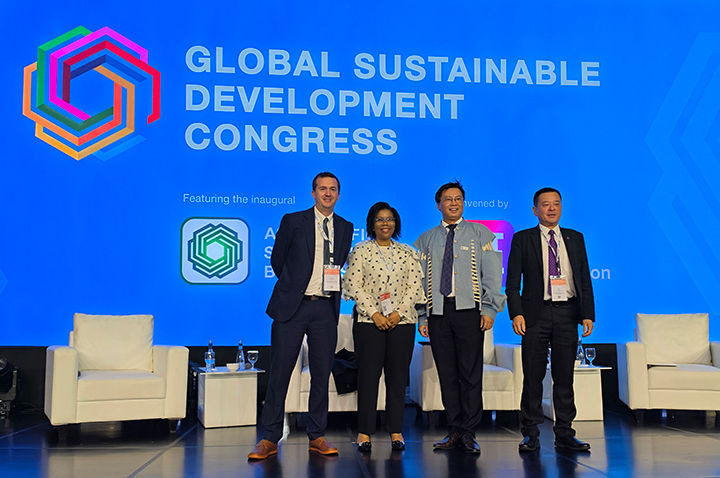 Prof LenkaBula brings African scholarship and women's leadership to global sustainability dialogue
 Unisa welcomes new Ethiopian postgraduates and hosts experience-sharing session
 Completing study tasks early reduces last-minute pressure, says RSRC graduate
 Outgoing Limpopo RSRC members lead by example
 Resilience beyond the finish line