

The African college of excellence in the social and human sciences
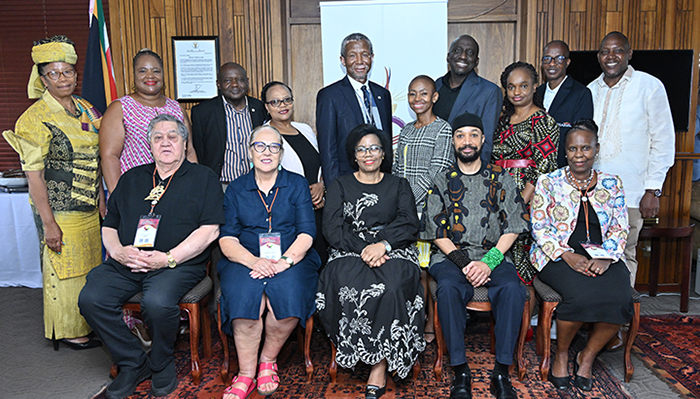
Prof Puleng LenkaBula (seated, centre) with Unisa's senior management and the 2026 Decoloniality Summer School's international keynote speakers
On 15 January 2026, Unisa’s Principal and Vice-Chancellor (VC), Prof Puleng LenkaBula, held a brief meeting with esteemed international keynote speakers of the 2026 Unisa Decoloniality Summer School, aimed at underscoring the global significance of decolonial scholarship and its implications of transforming higher education.
The speakers that the VC and Unisa’s senior management met with included Prof Graham Hingangaroa Smith of Massey University in New Zealand, Prof Linda Tuhiwai Smith of Te Whare Wānanga o Awanuiārangi, an indigenous institution of higher learning in New Zealand, and Prof Reiland Rabaka of the University of Colorado Boulder in the United States of America.
This year’s summer school, which was spearheaded by the College of Human Sciences, was themed "Decolonising the classroom: From epistemic critique to transformation practice". This annual event brings together academics, intellectuals and postgraduate students from the globe to rigorously interrogate decolonial theory and practice within contemporary higher education contexts.
Kelebamang Mokgupi, Head of the Decoloniality Summer School Organising Committee, indicated that this year’s theme highlighted the need to transform the curriculum, training and institutional culture within higher education.
During the meet-and-greet, LenkaBula highlighted key aspects, such as transforming institutions, decolonising methodologies, and the importance of valuing anthropology, epistemic processes and knowledge systems in universities. For her, these aspects would ensure that languages, philosophies and the sciences are not just spoken about, but are a part of the fabric of life, the laws, economy, as well as the higher education systems.
Further, the discussion unpacked the importance of sustained scholarly dialogue between academics and public intellectuals globally, particularly in addressing historical injustices and reimagining knowledge production in the Global South.
The VC also expressed gratitude to the speakers for their participation, and acknowledged their long-standing scholarly and societal impact. "Your presence here is a reignition to our commitment to social justice, to strengthen institutions that serve society, and ensure that the most marginalised are heard," she said.
The meeting reaffirmed Unisa’s commitment to advancing decolonial scholarship and maintaining global intellectual collaboration in pursuit of transformative education.
* By IHlubi Veli Mabona, Marketing Assistant, College of Human Sciences, and Victor Malatji, Communication Intern, Department of Institutional Advancement
Publish date: 2026-01-20 00:00:00.0

 Minister Manamela calls for systemic reset of South Africa's PSET sector
 Three Unisa women putting science, research and innovation into action
 From preserving knowledge to shaping the future: Unisa Press and LIS mark 150 years of collective impact
 Supporting success: How Unisa's PRG helped Babalwa Ramncwana take the next step in her academic journey
 Wisdom that connects generations: Unisa celebrates its senior citizens