

The African college of excellence in the social and human sciences
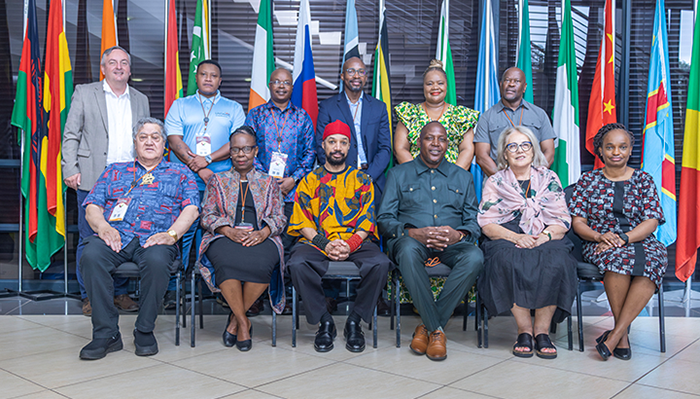
Front row (from left): Prof Graham Smith, Prof Bagele Chilisa, Prof Reiland Rabaka, Prof Thinandavha Mashau, Prof Linda Tuhiwai Smith and Prof Nampombe Saurombe
Back row (Unisa representatives from left): Prof Wessel Bentley, Paseka Pharumela, Prof Omwoyo Bosire Onyancha, Prof Siyasanga Tyali, Kelebamang Mokgupi and Prof Mokhele Madise
Unisa held the official opening of the 12th Decoloniality Summer School on 12 January 2026, led by the College of Human Sciences (CHS), under the theme Decolonising the classroom: From epistemic critique to transformative practice. Held at Unisa’s Muckleneuk Campus (Kgorong Building), the week-long event reaffirms the university’s standing as a leading global hub for critical engagement on decolonial thought, curriculum transformation, and African-centred knowledge systems.
Over the years, the Decoloniality Summer School has grown into a vibrant intellectual gathering that attracts scholars, practitioners and students from across the world. Its 12th edition marks not only continuity, but also a deepening commitment to moving decoloniality from theory into lived pedagogical and institutional practice.
A defining feature of the 2026 summer school is its deliberate foregrounding of Global South voices, reflected in an exceptional lineup of scholars, such as Prof Linda Tuhiwai Smith (Te Whare Wānanga o Awanuiārangi) as the keynote speaker, Prof Bagele Chilisa (University of Botswana), Prof Reiland Rabaka (University of Colorado Boulder), Prof Nampombe Saurombe (Unisa) and Prof Graham Smith (Massey University, New Zealand).
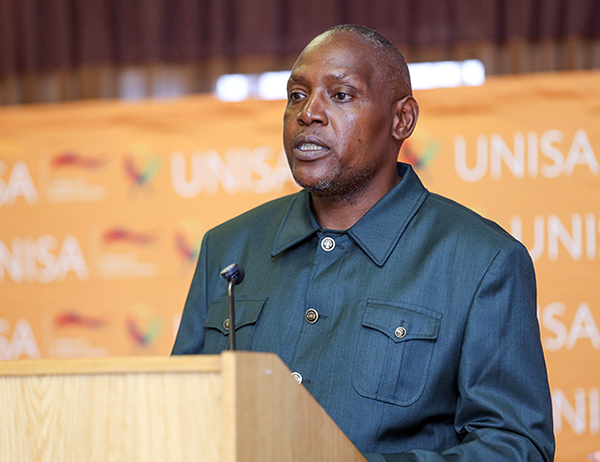
Prof Thinandavha Mashau
Delivering the welcome address, Prof Thinandavha Mashau, CHS’s Deputy Executive Dean, expressed profound excitement at hosting this event. He described the summer school as a global theatre of ideas, creativity, innovation and a space where some of the world’s most influential decolonial scholars engage critically among themselves and with participants.
Mashau said: "As we grapple with the thorny and multi-layered concept of decoloniality, we are reminded that this engagement is not abstract. It is about transforming what we teach, how we teach, and, ultimately, how we imagine ourselves and our futures." His address framed decoloniality not as a passing intellectual trend, but as a necessary, ongoing struggle for epistemic justice and human dignity.
Mashau also cited a Tshivenda proverb Mueni a songo hwalaho, zwa maramani u nazwo, a reminder that even when guests arrive without material gifts, they bring invaluable wisdom to share. The proverb captured the spirit of intellectual generosity and collective learning that defines the summer school.
Reaffirming Unisa’s identity as the university of the land, Mashau highlighted the institution’s leadership under Principal and Vice-Chancellor, Prof Puleng LenkaBula. He underscored the university’s pioneering role as Africa’s leading distance education institution and its broader mission Towards an African university shaping futures in the service of humanity.
Beyond access and scale, Unisa’s commitment lies in advancing decolonisation, Africanisation and transformation not as slogans, but as concrete institutional and curricular practices. Reflecting on the evolution of the summer school, Mashau also called for a curriculum that is Afrocentric, linguistically just, socially responsive and epistemically liberated, and one that aligns with continental and global frameworks, such as the Africa Agenda 2063, the United Nations’ Sustainable Development Goals, and South Africa’s National Development Plan, while centring social justice.
Further, Mashau affirmed that true liberation (Uhuru) remains impossible while English dominates as the primary language of teaching and learning, resulting in linguistic injustice and the erosion of African languages. "There must be a decisive shift from producing job seekers to nurturing entrepreneurial, innovative graduates capable of navigating complex global realities," he added.
Drawing inspiration from liberation movements such as the Fees Must Fall, Rhodes Must Fall, and Black Lives Matter, Mashau cautioned against symbolic transformation that leaves underlying power structures intact. He asserted: "Our curricula must confront racism, gender-based violence, and the enduring legacies of colonialism and apartheid."
Pointing out the challenges and opportunities of the Fourth and Fifth Industrial Revolutions, Mashau argued that Africa must reject the role of passive consumer of Western technological agendas. For him, initiatives such as CHS’s Advancing African Digital Humanities, exemplify how technology can be critically harnessed to advance African-centred scholarship and decolonial praxis.
Additionally, Mashau highlighted the enduring importance of Indigenous Knowledge Systems, noting how the Covid-19 pandemic exposed limitations within Western medical hegemony while reaffirming the relevance of African healing practices, including the use of lengana (Artemisia afra) and other indigenous remedies. Therefore, Mashau urged scholars and institutions to never apologise for advancing decoloniality and Africanisation. Quoting Walter Mignolo’s work, he reminded participants that while decoloniality cannot ignore the West, it is no longer compelled to obey it.
He said: "Decolonial scholars must help us not only to unthink the West, but to recentre Global South epistemologies and draw from our own wells." He concluded: "Vho tanganedzwa, mi amukeriwile. Ri a le amogela, karibu", affirming the inclusive, Pan-African spirit of the summer school.
* By Khabo Maduna, Communication and Marketing Specialist, College of Human Sciences
Publish date: 2026-01-16 00:00:00.0

 Reclaiming African heritage through geographical names
 From research to real-world impact: Unisa-linked project explores new ways to advance LGBTQIA+ rights
 Unisa hackathon winners develop AI solution to support students at risk of falling behind
 Beyond Black Wednesday: Unisa lecture calls for urgent action to protect media freedom and public broadcasting
 Unisa celebrates 25 new PhD graduates advancing research and innovation