

The African college of excellence in the social and human sciences
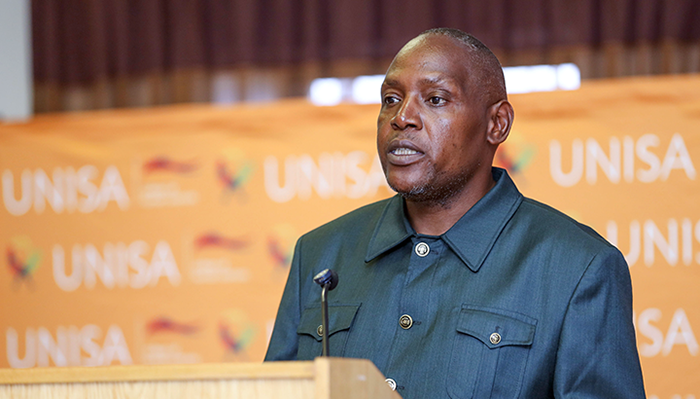
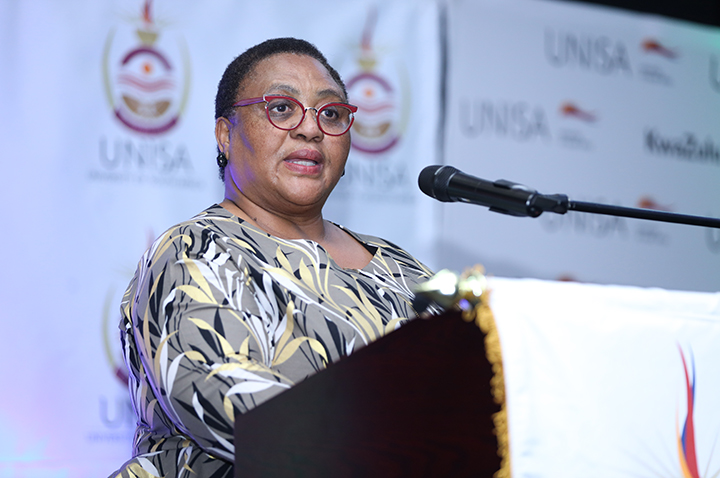
Prof Thinandavha Mashau
Themed "Decolonising the classroom: From epistemic critique to transformative practice", Unisa kick-started the 2026 academic year with the 12th Decoloniality Summer School from 12 to 16 January 2026, immersing students, scholars and researchers in critical debates on transforming knowledge production, curriculum design and institutional culture from decolonial perspectives. This annual event is spearheaded by the College of Human Sciences (CHS). The theme’s focus on praxis/practice highlights the importance to apply what has been absorbed as theory in a manner that interrogates its transformative, relational and centredness on collective wellbeing, among others.
In his opening address, Prof Thinandavha Mashau, CHS’s Deputy Executive Dean, reflected on the summer school from its inception in 2014, acknowledging it as a key intellectual platform in Unisa’s transformation agenda. He situated the 2026 edition as a space for theoretical engagement and practical reflection on how participants could reshape their teaching, research and institutional practices in the year ahead.
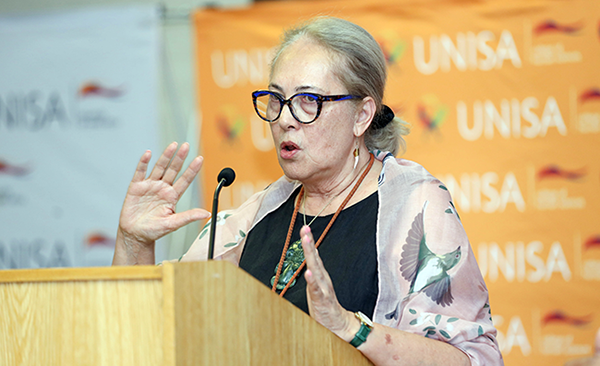
Prof Linda Tuhiwai Smith
Prof Linda Tuhiwai Smith, an influential and internationally recognised Māori scholar from Te Whare Wānanga o Awanuiārangi in New Zealand, delivered the keynote address, drawing on her groundbreaking work on indigenous methodologies. She explored research practices that move beyond Western paradigms and resist racism and exploitation.
Her presentation exposed attendees to a broad range of case studies involving indigenous communities, offering examples of how research can be conducted ethically, collaboratively and in ways that affirm local knowledges. Participants engaged deeply with her reflections on intergenerational trauma, leaving with acute understanding of how historical injustice continues to shape contemporary communities, and how scholarship can contribute to healing rather than harm.
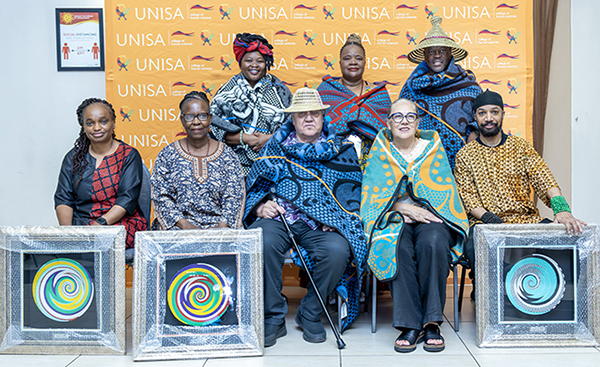
Back row (from left): Mabafokeng Hoeane, Kelebamang Mokgupi and Prof Mokhele Madise (Director of the School of Humanities, Unisa)
Front row (from left): Prof Nampombe Saurombe, Prof Bagele Chilisa, Prof Graham Smith, Prof Linda Tuhiwai Smith and Prof Reiland Rabaka
Over the course of the week, a series of high-level lectures equipped attendees with conceptual and practical tools to decolonise the curriculum, pedagogy and institutional structures.
Reiland Rabaka, Professor of African, African American, and Caribbean Studies from the University of Colorado in Boulder, used the image of the Sankofa bird to offer a critical and artistic meditation on decolonising the curriculum and the classroom. Emphasising "Aluta continua", he linked decolonisation, re-Africanisation and African renaissance, prompting participants to reimagine their teaching as part of a broader, ongoing struggle for justice.
Prof Bagele Chilisa, a post-colonial scholar from the University of Botswana, spoke on "Decolonising university disciplines", and guided attendees through approaches that integrate established research methods using African research methodologies. By foregrounding African epistemologies and languages as assets, she offered strategies for theorising new concepts, reshaping disciplines and designing context-responsive research.
Prof Nampombe Saurombe, Unisa’s acting Chair of the Department of Information Science, highlighted archives as catalysts for educational transformation. She further encouraged participants to view them not as static repositories but as living resources that bridge community knowledge and university learning. Participants gained insights into how archival practices can support decolonisation of both the curriculum and classroom.
Additionally, Graham Smith, a Distinguished Professor from Massey University in New Zealand, who is regarded as a champion for indigenous knowledge, focused on institutional transformation and the rise of indigenous universities. Drawing on New Zealand’s models, he provided illustrations of how institutions can structurally embed indigenous knowledge systems, inspiring attendees to rethink the long-term transformation of African universities. These academic engagements provided participants with a rich toolkit, ranging from theory to methodology, and institutional design relevant to integrate in teaching, research, and postgraduate work going forward.
The 2026 Unisa Decoloniality Summer School also prioritised interactive learning through decoloniality workshops designed to move beyond abstract discussion. Facilitated by Leon Roets from Unisa’s Department of Sociology, the workshops guided attendees through structured introspection of their own practices, asking which unjust approaches they would consciously exclude and which decolonial practices they would adopt and implement in their classrooms, research projects and institutional roles.
Participants reported that these sessions helped them translate the lectures into actionable plans. Most of them formulated commitments for curriculum reform, supervision practices and community-engaged research, reinforcing the summer school’s role as the academic launchpad for the year ahead.
A special session chaired by Mabafokeng Hoeane, Unisa’s Researcher at the Chief Albert Luthuli Research Chair, invited participants to reflect on the life and work of Prof Ngũgĩ wa Thiong’o, with particular emphasis on his enduring influence on decolonial thought. Tribute reflections were presented by representatives from various institutions, such as Dr Daniel Rankadi Mosako (Unisa), Harry Kapatika (University of Johannesburg), keynote speaker Smith, Tirivashe Jele (United Kingdom), and Prof Munyaradzi Mushonga (University of the Free State).
Each contributor linked Ngũgĩ’s theoretical and ideological perspectives to their respective fields, demonstrating how his ideas on language, culture, and decolonisation continue to shape contemporary scholarship. Attendees appreciated how literary, cultural, and political theory can inform academic practice.
Reflecting on the week-long event, Mante Mphahlele from Unisa’s Department of English Studies, spoke on transforming the curriculum using the full suite of lectures presented at the summer school. Highlighting Unisa as a comprehensive open distance e-learning university, she argued that the institution is well placed to forge a new academic and institutional culture rooted in the Sankofa principle of moving forward while critically engaging with the past.
Her reflection emphasised that curriculum transformation involves discerning what should be dismantled from the past, what can be retained and what must be reshaped. She urged attendees to imagine the curriculum as a repaved academic pathway, with each brick inscribed with the dual memory of where we come from and where we are going as an uncolonised society with a refined African identity.
For participants, this provided a conceptual roadmap for their 2026 teaching and research plans, helping them align course design, supervision, and scholarly output with decolonial principles.
Closing the summer school, Mashau expressed appreciation for the support of Unisa Principal and Vice-Chancellor (VC) Prof Puleng LenkaBula and CHS’s deanery. He highlighted a recent meet-and-greet between the VC and the event’s presenters, which strengthened inter-institutional relationships and opened pathways for collaboration on science, economic thought and postgraduate supervision grounded in indigenous approaches.
Mashau mentioned that Unisa is committed to transforming the curriculum, classroom and institution at large. He stressed that the Decoloniality Summer School’s discussions on "Ubuntufication" of a revolutionary curriculum in the Global South will shape how, why and for whom universities teach. Importantly, he reassured participants that CHS is committed to auditing current offerings and advancing decolonisation and Africanisation to ensure that the summer school is not reduced to a mere talk shop. Mashau concluded by appreciating the organisers and contributors whose work made the event a success.
* By Dr Daniel Rankadi Mosako, acting Chair of the Department of Art and Music, and Kelebamang Mokgupi, Office for Tuition and Learner Support, College of Human Sciences
Publish date: 2026-01-20 00:00:00.0
 Too few vets, too many outbreaks: South Africa's FMD challenge
 Unisa sparks critical conversation on South Africa's unfinished land question
 From Unisa graduate to global fraud intelligence investigator
 Studying at Unisa was the right decision
 More than a game: Unisa is building health, teamwork and lasting connections through sport