

The largest provider of business education in Africa and one of the largest in the world
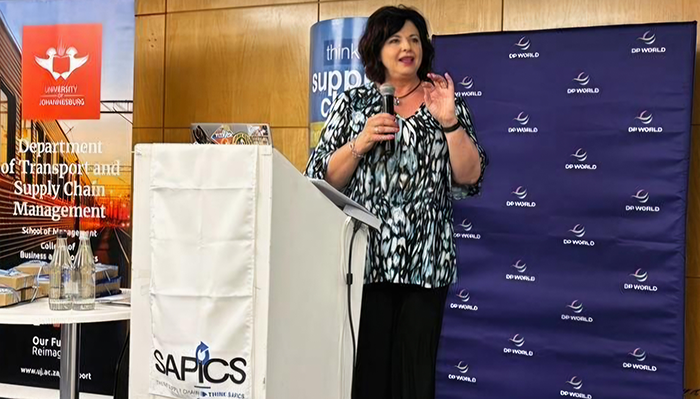
Prof Orpha Cilliers speaking at the conference
Prof Orpha Cilliers from the Department of Applied Management in the College of Economic and Management Sciences at Unisa served as a speaker at the recent SAPICS Young Professional and Student Conference, hosted by the University of Johannesburg.
The conference featured multiple academic and industry speakers who addressed various aspects of professional and technical development within the supply chain sector. Cilliers was the only representative from Unisa invited to contribute to the programme.
The conference brought together students, academics and industry professionals to engage on the future of supply chain management and the professional realities facing emerging graduates entering an increasingly competitive working environment.
Hosted by SAPICS, in collaboration with the University of Johannesburg at the University of Johannesburg Business School auditorium, the conference focused on strengthening both technical supply chain competencies and the broader professional capabilities required within industry. Industry representatives and academic leaders collectively emphasised the importance of preparing students not only with disciplinary knowledge, but also with the professional behaviours, and interpersonal and digital competencies expected within modern organisations.
Bennitta Senyatsi from DP World discussed employability and professional visibility in a competitive labour market, while Priscilla Leigh focused on communication and public speaking as leadership competencies. Sanjay Saha and Dr Andrew Brown explored professional coaching in supply chain careers, Steff Boyd from Switch Recruit addressed CV and interview preparation, Ayanda Ngcongo from Slimstock examined digital transformation within supply chains, and Khumo Mosathupa from Blu Trans reflected on his professional journey within the industry.
Dr Sebonkile Thaba, Deputy Head of Department: Teaching and Learning in the Department of Transport and Supply Chain Management at the University of Johannesburg, played an important role in hosting and supporting the conference as part of the department’s ongoing commitment to industry engagement and student development within the supply chain discipline. Her contribution reflected the University of Johannesburg’s emphasis on integrating academic development, digital competencies and industry relevance in preparing students for the evolving demands of contemporary supply chain environments.
Within this broader programme of specialist presentations and industry engagement, Cilliers delivered a lecture titled "Professionalism starts now: From student life to professional reputation", which aligned strongly with the conference objective of preparing students for sustainable professional success within the supply chain sector. Her presentation challenged the common perception that professionalism begins only after graduation or is primarily associated with appearance, confidence or seniority. Instead, she argued that professionalism develops progressively through consistent behaviour, accountability, responsibility and interpersonal conduct during student life itself. The presentation emphasised that professional identity is formed long before formal employment and that students actively shape their future professional reputations through their everyday actions and interactions.
Cilliers further explored professionalism through several interconnected dimensions, including reliability, responsibility, initiative, interpersonal skills and ethical behaviour. Students were encouraged to recognise the importance of meeting commitments, taking initiative, communicating respectfully and demonstrating integrity in both academic and professional contexts. Emphasis was placed on the development of professional trust, which was presented as a process built through consistency, dependability and sound professional judgement over time. A central contribution of the presentation was the conceptual framing of professionalism as the integration of competence, conduct and composure. Cilliers demonstrated that technical knowledge alone is insufficient for long-term professional success and that effective professional judgement emerges when expertise is combined with ethical conduct, professional composure and responsible decision-making under pressure. Particular attention was also given to the realities of contemporary supply chain environments, where professionals are often required to respond to disruptions, uncertainty and interpersonal challenges while maintaining professionalism, composure and sound judgement.
"In professional environments, people are remembered not only for what they know, but for how consistently they respond, support others and conduct themselves under pressure," said Cilliers. "Professional credibility is developed through everyday interactions and the ability to build trust with those around you."
Students were encouraged to recognise that professionalism requires moving beyond self-focused behaviour towards responsibility, collaboration and consideration for others within professional environments. She also highlighted the importance of professional relationships and the role of respectful communication and collaboration in establishing credibility and trust within organisations.
The presentation concluded with a strong reflective message encouraging students to critically consider how their current attitudes, behaviours and responses contribute to their developing professional reputations. Students were reminded that professionalism is demonstrated through preparation, accountability, responsiveness and consistent professional behaviour rather than through qualifications alone.
Cilliers’ participation added significant value to the conference by connecting academic perspectives on professionalism with the practical realities of industry expectations. Her contribution reinforced Unisa’s commitment to developing graduates who are professionally prepared, ethically grounded and capable of contributing meaningfully within complex organisational environments.
The SAPICS Young Professional and Student Conference further highlighted the importance of collaboration between higher education institutions, professional bodies and industry stakeholders in preparing future supply chain professionals. Through its participation in the conference, Unisa strengthened its engagement with the broader professional supply chain community while contributing to important conversations surrounding graduate employability and professional readiness.
The lecture formed part of the broader Supply Chain Management MiniMaster Classes, a registered Engaged Scholarship project, presented in partnership between Unisa and SAPICS. The project leadership team includes Cilliers, Dr Alicia Weber and Dr Themari Grebe. Participation in the conference further reflected the established collaborative relationship between the project and SAPICS. SAPICS is a leading professional body dedicated to elevating, educating and empowering the supply chain community across South Africa and the African continent. As a registered non-profit organisation, the organisation reinvests its resources into the development of individuals and organisations within the supply chain management profession.
* By Letitia Marcantuono, Lecturer, Department of Applied Management, and Prof Orpha Cilliers, Department of Applied Management
Publish date: 2026-05-28 00:00:00.0
 Prof LenkaBula brings African scholarship and women's leadership to global sustainability dialogue
 Unisa welcomes new Ethiopian postgraduates and hosts experience-sharing session
 Completing study tasks early reduces last-minute pressure, says RSRC graduate
 Outgoing Limpopo RSRC members lead by example
 Resilience beyond the finish line