

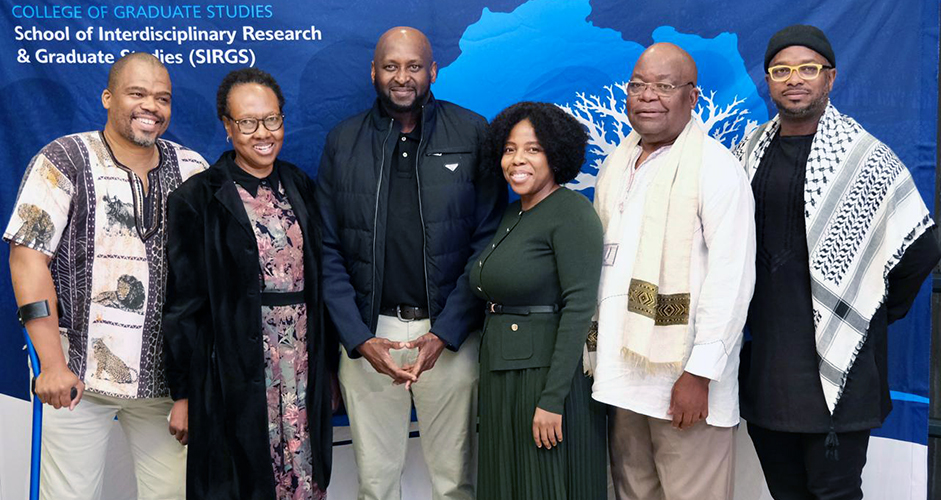
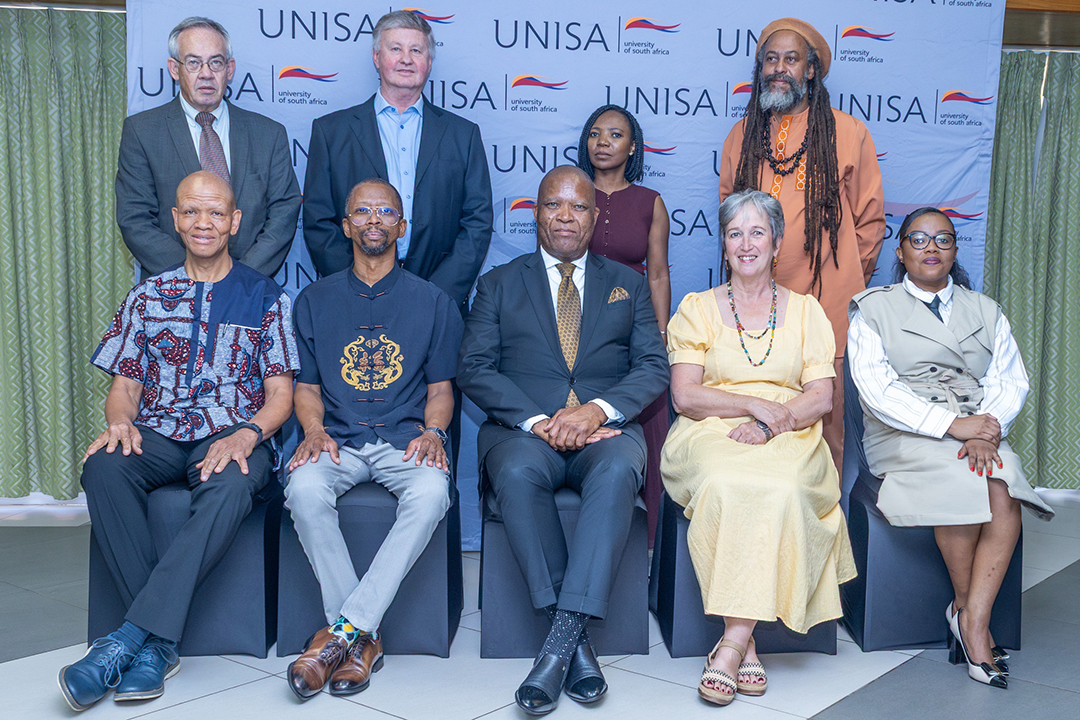
From left: Dr Tonny Matjila (SIRGS), Prof Khanyisile R Mbatha (Acting Director: SIRGS), Prof Tennyson Mgutshini (Executive Dean: College of Graduate Studies), Samu Makhanye (SIRGS), Prof Patrick Ngulube (SIRGS) and Prof Anthony Brown (SIRGS) at the seventh Indigenous Epistemologies Seminar Series.
Indigenous knowledge holders must be recognised as intellectual authorities whose expertise can contribute meaningfully to addressing poverty, inequality and some of society’s most pressing challenges.
This was the central message delivered by Prof Tennyson Mgutshini, Executive Dean of the University of South Africa's (Unisa) College of Graduate Studies (CGS), during the opening of the seventh Indigenous Epistemologies Seminar Series. Challenging the historical marginalisation of African knowledge within universities, Mgutshini argued that elders, traditional healers, farmers and other community knowledge holders should not merely be regarded as sources of information for academic research. Instead, their knowledge, developed through generations of observation, practice, memory and collective experience, deserves recognition as a legitimate form of intellectual authority.
Hosted by the School of Interdisciplinary Research and Graduate Studies (SIRGS), the 2026 seminar was held under the theme Still in our hands: Indigenous knowledge systems against poverty and inequality. The gathering brought together academics, researchers and indigenous knowledge advocates from Africa and beyond to examine how traditional knowledge systems can contribute to curriculum transformation, healthcare, environmental sustainability, conflict resolution and inclusive development. Initiated by Prof Patrick Ngulube in 2020, the seminar series has developed into a platform for advancing African epistemologies, supporting emerging scholars and encouraging critical engagement with the relationship between knowledge, heritage and social justice.
Its hybrid format enabled participation from different parts of South Africa and internationally, strengthening opportunities for dialogue across institutions and geographical boundaries. In his opening address, Mgutshini challenged participants to reconsider how universities recognise, value and engage with knowledge produced outside conventional academic institutions. He emphasised that indigenous knowledge systems are not informal collections of beliefs or practices, but bodies of knowledge developed and refined through sustained observation, experimentation, practical experience and intergenerational transmission.
These traditions have informed communities' approaches to agriculture, healthcare, environmental management and social organisation long before the establishment of modern universities. However, the contributions of indigenous knowledge holders have frequently been overlooked or treated as secondary to formally recognised academic knowledge. Mgutshini argued that genuine transformation requires universities to move beyond simply including indigenous knowledge in research projects or academic discussions.
They must also reconsider who has the authority to produce knowledge, whose contributions receive recognition and who benefits from the outcomes of research. To illustrate the distinction between equality and equity, he presented the example of a grandmother whose extensive agricultural knowledge was sought for an academic engagement. Although she was invited to share her expertise alongside a professor, she was excluded from authorship, research funding and decision-making.
The example demonstrated that providing access to academic spaces does not automatically translate into equitable participation. For Mgutshini, meaningful equity requires proper attribution, fair compensation, shared authority and access to the benefits arising from knowledge production. His message challenged researchers and institutions to develop partnerships with communities that recognise indigenous knowledge holders as collaborators rather than merely research participants.
Mgutshini also situated the seminar within South Africa's broader social and historical context. He challenged the perception that poverty is an unavoidable or natural condition, arguing that it has been shaped by historical processes, including land dispossession and linguistic exclusion. By recognising that inequality has been created and reinforced through human decisions and institutional arrangements, society can begin identifying the changes necessary to address it.
This perspective positioned indigenous knowledge as more than a cultural or academic concern. It highlighted the potential contribution of historically marginalised knowledge systems to economic participation, social inclusion and community development. Mgutshini also reflected on the importance of protecting human dignity and life. Referring to the reported discovery of nine deceased women, he called for a moment of silence and reminded participants that a society should be judged not only by what it produces, but also by how it protects its people.
His address reinforced the connection between knowledge, institutional responsibility and the pursuit of a more just society. The broader challenge, he suggested, is to ensure that universities do not reproduce the exclusions they seek to overcome. The seminar attracted contributions from scholars based in Oman, Canada, Uganda, Zimbabwe, Ethiopia and South Africa, creating opportunities to examine indigenous knowledge systems across different cultural and geographical contexts. Among the keynote speakers were Prof Sayan Dey of Bayan College in Oman, Prof Sabelo J. Ndlovu-Gatsheni of the University of Calgary in Canada, and Prof Francis Akena Adyanga of Kabale University in Uganda.
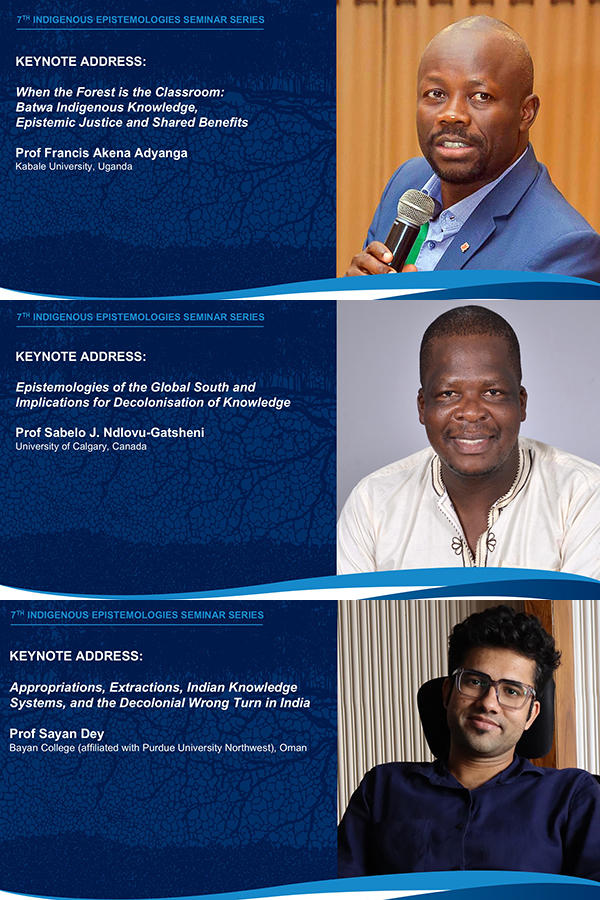
From top to bottom: Prof Francis Akena Adyanga, Kabale University, Uganda — When the Forest is the Classroom: Batwa Indigenous Knowledge; Prof Sabelo J. Ndlovu-Gatsheni, University of Calgary, Canada — Epistemologies of the Global South and Implications for Decolonisation of Knowledge; Prof Sayan Dey, Bayan College, Oman — Indian Knowledge Systems and Decoloniality.
Dr Stanley Murwira from Zimbabwe also contributed to the programme, alongside researchers from Ethiopian institutions, including Dilla University and Haramaya University. The international participation broadened discussions beyond African indigenous knowledge traditions to include experiences from India and the wider Global South. Dey’s keynote explored Indian knowledge systems and decoloniality, providing a South Asian perspective on the recognition of historically marginalised intellectual traditions.
Ndlovu-Gatsheni’s contribution, Epistemologies of the Global South and Implications for Decolonisation of Knowledge, examined broader questions surrounding knowledge production and the transformation of dominant academic frameworks. Adyanga’s presentation, When the Forest is the Classroom: Batwa Indigenous Knowledge, highlighted the educational significance of indigenous knowledge practices and the relationship between communities and their environments. These contributions demonstrated that debates about intellectual recognition, cultural heritage and knowledge justice extend beyond national boundaries.
Although indigenous knowledge traditions differ across societies, many communities share experiences of historical marginalisation and the struggle to secure recognition for their intellectual contributions. A significant feature of the seminar was its emphasis on the practical relevance of indigenous knowledge systems. Presentations examined how community-based knowledge can contribute to addressing challenges in healthcare, agriculture, environmental management, governance and conflict resolution.
Researchers from Ethiopia shared perspectives on indigenous medicinal practices and traditional approaches to resolving disputes. These contributions highlighted the importance of examining knowledge systems that have developed within communities and considering their relevance to contemporary development challenges. Presentations from Uganda, Zimbabwe and South Africa further explored the relationship between indigenous knowledge, governance, social justice and inclusive development. The discussions demonstrated that indigenous knowledge is not confined to historical preservation.
It continues to inform how communities understand their environments, manage resources, respond to social challenges and sustain cultural practices. At the same time, the seminar created opportunities for critical engagement with these traditions, including how indigenous knowledge can be documented, studied and incorporated into academic research while respecting the rights and contributions of knowledge holders. The exchange of experiences also highlighted the value of interdisciplinary research, particularly when complex challenges require perspectives from the humanities, social sciences, health sciences and environmental studies.
The seminar reinforced Unisa’s commitment to advancing African scholarship and promoting greater recognition of indigenous epistemologies within higher education. For universities, this requires more than expanding the range of topics covered in academic programmes. It involves examining how curricula are designed, how research questions are formulated and how knowledge is evaluated and disseminated. Recognising indigenous knowledge systems can help create more inclusive educational environments in which students encounter intellectual traditions that reflect their histories, communities and lived experiences.
It can also encourage research partnerships that connect academic inquiry with community knowledge and practical development needs. These priorities are consistent with Unisa’s broader commitment to socially responsive scholarship and curriculum transformation. The discussions also resonate with the African Union’s Agenda 2063 aspiration for an Africa with a strong cultural identity, common heritage, shared values and ethics.
They contribute to the objectives of Sustainable Development Goal (SDG) 4, which promotes inclusive and equitable quality education, and SDG 10, which seeks to reduce inequalities. The seminar’s focus on poverty and community development further connects with SDG 1, while discussions on indigenous healthcare and environmental practices demonstrate potential relevance to SDG 3 on health and well-being and SDG 13 on climate action. These connections underscore the importance of recognising knowledge traditions that can contribute to sustainable development while strengthening cultural identity and community participation. Beyond the formal presentations, the seminar provided opportunities for networking, academic exchange and discussions about future collaboration.
Moderated plenaries enabled participants to compare experiences, interrogate research approaches and explore shared challenges across different countries. The hybrid format also allowed scholars who could not attend physically to contribute to the discussions, extending the seminar’s reach and supporting wider participation. For emerging researchers, engagement with established scholars from different intellectual traditions provided opportunities to broaden their understanding of indigenous epistemologies and their application to contemporary research.
The international dimension was particularly valuable in demonstrating how collaboration can deepen understanding of shared challenges while recognising the distinct histories and knowledge traditions of different communities. Such exchanges can contribute to developing research approaches that are more inclusive, contextually relevant and responsive to the needs of societies across the Global South. The seventh Indigenous Epistemologies Seminar Series reinforced a central message: indigenous knowledge must be recognised not simply as cultural heritage to be preserved, but as an important intellectual resource that can contribute to contemporary scholarship and development.
The discussions challenged universities to reconsider how knowledge is produced, whose expertise is acknowledged and how communities benefit from academic research. For Unisa, the seminar strengthened its role as a platform for African intellectual engagement and international scholarly collaboration. It also highlighted the importance of moving from recognition to meaningful participation by ensuring that indigenous knowledge holders have a voice in research, authorship, decision-making and the sharing of benefits.
Ultimately, the seminar demonstrated that advancing knowledge justice requires institutions to recognise the intellectual contributions of communities whose expertise has historically been marginalised.
* By Prof Patrick Ngulube, School of Interdisciplinary Research and Graduate Studies and Hanli Wolhuter, Communication and Marketing Specialist, College of Graduate Studies
Publish date: 2026-10-29 00:00:00.0

 Unisa champions indigenous knowledge as a powerful force against poverty and inequality
 Unisa celebrates African heritage while advancing curriculum transformation and innovative online learning
 Unisa and National Press Club put municipal accountability under the spotlight ahead of elections
 Unisa brings student support closer to communities through municipal library partnerships
 Unisa Transport Summit calls for smarter, integrated transport systems to drive Africa's economic growth