News & Events
Unisa-JAR Partner energy symposium puts internationalisation into practice
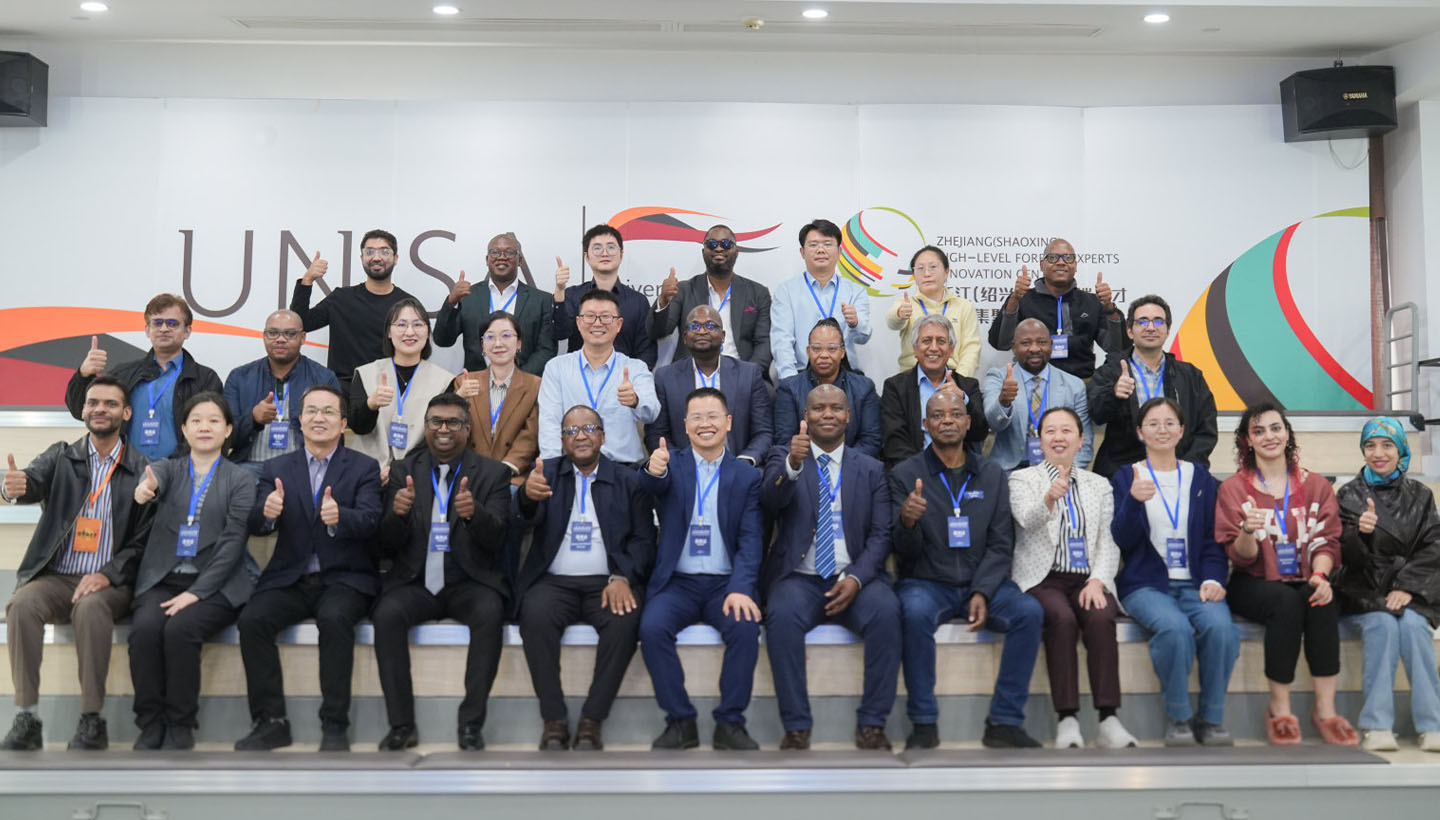
Unisa–JAR Partner Joint Energy Symposium attendees.
South Africa’s progress in moving beyond prolonged load-shedding and China’s rapid expansion of renewable energy highlight a shared challenge: building reliable, sustainable energy systems that can meet growing demand.
While South Africa continues to strengthen its electricity supply and expand alternative energy generation, China is deploying renewable energy technologies on a scale that is reshaping its energy landscape. Against this backdrop, the Unisa–JAR Partner Joint Energy Symposium brought researchers and industry partners together to explore how international collaboration can translate energy research into practical applications, commercial opportunities and the development of the next generation of researchers.
Held from 4 to 6 November 2026 at the Zhejiang (Shaoxing) High-Level Foreign Experts Innovation Centre in Shaoxing, China, the symposium was organised under the theme Next-Generation Energy Systems for a Sustainable Future. Speaking at the event, Prof Bhekie Mamba, Executive Dean of Unisa’s College of Science, Engineering and Technology (CSET), highlighted its contribution to the university’s Catalytic Niche Areas (CNAs) in Energy and Fourth Industrial Revolution and Digitalisation.
These areas are among the university’s research priorities, through which it seeks to strengthen its research capacity and contribute to solutions for complex societal challenges. Mamba said the success of an academic gathering should be measured not by the number of delegates attending, but by the opportunities and partnerships that emerge. “The real value of this symposium is in bringing together the right people: researchers, institutional partners and industry representatives who can identify opportunities and turn discussions into collaborative projects,” he said.
He encouraged participants to build on the connections established during the symposium and create opportunities for students and postdoctoral researchers to contribute to jointly developed projects. The symposium provided a platform for researchers from Unisa and several Chinese universities working in the energy field to share their expertise and discuss developments in the sector. Topics included renewable energy technologies, energy storage systems, smart-grid efficiency, hydrogen energy and fuel-cell technologies. Delegates also explored the use of artificial intelligence in the design of energy materials and systems.
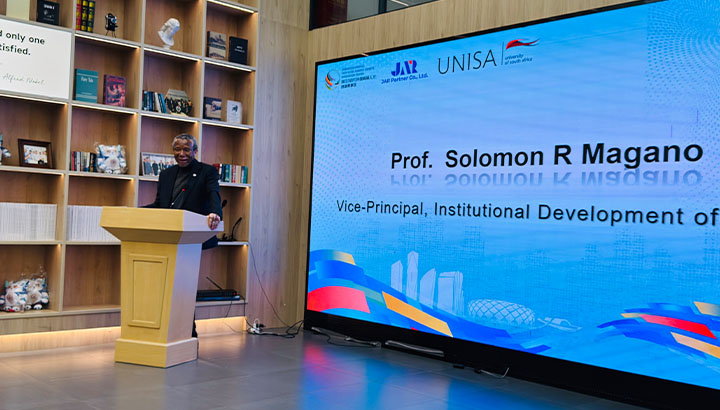
Prof Solomon Magano, Unisa’s Vice-Principal: Institutional Development, during his visit to the Unisa–JAR Partner research laboratories in China.
The discussions extended to shared research priorities, student exchange opportunities, bilateral and multilateral funding prospects, and collaborative approaches to global energy challenges. Among the plenary and keynote presentations were contributions from researchers in Unisa’s CSET, showcasing the breadth of research taking place within the college.
The presentations included:
- Prof Peter Makgwane: Engineering Material Heterostructure Interfaces for Sustainable Energy Conversion and Storage
- Prof Phumlani Msomi: Membrane Electrode Assemblies for Next-Generation Electrochemical Energy Systems
- Prof Nzondelelo Bingwa: Intrinsic Properties as Catalytic Drivers: A Perovskite Perspective for Energy Applications
- Dr Winny Maboya: Low Platinum-Loaded Cerium-Doped Non-Noble Metals as Electrocatalysts for HER
- Prof Yali Yao: Catalyst Pretreatment for Carbon-to-Clean Fuels and Chemicals
- Prof Katlego Makgopa: Enhancing the Electrochemical Efficiency of Metal-Based (Oxides and Phosphates) Nanoparticles and Porous Crystalline Framework Materials Using N-Doped Reduced Graphene Oxide for Advanced Supercapacitor Applications
- Prof Pita Mothibeli: From Blueprint to Reality: The Critical Role of Mechanical Engineering in Energy Manufacturing
- Prof Seshibe Makgato: Coal Quality Requirements for an 800 MW Supercritical Boiler and Associated Emissions
- Prof Ernest Mnkandla: Augmented Intelligence for Resilient and Just Energy Transitions: Optimising Smart Grids and Renewable Energy Integration in the Southern African Context
At the close of the symposium, Unisa announced the renewal of its memorandum of agreement with JAR Partner for a further five years. The decision followed what the university described as positive outcomes from the initial three-year partnership, which provided a basis for extending the collaboration.
One of the partnership’s key developments was the establishment of the Unisa–JAR Partner research laboratories at the High-Level Foreign Experts Innovation Centre in Zhejiang Province, Shaoxing, China. The laboratories were officially launched on 17 October 2024 as part of the partnership’s commitments. Since their launch, postgraduate students, postdoctoral research fellows and Unisa researchers have used the joint facilities to conduct research in several fields. Their work has included exoskeleton technologies, advanced engineering, drone designs for agricultural applications, chip technologies and materials science, among other areas.
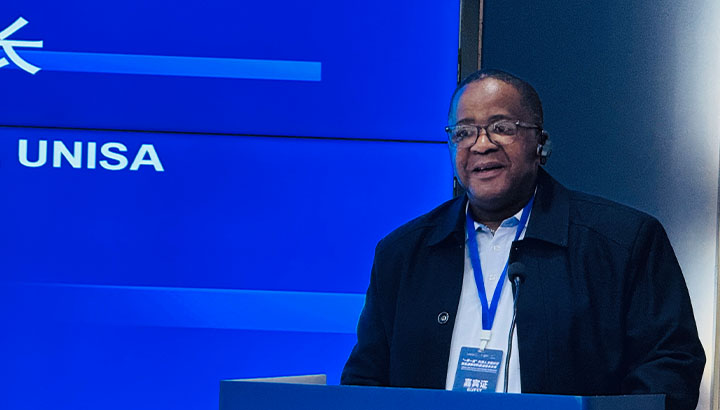
Prof Bhekie Mamba, Executive Dean of Unisa’s College of Science, Engineering and Technology, addresses delegates.
The laboratories provide researchers and students with access to a collaborative research environment in which they can work with international partners and explore the practical application of their research. At the conclusion of the symposium, Unisa’s Vice-Principal: Institutional Development, Prof Solomon Magano, visited the laboratories to engage with researchers and learn more about the projects being undertaken by Unisa researchers, postdoctoral fellows and postgraduate students.
“Seeing the developments that have taken place in the joint laboratories in person has given me a much deeper appreciation of the excellent work being undertaken through the Unisa–JAR partnership and the various collaborative projects,” said Magano. “What is particularly encouraging is the opportunity to see how research can move beyond academic publications and be translated into tangible innovations, technologies and practical solutions that improve people’s quality of life. This is an area in which Unisa is increasingly positioning itself, and one that we are committed to advancing,” he added.
Magano said universities were operating in an increasingly complex global environment, shaped by geopolitical tensions, emerging and evolving diseases, environmental concerns and rapid technological advancement. These challenges, he said, required institutions and researchers to draw on shared expertise and work together to develop solutions. “The technological advancements and research initiatives we are exploring through these partnerships should contribute meaningfully towards addressing such challenges,” he said.
The symposium and the joint laboratories demonstrate how Unisa’s Energy Catalytic Niche Area can be advanced through international research collaboration. The niche area provides an institutional focus for research into energy-related challenges and opportunities. The symposium’s discussions on renewable energy, storage technologies, hydrogen, fuel cells and smart grids show how researchers can contribute to developing more efficient and sustainable energy systems.
The work also connects with Unisa’s Fourth Industrial Revolution and Digitalisation Catalytic Niche Area, particularly through research involving artificial intelligence, smart-grid optimisation and advanced materials. These technologies have the potential to support more efficient energy systems and strengthen the integration of renewable sources. For students and early-career researchers, the partnership offers opportunities to participate in international research and gain experience in collaborative projects. This also speaks to Unisa’s Student Support and Co-Curricular Activities Catalytic Niche Area, which recognises the importance of developing students beyond formal academic teaching. Access to research facilities, international networks and practical projects can complement classroom learning and help prepare graduates for changing professional environments.
The partnership’s broader significance extends beyond the university. Its focus on energy research and innovation is relevant to Sustainable Development Goal 7, which calls for affordable and clean energy, as well as SDG 9 on industry, innovation and infrastructure and SDG 17 on partnerships for the goals. It also speaks to the African Union’s Agenda 2063 and South Africa’s National Development Plan 2030, both of which recognise the importance of infrastructure, technological development, skills and sustainable economic growth.
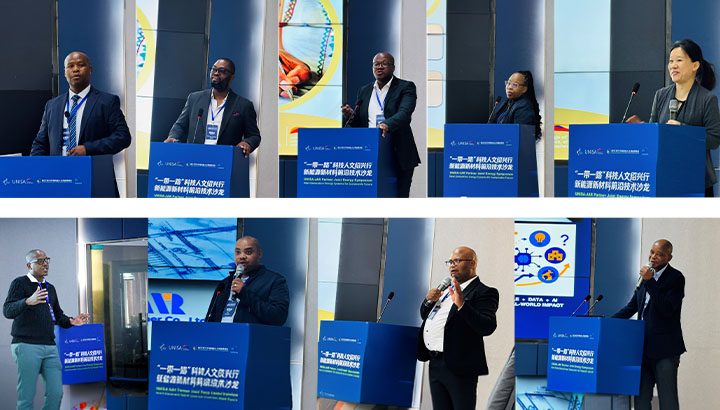
Unisa researchers who presented at the symposium.
The extent to which these collaborations contribute to wider development outcomes will depend on the research they produce, the technologies that can be applied and the benefits they deliver to communities and industry. The Unisa–JAR Partner partnership illustrates how internationalisation can move beyond agreements and institutional exchanges to create shared research opportunities, strengthen institutional capacity and support practical innovation.
Its renewed five-year commitment provides an opportunity to build on the work already undertaken and deepen collaboration between researchers, students and industry partners. Ultimately, the value of the partnership will be measured not only by the research conducted or the facilities established, but by the extent to which that work contributes to better energy solutions, improved livelihoods and a more sustainable future.
* By Dr Nozipho N. Madzivha, Communications and Marketing Specialist (Acting), College of Science, Engineering and Technology
Publish date: 2026-11-23 00:00:00.0