News & Events
Unisa takes water research from the laboratory into communities
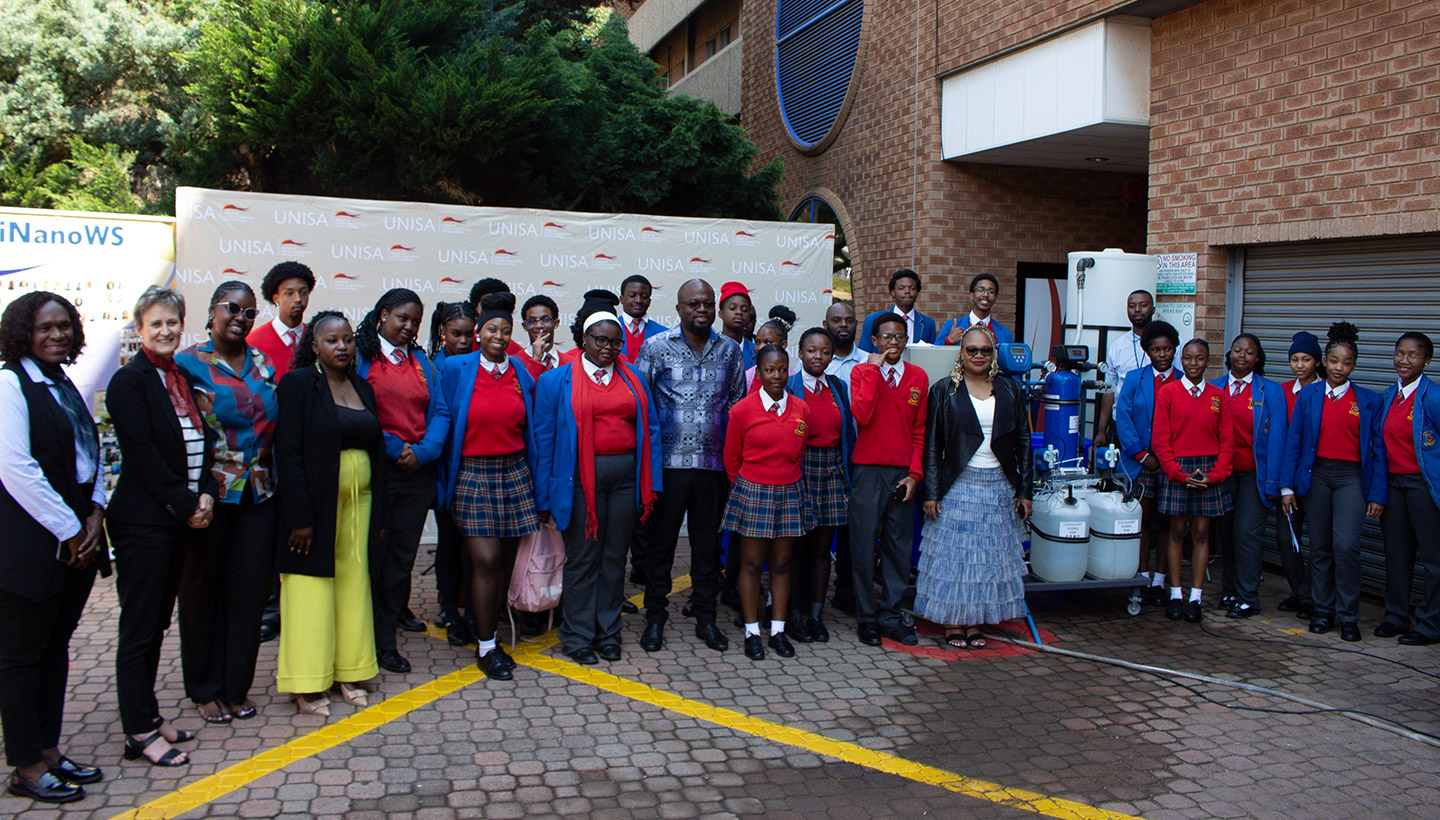
Delegates during the launch of Unisa’s demonstration unit for water treatment.
What if wastewater could become part of the solution to South Africa’s water challenges rather than simply something to be discarded?
At Unisa’s Florida Science Campus, researchers are demonstrating how that could work.
The university launched a mobile water treatment demonstration unit on 22 September 2026, taking research developed through its Institute for Nanotechnology and Water Sustainability (iNanoWS) into a practical environment where students, learners and communities can see the technology at work.
Developed as part of the Nano4Rural Engaged Scholarship Project, the unit can treat approximately 4.8 kilolitres, or 4 800 litres, of water a day.
It is not intended to operate as a full-scale treatment plant. Instead, it provides researchers with a platform to demonstrate how water treatment technologies work, while creating opportunities to educate communities about water quality, conservation and reuse.
The project brings into practical focus one of the central challenges captured by SDG 6: Clean Water and Sanitation, which calls not only for access to safe water but also improved water quality, wastewater treatment, recycling and reuse.
For Unisa, however, the initiative also addresses a fundamental question about university research: what happens when scientific knowledge leaves the laboratory?
Welcoming delegates on behalf of the College of Science, Engineering and Technology (CSET), Prof Eva Rapoo, Head of Teaching and Learning and Community Engagement Manager, said engaged scholarship should ensure that academic work makes an impact beyond the university.
She encouraged academics to continually consider how their work could improve the lives of South Africans, particularly as sustainability challenges place growing pressure on communities.
The involvement of residents from communities surrounding the Florida Science Campus, alongside school learners, provided an opportunity to connect university research directly with the people who could ultimately benefit from scientific innovation.
Prof Thabo Nkambule, Head of iNanoWS, said the demonstration unit represented an important step in showing how research could be translated into practical responses to water challenges.
“What we are launching today is a water treatment demonstration unit, not a full-scale plant. The purpose is to demonstrate how this technology can be applied in a practical setting and how treated water can become a useful resource.”
Nkambule said the system can produce approximately 4.8 kilolitres of treated water a day, while the longer-term ambition is to develop an increasingly energy-efficient and self-sufficient system.
That vision extends beyond the demonstration unit.
According to Nkambule, plans have been approved for a decentralised wastewater treatment system at the Florida Science Campus.
The intention is to treat wastewater on site and recirculate it for uses such as toilets and gardening rather than using potable water for purposes that do not necessarily require drinking-quality water.
Such a system could provide both environmental and financial benefits.
“This system will therefore solve two problems at one go: addressing wastewater while creating an additional water resource that can be put back into use,” Nkambule said.
The principle is important because sustainable water management is not only about finding new sources of water. It is also about using existing supplies more efficiently and finding safe ways of recovering and reusing water.
That circular approach connects the research naturally with SDG 12: Responsible Consumption and Production, while the development of practical water-treatment infrastructure also speaks to the innovation ambitions of SDG 9: Industry, Innovation and Infrastructure.
Within Unisa’s own research agenda, the project finds its clearest home in the university’s Natural Sciences (Biotechnological Studies) Catalytic Niche Area, where scientific research and technological development are directed towards improving human life and the health of the planet.
Here, that ambition is being tested through something tangible: whether research can help reduce wastewater, conserve potable water and create an additional resource that can be reused.
The unit was deliberately designed to be mobile.
Dr Tshimangadzo Munonde, Chair of the Nano4Rural Engaged Scholarship Project, said this allows researchers to take water-treatment education beyond the Florida Science Campus and into schools, communities and public spaces.
Instead of explaining water treatment only through presentations, researchers can demonstrate the process and allow people to see how wastewater is treated.
This creates opportunities for conversations about water quality, conservation and responsible water use.
Munonde said the approach also recognises that communities are not empty vessels waiting for universities to provide knowledge.
“Through dialogue, awareness initiatives and hands-on learning, we empower people to make informed decisions about water use, protect local water resources, promote healthier, more sustainable communities and strengthen community capacity to address local water challenges, building from their indigenous knowledge of water treatment they already possess.”
This relationship between technology and community knowledge is central to the engaged-scholarship component of the project.
Researchers and students bring scientific expertise and technology into communities, while communities contribute their experiences, practices and understanding of local water challenges.
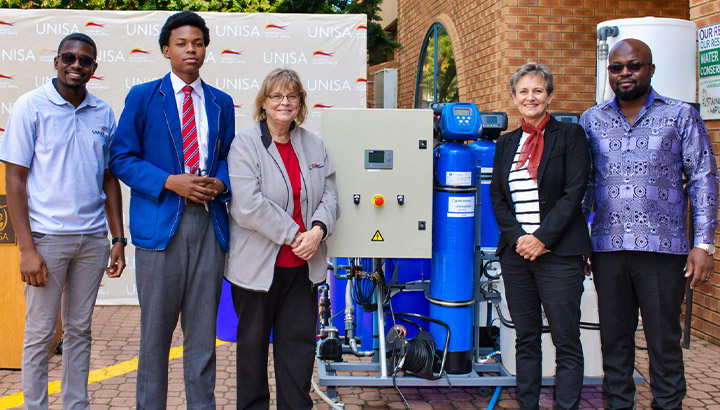
Dr Tshimangadzo Munonde, Chair of the Nano4Rural Engaged Scholarship Project; Charles Okoye, Royal College learner; Prof Eva Rapoo, Head of Teaching and Learning (CSET) and Community Engagement Manager; Dr Erin Naude, Acting Regional Director, Gauteng Region; Professor Thabo Nkambule, Head of iNanoWS.
The launch also highlighted a less technical part of South Africa’s water challenge: human behaviour.
Representing the project’s collaborators, Dr Erin Naude, Acting Regional Director for the Gauteng Region, called for greater awareness of water conservation across the university.
“We need to run campaigns to raise awareness and reduce water wastage in what we do,” she said.
She further emphasised the importance of Unisa Global, collaboration and strategic partnerships involving the Gauteng Province, the College and local communities in addressing future challenges. She noted that water challenges extend beyond individual communities and called on the project team to continue pursuing collaborative and sustainable solutions to water-related problems.
Kagiso Mekoe of Unisa’s Counselling Directorate took the argument further, calling on students to become water ambassadors who encourage responsible water use.
He pointed to activities where potable water is unnecessarily wasted, arguing that changing behaviour must form part of the response to water scarcity.
The message emerging from these contributions was that technology can improve how water is treated, recovered and reused, but sustainable water management also depends on how people value and use the resource.
That becomes particularly important in cities and communities facing pressure on water infrastructure, connecting the initiative with the wider ambitions of SDG 11: Sustainable Cities and Communities.
Among those watching the technology in action were learners from Royal College.
Their participation gave another dimension to the launch.
Learners toured the iNanoWS laboratories and were exposed to researchers, scientific facilities and technologies that demonstrated how concepts encountered at school can become solutions to real-world problems.
For Royal College learner Charles Okoye, seeing the demonstration unit transformed science from something studied on a page into something tangible.
“Today, Unisa and the iNanoWS team have taken those concepts off the page and turned them into reality right before our eyes,” he said.
Okoye said access to clean water remained an important challenge for communities and that seeing the technology operate demonstrated the potential of science to respond.
“Science goes far beyond the classroom. It is a vital tool for transforming lives and safeguarding our planet.”
But perhaps the most significant impact for the learners was seeing the people behind the science.
“Looking at the professors and experts in this room, we see the future we aspire to build,” Okoye said.
With Dr Makhwedzha-Ramutshatsha, UWC/WTT Thematic Area Leader, facilitating proceedings, the launch brought researchers, students, school learners, communities and institutional partners together around a shared challenge.
Delivering the closing remarks, Ntokozo Magwaza reflected on how the discussions connected with water challenges in her own community and the potential for initiatives such as this to ensure communities are not left behind as new water-treatment technologies are developed.
That is ultimately where the significance of the demonstration unit lies.
Its immediate output may be measured in the 4 800 litres of water it can treat each day, but its wider purpose is to demonstrate what becomes possible when scientific research, technological innovation, education and community engagement meet.
For Unisa, the project turns its Natural Sciences Catalytic Niche Area into something students and communities can see working in front of them.
And for a country where every litre increasingly matters, it demonstrates a simple but important principle: water that would otherwise be discarded can, with the right science and responsible management, become a resource again.
* By Thembeka Ntuli-Mpapama, Manager, Unisa Gauteng Region; Dr Tshimangadzo S. Munonde, Institute for Nanotechnology and Water Sustainability (iNanoWS); and Dr Nozipho Madzivha, Acting Communication and Marketing Specialist, CSET
Photography: Lesego Maloka, Marketing Administrator, Unisa College of Science, Engineering and Technology (CSET)
Publish date: 2026-10-02 00:00:00.0