News & Events
Unisa law students take on Africa’s leading human rights moot court competition
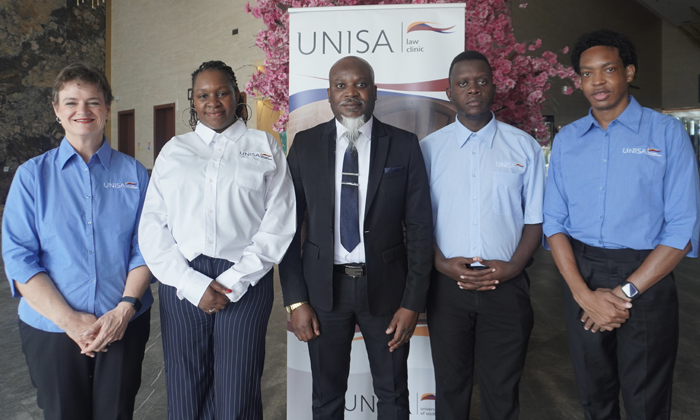
From left to right: Shelley Lara de Klerk (Unisa LLB student), Anoeska Prins (Faculty representative), Adv Saul Makama (Trainer), Sipho Matshie (Trainer) and Captain Samson Mnisi (Unisa LLB student).
The University of South Africa (Unisa) joined law students from across Africa in Abidjan, Côte d’Ivoire, for the 35th Christof Heyns African Human Rights Moot Court Competition, hosted by the Institut Universitaire d’Abidjan.
The 2026 competition was particularly significant, marking three important milestones in African human rights education and jurisprudence: the 35th anniversary of the Christof Heyns African Human Rights Moot Court Competition, the 40th anniversary of the Centre for Human Rights and the 20th anniversary of the African Court on Human and Peoples’ Rights.
The event was also only the second time Côte d’Ivoire had hosted the competition, following the eighth edition held in Abidjan in 1999.
Often described as Africa’s largest annual human rights gathering, the moot court competition brings together law students from universities across the continent to argue a fictional case before a simulated African Court on Human and Peoples’ Rights.
For the students, however, the experience goes far beyond competing for a place in the next round. It provides an opportunity to apply legal theory to complex, real-world issues while developing the research, advocacy, critical thinking and courtroom skills required of future legal practitioners.
The 2026 moot problem focused on several pressing areas of contemporary law, including business and human rights, corruption and digital rights. These issues are increasingly important as African countries grapple with the impact of technology, corporate activity and governance on fundamental rights.
For Unisa, participation in the competition reinforced its commitment to producing graduates who can engage confidently with complex legal questions at national, regional and international levels.
Unisa was represented by Bachelor of Laws (LLB) students, Shelley Lara de Klerk and Captain Samson Mnisi, who were supported by moot court trainers Advocate Makama and Sipho Matshie.
During the preliminary rounds, the two students took on both sides of the hypothetical dispute. In the first session, they appeared for the respondents before returning in the second session to argue on behalf of the applicants.
Their performances required them to present carefully researched legal arguments and respond to questions from a panel of judges with extensive experience in human rights law.
For students, this type of exercise provides a valuable bridge between classroom learning and legal practice. It requires them to think on their feet, defend their interpretation of the law and respond constructively when challenged by the bench.
Advocate Makama described the opening stages of the competition as an enriching and intellectually stimulating experience for both students and coaches.
He said the competition created an environment where participants could grapple with difficult legal questions while learning from students, academics and legal practitioners from other parts of Africa.
He was also encouraged by the Unisa team’s preparation and performance, particularly their discipline, commitment and understanding of human rights law.
The interaction between participating universities also provided opportunities for students and coaches to build professional relationships and exchange ideas about the development of human rights law across the continent.
For Captain Mnisi, the competition carried an additional personal significance.
As a hearing aid user, he faced challenges during proceedings when trying to hear questions from members of the judicial panel. Despite this, he remained composed and continued to participate with confidence and determination.
Reflecting on his experience, Mnisi said:
It is an honour to represent the University. Although there are times when it can be challenging to hear the judges’ questions, I always strive to answer them to the best of my ability.”
His participation highlights the importance of creating opportunities in which students with disabilities can participate fully and compete on an equal footing.
Mnisi's experience also serves as a reminder that academic and professional excellence should not be defined by physical ability. His determination to participate at a major continental legal competition demonstrates the value of perseverance, confidence and appropriate support in enabling students to realise their potential.
For Unisa, an institution committed to accessible and inclusive education, his achievement is particularly meaningful. The university continues to promote an environment in which students with disabilities can pursue their academic and professional ambitions and make their contributions across society.
The Christof Heyns African Human Rights Moot Court Competition was established in 1992 and has become an important fixture in African legal education.
Conducted in English, French, Portuguese and Arabic, the competition has brought together students from 205 universities across 47 countries over the years.
Its reach has helped create a platform where future lawyers can engage with different legal traditions and perspectives while developing a deeper understanding of human rights on the continent.
The competition also contributes to the development of African human rights jurisprudence by encouraging students to examine emerging legal questions and consider how regional human rights instruments can be applied to contemporary challenges.
For de Klerk and Mnisi, representing Unisa in Abidjan was therefore about more than advancing through the competition.
It was an opportunity to test their legal knowledge in an international setting, learn from their peers and engage with judges and legal practitioners working in the field of human rights.
It also allowed them to represent Unisa and demonstrate the standard of legal education and advocacy skills developed through their studies.
Their participation reflects the university's broader commitment to preparing graduates who are academically strong, professionally capable and socially conscious.
As Africa continues to confront complex questions around digital rights, corporate accountability, corruption and access to justice, the need for lawyers who understand both the law and its broader social implications is increasingly important.
Through initiatives such as the Christof Heyns African Human Rights Moot Court Competition, Unisa students are gaining exposure to those challenges while developing the confidence and practical skills to contribute to the legal profession.
The participation of de Klerk and Mnisi in Abidjan is therefore not only a milestone for the two students. It is also a reflection of Unisa's continuing contribution to legal education, human rights advocacy and the development of the next generation of African legal professionals.
* By Kgopotjo Lebepe, Communication and Marketing Officer, Unisa Law Clinic
Publish date: 2026-08-12 00:00:00.0