News & Events
Unisa hosts postgraduate student research workshop in KZN
From left, Prof Samuel Mojapelo, Department of Information Science, College of Human Sciences, Fikile Mhlongo, Chairperson of the KwaZulu-Natal Region Research Committee, and Asanda Kafile, Deputy Chairperson of the KwaZulu-Natal Region Research Committee
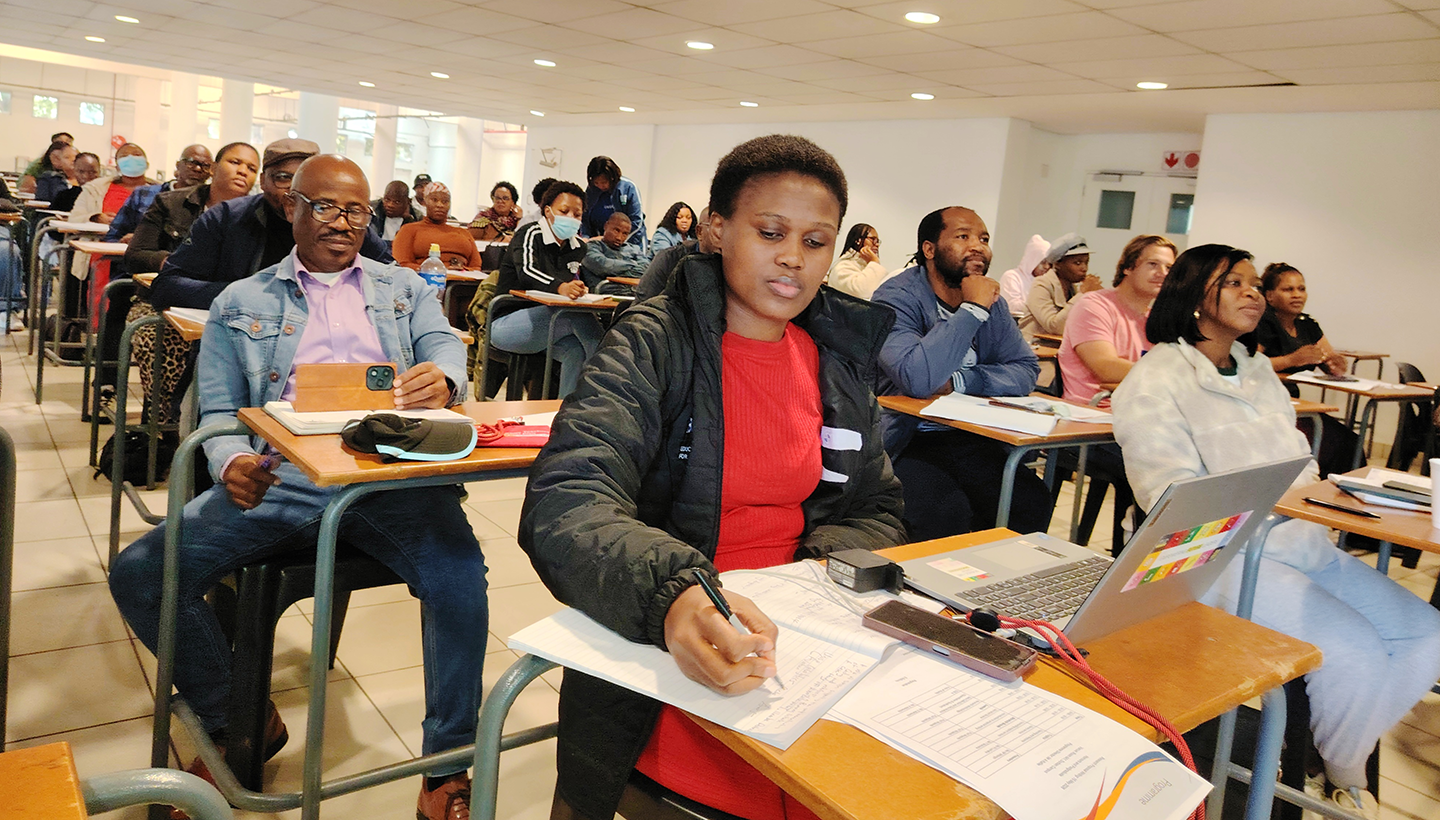
On 15 and 16 May 2026, the KwaZulu-Natal (KZN) Regional Research Committee hosted a two-day postgraduate academic research workshop at the Hoy Park Building on the Durban Campus. Attended by more than 80 postgraduates from across the region, the workshop aimed to help them navigate what can be a challenging and complex academic journey.
As part of its annual plan, the KZN Research Committee coordinates biannual workshops to offer practical assistance to Unisa postgraduates who may feel somewhat isolated or disconnected, equipping them with the relevant tools to optimise their chances of academic success.
The open and distance e-learning (ODeL) mode of teaching and learning demands considerable effort on the part of the university to provide maximum support to students who do not have the luxury (which their counterparts at residential institutions do) of interacting with their lecturers and supervisors on campus. The research academic workshop is but one of many offerings aimed at ensuring that Unisa ODeL students can study and complete their qualifications within the stipulated time frame, by bridging the physical distance between all the parties involved.
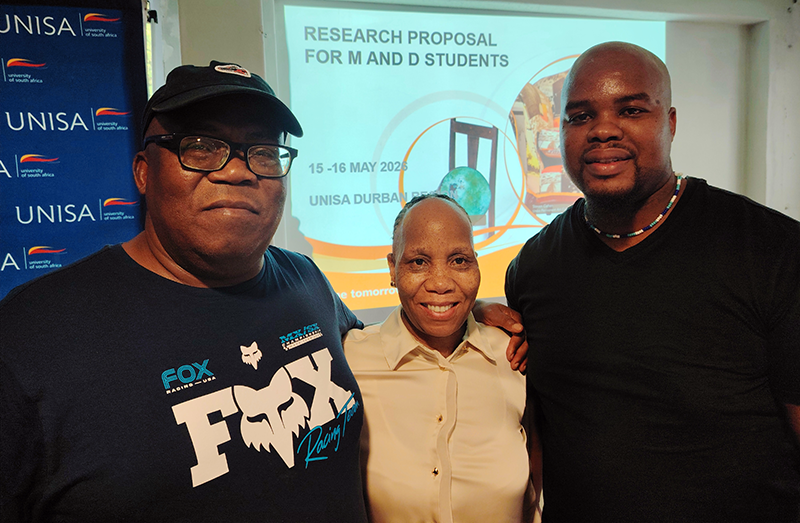
From left, Prof Samuel Mojapelo, Department of Information Science, College of Human Sciences, Fikile Mhlongo, Chairperson of the KwaZulu-Natal Region Research Committee, and Asanda Kafile, Deputy Chairperson of the KwaZulu-Natal Region Research Committee
In her opening remarks and welcome address, the KZN Research Committee Chairperson, Fikile Mhlongo, reiterated that the committee echoes Unisa’s commitment to putting in place mechanisms to equip students with the relevant tools. Postgraduate studies require critical thinking and a thorough engagement with the literature in a student’s area of interest, especially as empirical research must be conducted. To that end, the two-day workshop covered topics such as the following:
- Library services
- Counselling
- Introduction to proposal writing, literature review and research methodology
- Theoretical and conceptual frameworks
- Philosophies, worldviews and paradigms
- Data collection and analysis in quantitative and qualitative studies, and
- Ethics in research.
Postgraduate students are not passive participants during such workshops – the presenters ensure that attendees engage by encouraging them to share their queries and opinions freely and robustly.
Professor Samuel Mojapelo, from the Department of Information Science in the College of Human Sciences, who adopted his unique yet effective approach to imparting knowledge to those present, emphasised that postgraduate study is about crafting a researchable topic that is aligned with one’s career growth and academic objectives, since the bulk of the work will be done independently from a supervisor.
He advised students to master the basics of research – from proposal writing to identifying the research problem, objectives and questions, and deciding on the methodology. These elements must be in sync and aligned to the topic, literature review, data collection and analysis, and be reflected in the findings and results at the end of the study. In his view, the chosen ontology, epistemology and methodology act as a golden thread that holds a study together, such that when conclusions and recommendations are made, they should make sense and answer the initial research question.
Mojapelo strongly encouraged students to actively participate in the workshop as part of their learning journey. He reminded them that he had started his career as a schoolteacher because teaching is in his blood – something that was clearly evident in the way he conducted his sessions.
With the explosion of artificial intelligence (AI) use in academia, the postgraduates were encouraged to use AI ethically, transparently and responsibly, since AI should not (and cannot!) replace a human being’s critical thinking capacity. While AI can serve as a valuable means of fast-tracking complex academic tasks that would otherwise take considerable time to complete, the final product must be the student's work, not that of an AI tool.
Since AI cannot be credited as a co-author of an academic work, students must be transparent about its use. They should avoid overreliance on AI, as this could negatively affect their academic writing skills and critical thinking. The attendees were also warned that AI sometimes hallucinates and fabricates information, thus providing false and non-existent data and citations. Human intervention and the verification of all information and sources cited by AI are crucial for maintaining academic integrity.
Unisa remains dedicated to supporting its student cohort. Academic support, in particular, is central to scholarship, as it speaks to the heart of the mission and vision of this great African university, which is in the service of humanity. Postgraduate student success is, to a significant extent, dependent on effective support. Together, the contributions that students, lecturers and supervisors make to the body of knowledge serve to shape a better society, informed by real-world researched solutions generated through sound empirical research.
* By Siyabonga Seme, Manager: Communication and Marketing, KwaZulu-Natal Region
Publish date: 2026-05-28 00:00:00.0