News & Events
Unisa equips Daveyton residents with skills to fight food insecurity and unemployment
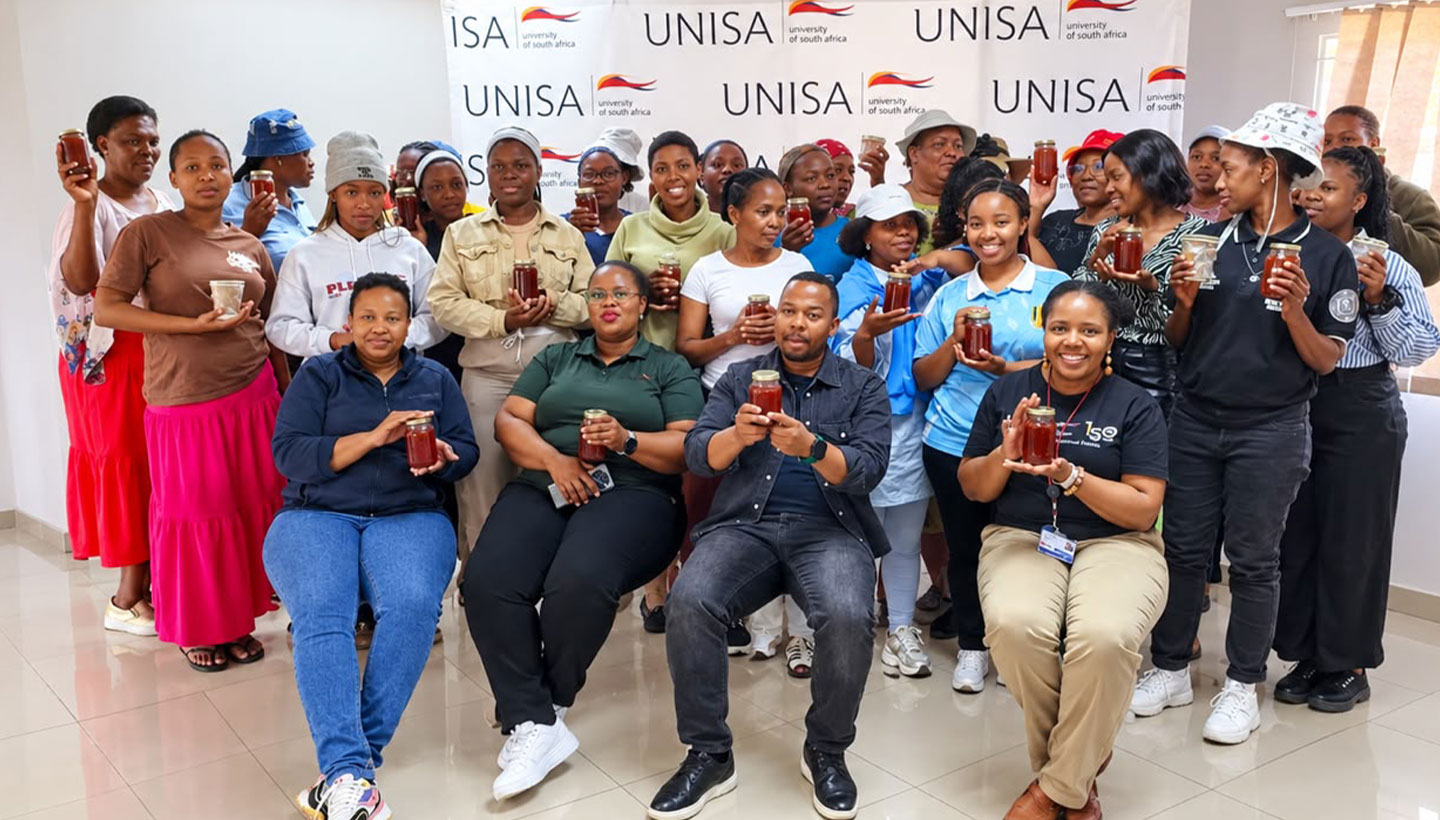
CAES facilitators from the Department of Agriculture and Animal Health lead the Daveyton Hub food preservation training programme.
For residents of Daveyton, turning surplus food into products that can be stored longer or potentially sold is becoming part of a broader effort to tackle food insecurity and create livelihood opportunities.
The skills are being developed through the Daveyton Hub Community Engagement Project, an initiative led by the University of South Africa’s (Unisa) College of Agriculture and Environmental Sciences (CAES), in collaboration with the Unisa Gauteng Region and the Ekurhuleni Regional Service Centre.
Led by Dr Mhlonipheni Msomi of the Department of Agriculture and Animal Health, the project combines academic expertise with practical community-based training in food production, preparation and preservation.
Rather than focusing on once-off interventions, the project aims to build skills that residents can apply in their households and potentially develop into income-generating activities.
The Daveyton Hub project is designed to support communities in Daveyton and surrounding areas of Ekurhuleni through training, mentorship and continued engagement.
Its focus extends beyond food production to broader issues affecting household livelihoods, including poverty, unemployment and food insecurity.
The programme also recognises that communities already possess knowledge and experience that can be strengthened through additional training. Indigenous knowledge systems are incorporated into areas such as food and nutrition security, household food production, sustainable livelihoods, hospitality, and clothing and consumer sciences.
Through workshops and other community activities, participants are introduced to practical skills that can improve household nutrition while opening potential avenues for small-scale enterprise.
The approach reflects Unisa’s vision of being “the African university in the service of humanity” by connecting academic knowledge with challenges experienced in communities.
Food preservation has emerged as one of the practical components of the programme.
On 16 and 17 September 2026, participants took part in hands-on food preservation workshops facilitated by Prof Thabisile Mbombo-Dweba and Nature Masufi from the Department of Agriculture and Animal Health.
The sessions focused on techniques that can reduce food waste and extend the shelf life of food.
Participants put the techniques into practice by producing items including strawberry and tomato jam, demonstrating how food that might otherwise spoil can be processed into products for household consumption and potentially small-scale sale.
“The hope for the project is that communities will start their own businesses, assisting in employment creation and food security,” said Dr Msomi.
The training is intended to provide participants with more than theoretical knowledge. By working directly with food and preservation techniques, they gain skills that can be replicated at home and potentially developed into small businesses.
Dr Msomi said the practical nature of the training was central to the project.
“The food preservation training is more practical, and attendees are equipped with various ways of preserving food,” he said.
Growing food at household level
The next phase of the project will focus on vegetable gardening.
Participants will receive training in land preparation, cultivation techniques and the production of different vegetables.
The gardening component is intended to strengthen household food production while introducing participants to techniques that could potentially support small-scale commercial farming.
Together, the food preservation and vegetable production components provide a practical continuum, from producing food to preserving surplus produce and exploring possible ways of generating income from it.
Food preservation is particularly relevant in communities where households may struggle to afford food consistently or lack reliable ways of storing fresh produce.
By extending the shelf life of food, preservation techniques can help households make better use of available produce and reduce unnecessary waste.
The project therefore links household food security with responsible food consumption and production.
It also contributes to several Sustainable Development Goals, including No Poverty, Zero Hunger, Responsible Consumption and Production, and Climate Action.
The initiative further aligns with Unisa’s Catalytic Niche Areas, particularly Feminist/Womanist/Bosadi Theorisations and Natural Sciences (Biotechnological Studies), through its focus on community networks, practical skills development and the application of academic knowledge to local challenges.
The success of the Daveyton Hub project will ultimately depend on what happens after participants leave the workshops.
The intention is for residents to apply what they have learnt in their households, share the knowledge with others and, where possible, use the skills to develop livelihood opportunities.
A household vegetable garden, for example, can contribute to food on the table, while preservation skills can help families make better use of surplus produce. For some participants, these same skills could potentially form the foundation of small-scale enterprises.
The project therefore places practical knowledge at the centre of its community engagement approach.
For Unisa, the Daveyton Hub is an opportunity to connect teaching, research and community engagement with challenges that directly affect people’s daily lives. For the residents taking part, the value lies in having practical skills that can be applied long after the workshops have ended.
* By Thembeka Mpapama, Communication and Marketing Manager, Unisa Gauteng Region, and Dr Mhlonipheni Msomi, College of Agriculture and Environmental Sciences (CAES)
Publish date: 2026-09-30 00:00:00.0