News & Events
Unisa celebrates 25 new PhD graduates advancing research and innovation
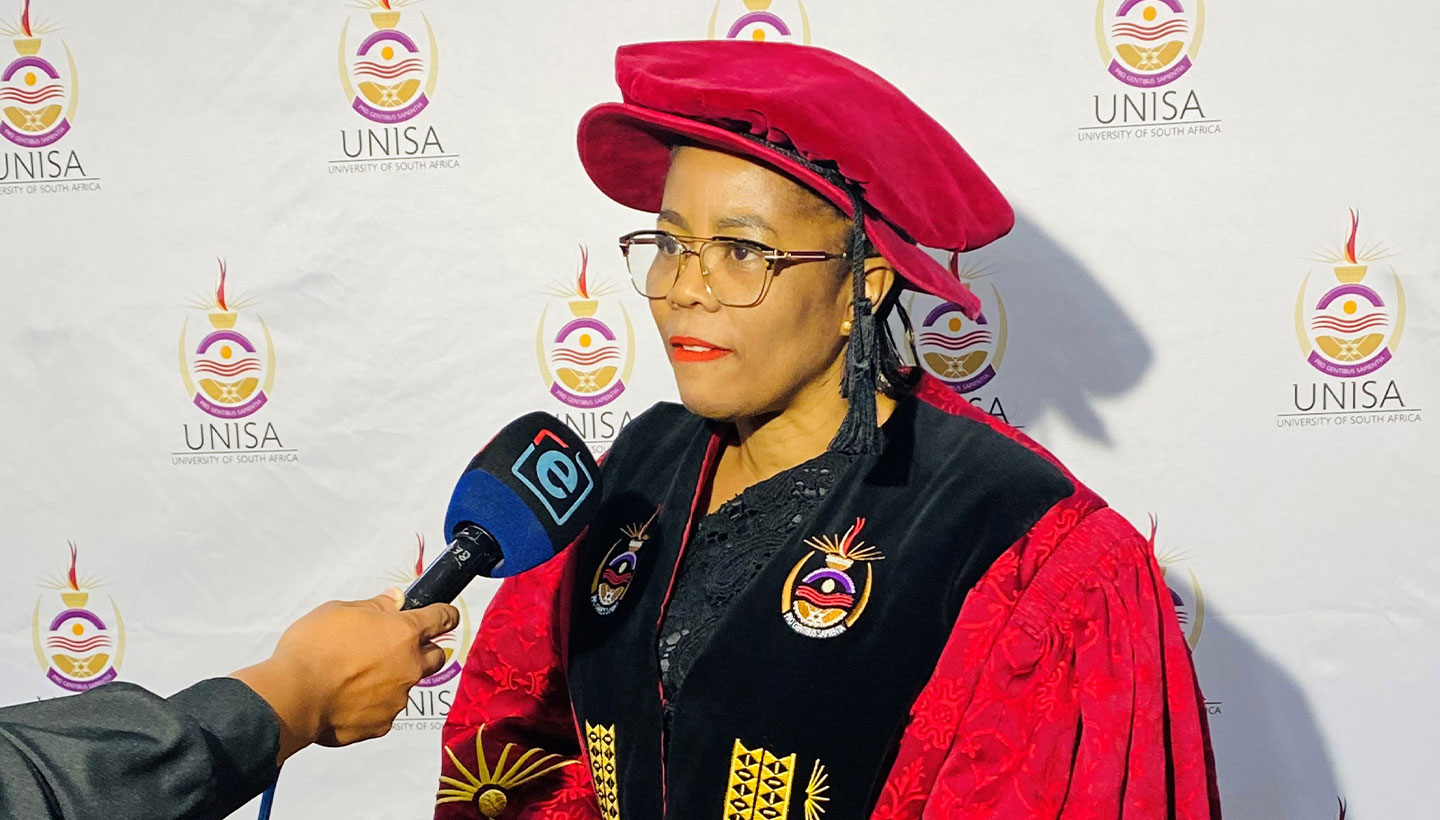
Unisa Principal and Vice-Chancellor, Prof Puleng LenkaBula
The University of South Africa (Unisa) has celebrated 25 new doctoral graduates whose research is advancing scientific discovery, technological innovation, and solutions to some of South Africa’s pressing industrial and developmental challenges.
The graduates were recognised during a spring graduation ceremony at the ZK Matthews Great Hall, marking another milestone in the university’s commitment to developing highly skilled researchers and strengthening Africa’s knowledge economy.
Their research spans several disciplines, including materials science, geotechnical engineering and mining technology, demonstrating how postgraduate scholarship can contribute to safer industries, improved infrastructure and more sustainable development.
The ceremony also provided an opportunity to reflect on Unisa’s expanding research profile and its contribution to doctoral education, with the university highlighting its leading position in doctoral graduate production and its standing in national research output.
For the graduates, the occasion represented years of academic dedication, intellectual discovery and perseverance. For Unisa, it reaffirmed the importance of producing researchers equipped to respond to challenges facing South Africa, the African continent and the wider world.
Among the graduates was Bila Oliwamnisi, whose doctoral research applied first-principles computational analysis to investigate ruthenium-based alloys.
His study examined the structural, electronic and mechanical properties of these materials, contributing to scientific understanding that could inform future developments in materials engineering and advanced technologies.
Research into the behaviour and performance of alloys is important for industries seeking materials with improved durability, efficiency and performance under demanding conditions.
By expanding knowledge of ruthenium-based materials, Oliwamnisi’s work contributes to the scientific foundation needed for further investigation and potential technological applications.
Another graduate, Dr Vhuhwaho Mudau, completed her PhD in rock engineering, focusing on an innovative approach to improving safety in underground mining environments.
Her research investigated the use of Thorax steel fibre, described in the study as corrosion-resistant, combined with dolerite aggregates to develop a sustainable shotcrete mix design.
Shotcrete, a concrete applied by spraying, is commonly used to support and stabilise underground excavations.
Mudau’s research explored how alternative materials could improve the performance of shotcrete used in underground mining, particularly in reinforcing tunnels and reducing risks associated with falling rock.
The study is significant in a country where mining remains an important economic activity and where worker safety, infrastructure durability and sustainable engineering practices continue to demand attention.
Beyond its technical contribution, the research highlights the value of developing practical engineering solutions that respond to industry needs while considering the efficient use of materials and long-term infrastructure performance.
The research undertaken by Oliwamnisi and Mudau illustrates the contribution that universities can make by connecting scientific inquiry with industrial and societal challenges.
Their work is relevant to the objectives of Sustainable Development Goal (SDG) 9, which promotes resilient infrastructure, sustainable industrialisation and innovation.
Mudau’s focus on underground mining safety also relates to SDG 8, particularly the promotion of safe and secure working environments, while the broader emphasis on sustainable engineering contributes to ongoing efforts to improve resource efficiency.
These priorities align with South Africa’s National Development Plan 2030, which recognises science, technology, innovation and skills development as important drivers of economic competitiveness and inclusive growth.
At a continental level, the research supports the African Union’s Agenda 2063 ambition to build a prosperous Africa through science, technology, industrial development and the strengthening of African research capabilities.
For Unisa, the significance of such scholarship lies not only in the awarding of doctoral qualifications but also in the potential of research to inform industrial practices, advance knowledge and contribute to long-term development.
Addressing graduates and guests, Unisa Principal and Vice-Chancellor, Prof Puleng LenkaBula, reflected on the university’s contribution to higher education, research and the development of leaders who have helped shape South Africa and the continent.
She highlighted Unisa’s academic legacy, including its association with former President Nelson Mandela and other prominent figures whose educational journeys have contributed to public life and social transformation.
LenkaBula emphasised that education extends beyond individual achievement, providing the knowledge and capabilities needed to strengthen institutions, empower communities and respond to complex societal challenges.
Drawing on Mandela’s enduring message about the transformative power of education, she encouraged graduates to recognise their responsibility to use their knowledge for the benefit of society.
Her address also highlighted the university’s growing research contribution, including its reported position as the country’s second-largest contributor to research output.
LenkaBula further reflected on Unisa’s institutional progress, noting that the university produced more than 60,000 graduates in 2025.
She also highlighted improvements in undergraduate success rates, which she said had increased from 57% to more than 71% in recent years.
The Vice-Chancellor pointed to growth in the proportion of academic staff holding doctoral qualifications as further evidence of the institution’s efforts to strengthen its research capacity and academic expertise.
These developments, she indicated, demonstrate Unisa’s continued investment in educational quality, postgraduate scholarship and the development of highly qualified academics.
The ceremony also welcomed international guests, including a delegation from the Open University of Tanzania, reflecting Unisa’s longstanding commitment to collaboration with institutions across the African continent.
LenkaBula acknowledged the historical relationship between South Africa and Tanzania, recalling Tanzania’s role in supporting South Africans during the struggle against apartheid, including through the Solomon Mahlangu School.
The reference underscored the importance of educational cooperation, solidarity and shared development priorities in shaping Africa’s future.
As an open distance e-learning institution, Unisa occupies an important position in expanding access to higher education beyond geographical and national boundaries.
Its educational model provides opportunities for students who may face barriers to conventional campus-based study, while its research and institutional partnerships contribute to knowledge exchange and academic capacity development.
Such cooperation supports Agenda 2063’s vision of an Africa that invests in its people, particularly through education, science, technology and innovation.
It also reinforces SDG 4, which promotes inclusive and equitable quality education and lifelong learning opportunities.
For Mudau, obtaining a doctorate in rock engineering represents both a personal achievement and an opportunity to contribute to a discipline in which women have historically been underrepresented.
Originally from Thoyandou in Limpopo, she developed a passion for learning that eventually led her into advanced engineering research.
Her academic journey reflects the importance of encouraging greater participation by women in science, technology, engineering and mathematics.
Beyond her doctoral achievement, Mudau is considering opportunities to contribute to curriculum development, particularly by strengthening the relationship between academic training and the practical skills required by industry.
Such an approach could help ensure that engineering education remains responsive to changing technologies, workplace demands and the challenges facing South Africa’s industrial sectors.
Her achievement also speaks to the objectives of SDG 5, which promotes gender equality and women’s participation in all areas of society, including scientific research and technical professions.
By succeeding in a specialised engineering field, Mudau contributes to the visibility of women in advanced research and offers encouragement to aspiring female scientists and engineers.
Congratulating the graduates, LenkaBula encouraged them to recognise that the value of their qualifications would ultimately be reflected in how they applied their knowledge to improve society.
“Become knowledge citizens and leaders who build strong communities, ready to face the world’s challenges,” she urged.
Her message reinforced the responsibility that accompanies advanced academic qualifications, particularly at a time when countries face interconnected challenges involving economic development, technological change, environmental sustainability and social inequality.
Doctoral graduates play an important role in responding to these challenges through research, innovation, teaching, policy development and the transfer of specialised knowledge.
For Unisa, producing doctoral graduates is therefore not only a measure of academic achievement but also an investment in the people and expertise needed to strengthen institutions and contribute to national and continental development.
The achievements of Oliwamnisi, Mudau and their fellow graduates demonstrate the potential of research to extend beyond university laboratories and academic publications.
Their work reflects the importance of generating knowledge that can support safer working environments, inform technological development and address challenges affecting communities and industries.
As the 25 doctoral graduates embark on the next chapter of their academic and professional journeys, their achievements reinforce Unisa’s commitment to developing researchers whose contributions can help shape a more innovative, inclusive and sustainable future.
* By Sipho Jack, Journalist, Department of Institutional Advancement
Publish date: 2026-10-21 00:00:00.0