News & Events
Unisa PhD student Gosego Sedikelo wins prestigious 2026 Eni Award for sustainable battery recycling research
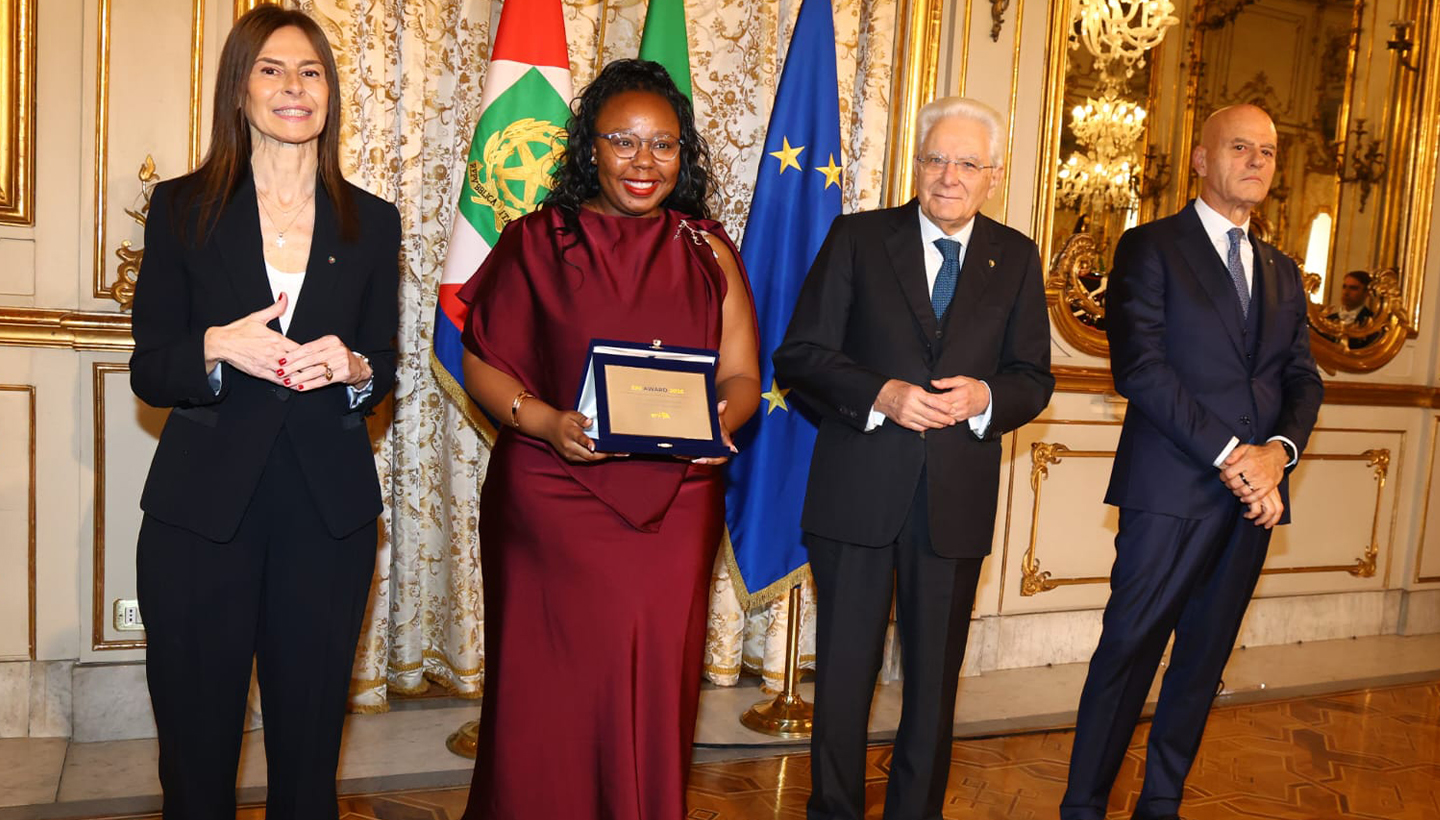
Celebrating scientific excellence in Rome. From left: Giuseppina Di Foggia, Chairwoman of the Board of Directors of Eni SpA; Unisa PhD student and Eni Award recipient Gosego Sedikelo; Italian President Sergio Mattarella; and Claudio Descalzi, Chief Executive Officer of Eni SpA.
Research aimed at making lithium-ion battery recycling more sustainable has earned University of South Africa (Unisa) PhD student Gosego Sedikelo one of Africa's most prestigious international scientific honours.
Sedikelo, a doctoral researcher at the Institute for Catalysis and Energy Solutions (ICES) in Unisa's College of Science, Engineering and Technology (CSET), was named one of two recipients of the 2026 Eni Award in the Young Talents from Africa category. She received the award from Italian President Sergio Mattarella during a ceremony held at the Quirinal Palace in Rome on 29 October 2026.
Now in its 18th edition, the Eni Award is an internationally recognised initiative that celebrates scientific excellence and technological innovation in energy, environmental protection and sustainable development. Organised annually by global energy company Eni, the awards recognise researchers whose work contributes to addressing some of the world's most pressing energy and environmental challenges. The Young Talents from Africa category specifically recognises promising African researchers whose scientific contributions demonstrate the potential to advance sustainable development and technological innovation. Sedikelo shared the 2026 honour with Nosakhare Jeremiah Aigbedion of the Pan African University Institute for Basic Sciences, Technology and Innovation in Kenya. Both recipients received financial support to further their research and advance their doctoral studies.
For Unisa, Sedikelo's achievement represents an important international endorsement of the university's research capabilities, postgraduate supervision and contribution to developing scientific solutions to global sustainability challenges. Prof Yali Yao, a professor at ICES and Sedikelo's PhD supervisor, described the recognition as a significant milestone for both the researcher and the institution. "Only two researchers from across Africa receive this award each year, and we are extremely proud that one of the 2026 winners is from Unisa. This is a remarkable achievement for Gosego and an important international recognition of Unisa's research excellence, postgraduate training and contribution to sustainable energy and environmental technologies," said Yao.
At the centre of Sedikelo's award-winning research is a challenge becoming increasingly important as the world transitions towards cleaner energy: what happens to lithium-ion batteries when they reach the end of their useful lives? Lithium-ion batteries are essential components of electric vehicles, renewable energy storage systems and everyday electronic devices. However, their growing use also raises concerns about the environmental consequences of battery waste and the sustainable supply of the critical minerals required to manufacture them. Sedikelo's doctoral research investigates innovative and sustainable methods of recovering valuable metals from spent lithium-ion batteries. By exploring more efficient approaches to extracting and reusing these materials, her work seeks to reduce waste, improve resource efficiency and support the development of a circular economy.
Rather than allowing valuable materials contained in discarded batteries to go to waste, sustainable recycling technologies offer opportunities to recover resources that can potentially be used in manufacturing new batteries and other products. This approach is particularly relevant to Africa, where the expansion of renewable energy infrastructure, electric mobility and battery-related industries presents opportunities for scientific innovation, industrial development and more sustainable resource management.
For South Africa, research of this nature could contribute to strengthening local capabilities in battery recycling, reducing the environmental impact of technological waste and supporting the development of industries linked to the clean energy transition. Sedikelo's work also aligns with Unisa's Catalytic Niche Area in Energy Studies, which promotes research and innovation addressing energy challenges and advancing sustainable energy solutions. Beyond its institutional relevance, the research contributes to several United Nations Sustainable Development Goals (SDGs), particularly SDG 7 on affordable and clean energy, SDG 9 on industry, innovation and infrastructure, and SDG 12 on responsible consumption and production. Its emphasis on resource recovery and sustainable industrial processes also speaks to the African Union's Agenda 2063 aspirations for environmentally sustainable and resilient economies, while supporting the objectives of South Africa's National Development Plan (NDP) to encourage innovation, strengthen scientific capabilities and transition towards a more environmentally sustainable economy.
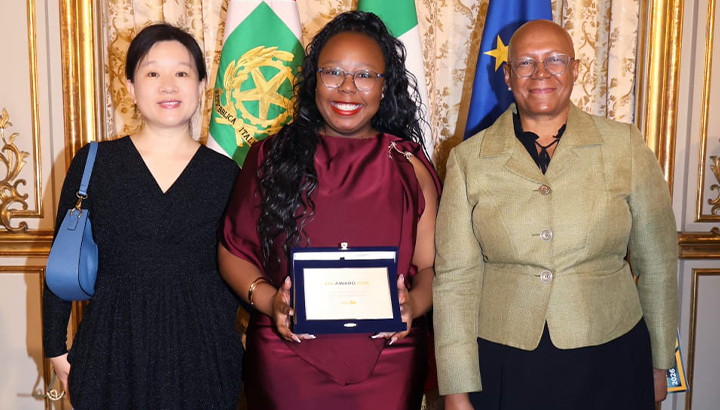
South Africa's Ambassador to Italy, Her Excellency Nosipho Nausca-Jean Jezile, at the 2026 Eni Award ceremony in Rome, where Unisa PhD student Gosego Sedikelo received international recognition for her research into sustainable battery recycling.
For Sedikelo, the award is both a personal milestone and an opportunity to draw international attention to the contribution African researchers can make in developing solutions to global challenges. Reflecting on the recognition, she expressed gratitude for the support she has received throughout her doctoral journey and highlighted the broader significance of her research. "I am deeply humbled and honoured to receive the Eni Award 2026 – Young Talents from Africa, recognising my PhD research on the recycling of lithium-ion batteries and the development of sustainable approaches for recovering valuable materials from spent batteries. "This prestigious recognition highlights the importance of advancing innovative recycling technologies that promote resource efficiency, environmental sustainability and the circular economy. It also reflects the invaluable guidance and support of my supervisors and the research environment provided by Unisa."
Sedikelo emphasised that the achievement extends beyond individual recognition, demonstrating the importance of investing in African research institutions and developing the continent's scientific talent. "Beyond individual achievement, this award demonstrates the potential of South African research to contribute meaningfully to global scientific innovation and address critical challenges associated with the transition to cleaner energy technologies. I hope this recognition inspires greater investment in African scientific research and the development of sustainable technologies that benefit South Africa and the broader African continent," she said. Her achievement comes at a time when African countries are seeking to strengthen their participation in global clean energy value chains, including the development, processing, recovery and reuse of materials essential to emerging technologies.
Research such as Sedikelo's demonstrates how African universities can contribute scientific knowledge and technological solutions while developing the expertise needed to support sustainable industrialisation. Sedikelo's international recognition highlights the important role of postgraduate research in advancing Unisa's contribution to scientific discovery, innovation and sustainable development. It also demonstrates the value of investing in emerging researchers, providing effective postgraduate supervision and creating research environments that enable students to address challenges extending beyond national borders. Through institutes such as ICES, Unisa continues to contribute to research in energy technologies and environmental sustainability, areas increasingly central to economic development and global efforts to address climate change.
The recognition further reinforces the importance of strengthening Africa's research capacity and ensuring that young scientists have opportunities to participate in international scientific networks. For Unisa, the award is a reflection of the potential of its postgraduate researchers to produce work with relevance far beyond the university. For Sedikelo, it provides an opportunity to build on her doctoral research and contribute to the development of technologies that could help make the global energy transition more sustainable. Her achievement also sends an encouraging message to emerging African scientists: research undertaken on the continent can compete internationally and contribute to solving some of the world's most pressing challenges.
* By Dr Nozipho N. Madzivha, Communications and Marketing Specialist (Acting), College of Science, Engineering and Technology
Publish date: 2026-11-06 00:00:00.0