News & Events
Unisa, UCT and University of Bristol strengthen partnership to transform global research collaboration
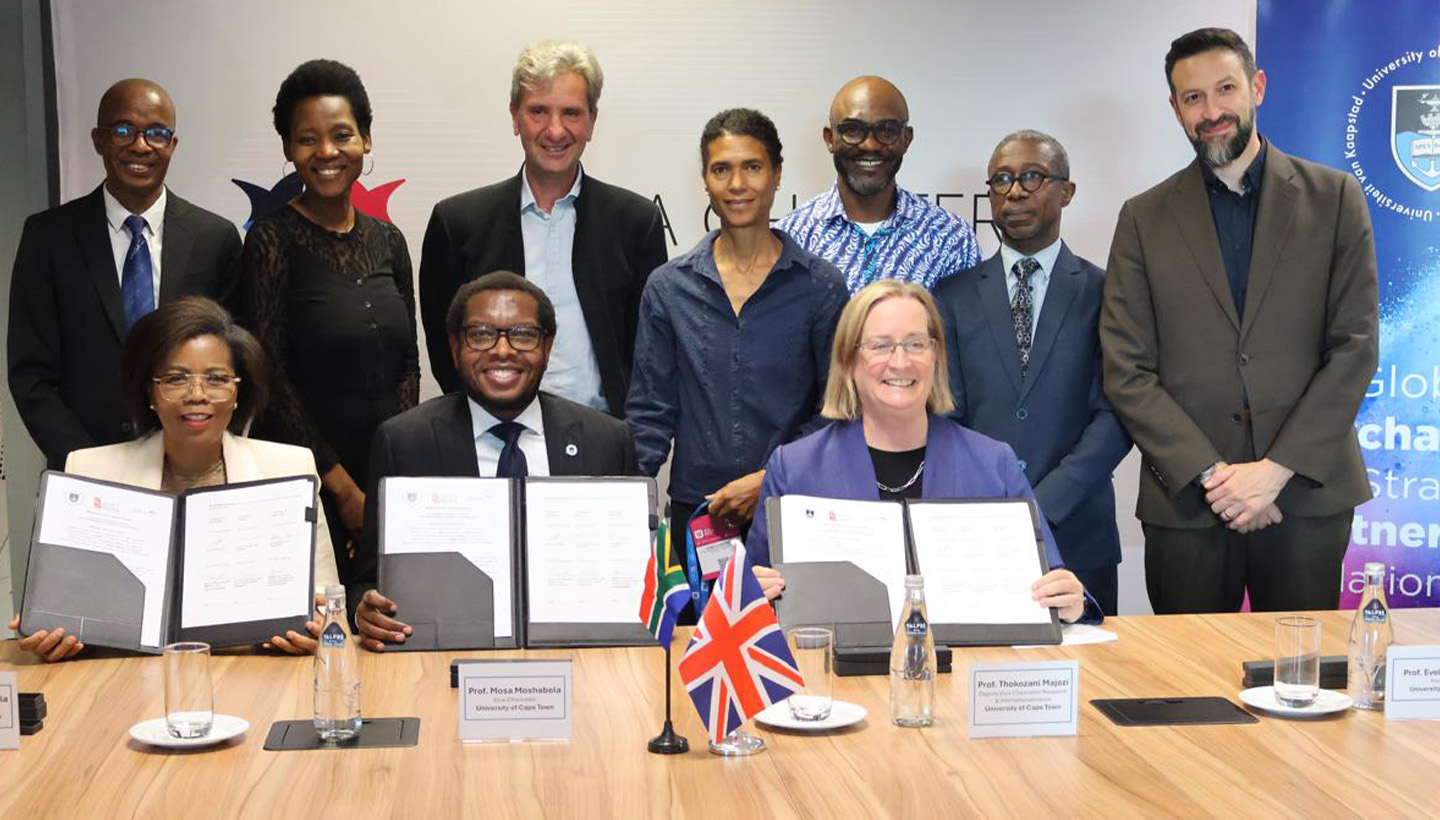
Front: Prof Puleng LenkaBula (Unisa VC), Prof Evelyn Welch (University of Bristol), Prof Mosa Moshabela (UCT VC) Back row: Prof Mpho Ngoepe (Unisa VP: Teaching, Learning, Community Engagement and Student Support.), Prof Puleng Segalo (Chief Albert Luthuli Research Chair, Unisa), Dr James Alexander (Founder of the Perivoli Foundation), Prof Isabella Aboderin (Chair in Africa Research and Partneships and Director of the Perivoli Africa Research Institute), Prof Divine Fuh (Director of UCT’s Institute for Humanities in Africa), and Prof Thokozani Majozi (Deputy Vice-Chancellor: Research and Internationalisation, UCT)
The University of South Africa (Unisa), University of Cape Town (UCT) and University of Bristol have formalised a partnership aimed at transforming global research collaboration, challenging longstanding inequalities in knowledge production and strengthening Africa’s position as a leading contributor to international scholarship.
The tripartite agreement was signed during a gathering of signatories and partners of the Africa Charter for Transformative Research Collaborations in Cape Town on 1 October 2026.
The agreement represents a significant step towards translating the Charter’s principles into institutional action, with the three universities committing to advancing equitable, reciprocal and inclusive research partnerships.
The gathering followed the signing of a separate bilateral agreement between Unisa and UCT on 30 September 2026, aimed at strengthening cooperation in higher education, training, science, research and innovation.
Held under the theme “Towards a Community of Action,” the forum brought together representatives of universities, research institutions, scholarly networks and other stakeholders committed to reshaping the relationship between African researchers and their international counterparts.
At the centre of the discussions was a shared determination to address historical power imbalances that have often left African institutions and scholars with limited influence over research agendas, funding decisions and the ownership and dissemination of knowledge produced on the continent.
Speaking during the signing ceremony, Unisa Principal and Vice-Chancellor, Prof Puleng LenkaBula, described the partnership as a major milestone in the movement to establish more equitable international research relationships.
She emphasised that the Africa Charter calls for a fundamental shift in how research partnerships involving African institutions are conceived, implemented and evaluated.
The initiative seeks to move beyond conventional models of collaboration towards arrangements that recognise African scholars as equal intellectual partners who contribute to shaping research priorities, methodologies and outcomes.
LenkaBula congratulated Prof Puleng Segalo of Unisa, Prof Divine Fuh of UCT and Prof Isabella Aboderin of the University of Bristol for initiating the collaboration.
She described their contribution as a global gift and an important resource for developing progressive research partnerships that recognise Africa’s intellectual contribution.
The Vice-Chancellor’s remarks reinforced Unisa’s commitment to advancing African scholarship, strengthening international academic cooperation and ensuring that the continent plays a more influential role in shaping global research.
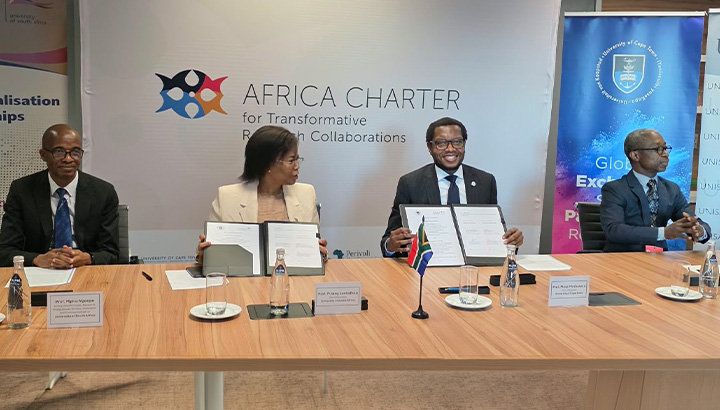
Prof Mpho Ngoepe (Unisa VP), Prof Puleng LenkaBula(Unisa VC), Prof Mosa Moshabela (UCT VC), Prof Thokozani Majozi (Deputy Vice-Chancellor: Research and Internationalisation (UCT)
The partnership also reflects the university’s broader commitment to African-centred knowledge production and the transformation of higher education through research that responds to societal challenges.
A major development at the forum was the introduction of a proposed Implementation Framework designed to help institutions translate the Africa Charter’s commitments into practical measures.
While the Charter provides a shared vision for transforming research collaboration, the framework seeks to establish clearer expectations and processes for institutions that have endorsed its principles.
It includes a declaration outlining the responsibilities associated with becoming a Charter signatory, a roadmap for implementing its aspirations and principles, and mechanisms for sharing information, documenting progress and encouraging institutional learning.
The framework is intended to support changes in how universities and research organisations develop partnerships, allocate responsibilities, establish research priorities and evaluate the outcomes of collaborative projects.
Participants also examined how the Charter’s principles could influence institutional policies, research funding arrangements, academic guidelines and professional standards.
The discussions recognised that meaningful transformation requires more than commitments made at conferences or through formal agreements. It depends on institutions reviewing established practices and creating systems that promote fairness, accountability and shared intellectual ownership.
Through plenary discussions, interactive sessions and networking opportunities, delegates exchanged experiences and explored ways to strengthen cooperation at institutional, national and international levels.
The forum also provided an opportunity to consider how changing geopolitical conditions and developments in global higher education could affect the future of international research partnerships.
Prof Puleng Segalo, who holds Unisa’s Chief Albert Luthuli Research Chair and is one of the Charter’s initiators, traced the origins of the initiative and explained its broader significance.
The Africa Charter was launched on 5 July 2023 in Windhoek, Namibia, during the Association of African Universities’ Conference of Rectors, Vice-Chancellors and Presidents.
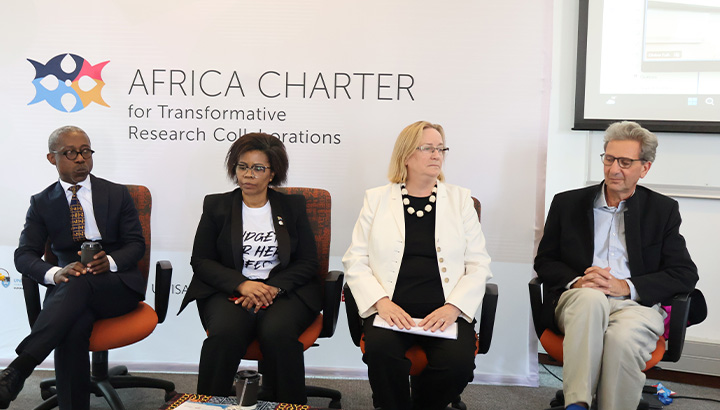
Prof Thokozani Majozi (Deputy Vice-Chancellor: Research and Internationalisation (UCT), Prof Puleng LenkaBula(Unisa VC), Prof Evelyn Welch (University of Bristol), and Dr James Alexander (Founder of the Perivoli Foundation)
It emerged through collaboration involving the Perivoli Africa Research Centre at the University of Bristol, the Chief Albert Luthuli Research Chair at Unisa and UCT’s Institute for the Humanities in Africa.
The Charter was developed in response to longstanding concerns about inequalities in international research partnerships, particularly those involving African institutions and researchers.
These inequalities can manifest in the concentration of research funding and decision-making authority outside Africa, unequal access to resources and limited recognition of African intellectual contributions.
The Charter seeks to address these challenges by promoting research relationships built on mutual respect, shared responsibility and equitable participation.
According to Segalo, its 10 principles and six aspirations are intended to influence not only individual research projects but also the institutional systems that determine how knowledge is produced, funded, recognised and shared.
This includes encouraging changes to university policies, funding models, research guidelines and standards across the higher education sector.
The initiative recognises that transforming global research collaboration requires structural changes that extend beyond individual academics and their institutions.
It also seeks to strengthen Africa’s ability to define research priorities that reflect the continent’s developmental needs, intellectual traditions and diverse knowledge systems.
Building an Independent Global Platform
Another important development announced at the forum was the establishment of an independent digital presence for the Africa Charter.
The dedicated platform is intended to serve as a central space where signatories, researchers and partner institutions can access information, document initiatives, exchange experiences and strengthen collaboration.
It will also support networking and mutual learning among institutions seeking to implement the Charter’s principles.
The development forms part of broader plans to establish the Africa Charter as an independent global commons, stewarded from the African continent.
Such an arrangement is intended to support the Charter’s long-term development while maintaining African intellectual leadership and ownership of its transformative agenda.
By creating mechanisms for continued engagement, the initiative seeks to move beyond occasional gatherings towards a sustained international community committed to reforming research practices.
The Africa Charter’s objectives resonate with Unisa’s Catalytic Niche Area of Feminist/Womanist/Bosadi Theorisations, particularly its emphasis on questioning established systems of power and challenging the marginalisation of knowledge and perspectives historically excluded from dominant academic traditions.
The Charter’s focus on intellectual justice and more inclusive knowledge production also reflects the broader contribution of Unisa’s Chief Albert Luthuli Research Chair, which engages with questions of social justice, transformation and African-centred scholarship.
By promoting equitable participation in international research, the partnership supports the United Nations Sustainable Development Goal 4, which seeks to ensure inclusive and equitable quality education and strengthen opportunities for knowledge development.
It also advances SDG 10, which focuses on reducing inequalities, and SDG 17, which recognises the importance of equitable partnerships in achieving sustainable development.
For African universities, these objectives carry particular significance.
Greater influence over research agendas and stronger institutional partnerships can help ensure that scholarship produced on the continent responds to local priorities while contributing to international academic debates.
They can also create opportunities for African researchers to participate more meaningfully in decisions about research design, resource allocation, publication and the application of research findings.
The partnership between Unisa, UCT and the University of Bristol provides an institutional foundation for pursuing these objectives through sustained cooperation.
The Cape Town gathering marked an important transition in the development of the Africa Charter, shifting the focus from building awareness and securing support towards implementing its principles.
Under the theme “Towards a Community of Action,” participants were encouraged to identify practical steps that institutions could take individually and collectively to transform research collaboration.
The proposed Implementation Framework, plans for an independent digital platform and efforts to establish the Charter as an African-stewarded global commons provide mechanisms through which that ambition can be pursued.
However, the success of the initiative will ultimately depend on whether universities, research organisations and funding institutions translate these commitments into measurable changes in their policies and everyday practices.
For Unisa, the partnership strengthens its role in advancing African intellectual leadership and contributing to international efforts to create a more inclusive and equitable research environment.
It also demonstrates how collaboration between African and international universities can be structured around shared responsibility rather than unequal relationships.
As the Africa Charter enters its next phase, its central message remains that Africa must be recognised not merely as a location where international research takes place, but as an intellectual force capable of shaping the questions, methods and knowledge that inform global scholarship.
Through the formalised partnership, Unisa, UCT and the University of Bristol are helping to advance a vision of international research collaboration in which African knowledge, leadership and intellectual contributions are recognised as essential to the future of global scholarship.
* By Nnana Martina Jege, College of Human Sciences: Communications and Marketing
Publish date: 2026-10-09 00:00:00.0