News & Events
Three Unisa women putting science, research and innovation into action
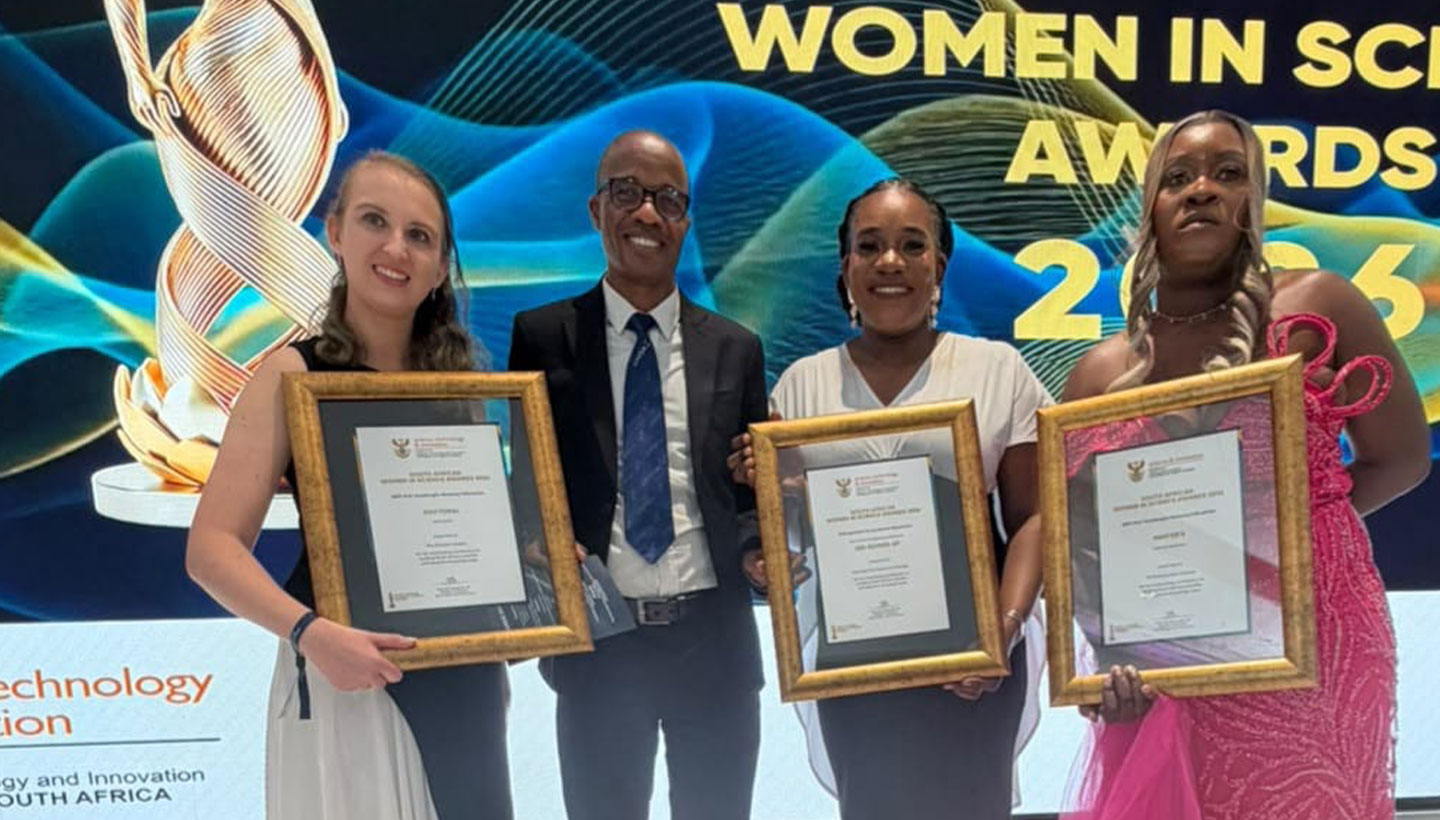
From L-R: Annarien Headley, Prof Mpho Ngoepe, Prof Muthumuni Managa and Mushayathoni Nwovhe
For three Unisa women, being recognised at the 2026 South African Women in Science Awards (SAWiSA) is about more than receiving an accolade. Their achievements offer a glimpse into the breadth of research taking place at the University and the contribution its women researchers and students are making to science, technology and society.
Professor Muthumuni Managa, Annarien Headley and Mushayathoni Nwovhe were among the women recognised at this year’s awards, hosted by the Department of Science, Technology and Innovation (DSTI). The 23rd annual awards ceremony took place in Johannesburg on 20 August under the theme, “Placing Women at the Centre of Science, Technology and Innovation.”
The theme was particularly fitting. Beyond celebrating established researchers, the awards recognise the importance of creating opportunities for young women to enter and advance in scientific fields. This year’s programme also included postgraduate fellowships aimed at supporting talented women pursuing master’s and doctoral degrees.
For Unisa, the recognition provides an opportunity to showcase how research conducted by its academics and students is contributing to some of society’s most pressing questions.
Managa, an associate professor in the College of Science, Engineering and Technology (CSET) and a researcher at the Institute for Nanotechnology and Water Sustainability (iNanoWS), was named second runner-up in the Distinguished Young Women Researcher Award category for Natural, Life and Physical and Engineering Sciences.
Her research brings together nanotechnology, chemistry and sustainable water solutions. She focuses on synthesising and analysing specialised chemicals and nanomaterials, with her work contributing to efforts to address clean water and environmental challenges.
Her achievement demonstrates how scientific research can move beyond the laboratory to address challenges that affect communities and the environment.
Headley, a PhD student in Astronomy at CSET, received a DSTI-Prof. Keolebogile Motaung Doctoral Fellowship. Her research takes a very different path, looking beyond Earth to understand how stars form within molecular clouds across the Milky Way.
Her work examines more than 50 specific regions and has contributed to findings showing that galactic environments can influence the formation of transition disks, with stellar ages changing according to their distance from the centre of the galaxy. She published her findings in a 2026 pilot study in New Astronomy and presented them at the International Astronomical Union General Assembly.
Her recognition is a reminder that scientific curiosity has no boundaries. Whether researchers are studying the water we depend on or the stars beyond our planet, their work expands what we know and opens new possibilities for understanding the world around us.
Nwovhe, a master’s student in Life Science – Microbiology at the College of Agriculture and Environmental Science, received the DSTI-Prof. Keolebogile Motaung Master’s Fellowship. She is a Microbiology and Virology student with a background in haematology whose research focuses on infectious diseases.
Her achievement places the importance of supporting emerging researchers into sharp focus. A postgraduate student today can become the scientist, academic or research leader who helps address tomorrow’s public health challenges.
The 2026 awards also carried particular significance because the DSTI fellowships were renamed in honour of Professor Keolebogile Shirley Motaung, one of South Africa’s distinguished women scientists. The fellowships recognise academic excellence and research potential among young women pursuing master’s and doctoral degrees.
For Unisa students, the achievements of Managa, Headley and Nwovhe provide more than inspiration. They demonstrate that research can be a pathway to solving real-world problems, contributing to global knowledge and building a career that creates an impact beyond the university.
For staff, their recognition also reflects the University’s role in creating an environment in which academics and students can develop their ideas, pursue ambitious research and contribute to national and international conversations.
Their stories show three different paths through science: one focused on water and environmental sustainability, another on the mysteries of the universe, and another on infectious diseases and public health. Together, they illustrate the depth and diversity of research being undertaken at Unisa.
Prof Les Labuschagne, Executive Director: Research, Innovation and Commercialisation, congratulated the winners.
He said their achievements were not only a celebration of individual excellence but also a significant milestone for UNISA and its Research, Postgraduate Studies, Innovation and Commercialisation Portfolio.
“Their national recognition reflects the quality and impact of research conducted at the University and reinforces UNISA’s position as a leading contributor to South Africa’s science, technology, and innovation landscape,” he said.
“Importantly, their success serves as a powerful source of inspiration for current and future women researchers. By showcasing women who are excelling at the highest levels of research and postgraduate scholarship, these awards provide visible role models for aspiring scientists and innovators. Their achievements demonstrate that dedication, innovation and academic excellence can lead to national recognition, encouraging more young women to pursue research careers and contribute to the advancement of knowledge, innovation and societal development,” he added.
As the University continues to strengthen its research and innovation agenda, their achievements offer a powerful message to the next generation: there is a place for women in every field of science, and the research they undertake can change how we understand and respond to the world.
By Nontsikelelo Ndebele, Communications Intern, Department of Institutional Advancement
Publish date: 2026-08-25 00:00:00.0