News & Events
Three Unisa students selected among Africa’s top 20 student quality assurers
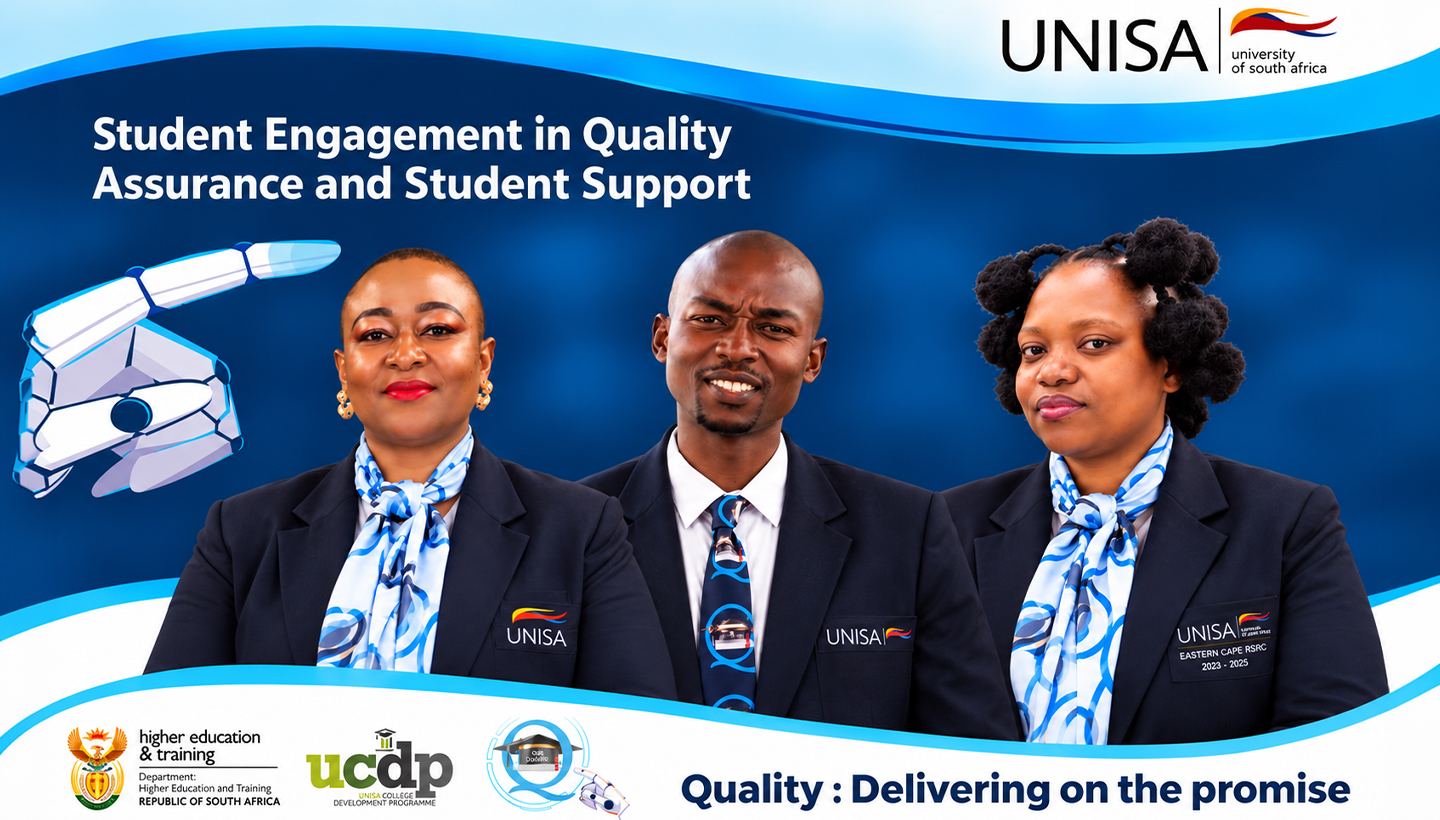
From left: Adv N. Mnisi, Phuti Molebala and Tsholofelo Nkomo, three Unisa students selected among 20 student quality assurers from across Africa through the HAQAA initiative.
The University of South Africa (Unisa) has achieved a significant milestone in student leadership development, with three students selected among 20 student quality assurers from across Africa to contribute to strengthening the quality of higher education on the continent.
The students, all alumni of Unisa’s Student Engagement in Quality Assurance and Student Support (SEQASS) project, were selected through a competitive recruitment process conducted by the All-Africa Students Union (AASU) under the Harmonisation of African Higher Education Quality Assurance and Accreditation (HAQAA) initiative. The selection process attracted more than 300 applications from students across the continent, with Unisa accounting for three of the 20 successful candidates, representing 15% of the selected group. The successful students are Phuti Molebala, an undergraduate student and former Chairperson of the Limpopo Regional Student Representative Council (SRC) and Speaker of Parliament; Adv Nqobile Mnisi, a postgraduate student; and Tsholofelo Nkomo, an undergraduate student and former Chairperson of the Eastern Cape Regional SRC.
Their selection places Unisa students among emerging African leaders who could contribute to quality assurance reviews, policy discussions and initiatives aimed at improving higher education standards across the continent. For Unisa, the achievement demonstrates the growing impact of SEQASS, an initiative established in 2024 to strengthen student participation in institutional quality assurance and improvement. The project recognises students as more than recipients of educational services or participants in institutional feedback processes. Instead, it positions them as active partners who can contribute meaningfully to decisions affecting teaching, learning and the overall student experience.
Through capacity-building initiatives and leadership development opportunities, SEQASS equips students with the knowledge, competencies and confidence needed to participate in quality assurance processes. Just two years after its establishment, the project is beginning to demonstrate how investing in student participation can create opportunities extending beyond the university. Prof Itumeleng Setlhodi, SEQASS project facilitator and co-owner, described the students’ selection as an important institutional achievement.
“Their selection is a moment of immense institutional pride, demonstrating the potential of student leadership development to prepare students at different academic levels for meaningful contributions to quality assurance beyond the university,” said Setlhodi. The achievement also reflects the value of creating opportunities for students from different academic backgrounds and leadership structures to participate in shaping higher education. The HAQAA initiative seeks to improve the quality, comparability and recognition of higher education qualifications across Africa by strengthening quality assurance systems and promoting cooperation among institutions and regulatory bodies. Through the initiative, students are recognised as important stakeholders whose experiences and perspectives can contribute to evaluating and improving higher education.
As members of HAQAA Pool 3, the three Unisa students will be eligible for consideration for external quality assurance reviews, policy and technical engagements, capacity-building programmes and other relevant assignments, depending on the requirements of individual activities. Their inclusion does not automatically guarantee participation in every activity, but it creates opportunities to contribute to continental discussions and processes concerned with higher education quality. For Unisa, the selection demonstrates how student leadership development can contribute to wider efforts to strengthen higher education systems across Africa.
It also supports the African Union’s Agenda 2063 vision of a prosperous continent driven by education, skills development, innovation and cooperation. By promoting meaningful student participation in quality assurance, the initiative contributes to Sustainable Development Goal 4, which seeks to ensure inclusive and equitable quality education. Prof Lumkile Luvuyo Lalendle, SEQASS project owner, highlighted the significance of having both undergraduate and postgraduate students selected for the continental initiative. He noted that the inclusion of two former SRC chairpersons alongside a postgraduate student demonstrates the potential of student-centred quality assurance to transcend academic levels and leadership backgrounds. The achievement shows that student leadership is not confined to elected representative structures but can provide a foundation for broader participation in institutional development and higher education governance.
It also illustrates how students can transfer skills acquired through campus leadership, academic engagement and institutional participation into wider professional and continental environments. The success is particularly relevant to Unisa’s Catalytic Niche Area of Student Support and Co-curricular Activities, which recognises the importance of developing students beyond their formal academic programmes. By combining leadership development with opportunities to contribute to quality assurance, SEQASS provides a practical example of how co-curricular engagement can strengthen students’ capabilities and prepare them for future responsibilities.
Refiloe Tsephe, SEQASS project leader and workshop facilitator, described the achievement as a reflection of the project’s founding vision. “The selection of three QASSA members comprising two former members of the SRC among 20 student quality assurance experts across Africa is an inspiring achievement for the students and a proud moment for Unisa,” she said. “When we established SEQASS in 2024, our aspiration was to move beyond simply listening to student voices. We aspired to move towards developing students as knowledgeable partners, contributors, and future leaders in quality assurance.” Tsephe emphasised that meaningful student engagement requires institutions to invest in developing students’ abilities rather than merely providing platforms for consultation.
The students’ continental recognition demonstrates how sustained investment in leadership development can produce outcomes that extend beyond immediate institutional activities. It also reinforces the importance of recognising students as contributors to the university’s academic mission and broader transformation agenda. As a comprehensive open distance e-learning university, Unisa serves students across different geographical locations, academic disciplines and socioeconomic backgrounds. This diversity creates opportunities to incorporate a wide range of student experiences into institutional quality enhancement.
The success of the three SEQASS alumni demonstrates the potential of Unisa’s model to develop student leaders who can contribute to higher education beyond their immediate learning environments. It also provides an opportunity for academic colleges, departments, regional operations and administrative structures to strengthen collaboration with students in identifying challenges and improving institutional processes. By encouraging students to participate actively in quality assurance, Unisa can continue building a culture in which academic excellence and student experience are treated as shared responsibilities. Such participation is particularly important in distance education, where understanding students’ experiences across different locations and learning circumstances can help institutions respond more effectively to their needs.
The selection of Molebala, Mnisi and Nkomo marks an important chapter in the development of SEQASS and provides encouragement for expanding student participation in quality assurance. Their achievement demonstrates that student leadership initiatives can generate meaningful opportunities when they are supported by structured development, mentorship and institutional commitment. It also reinforces Unisa’s contribution to advancing African higher education through knowledge-sharing, collaboration and the development of emerging leaders. As the university continues to strengthen its student-centred approach to teaching, learning and institutional quality, the success of the three students provides a compelling example of what can be achieved when students are empowered to participate in shaping the future of higher education.
For SEQASS, the milestone is both recognition of progress made since 2024 and an opportunity to deepen its work in developing students as knowledgeable partners in institutional transformation. Above all, the achievement demonstrates that investing in student leadership can create opportunities whose impact extends far beyond the university, contributing to the development of stronger and more inclusive higher education systems across Africa.
* By Refiloe Tsephe, SEQASS Project Leader
Publish date: 2026-11-02 00:00:00.0