News & Events
Students take centre stage as Unisa hosts National Multilingual Student Debate
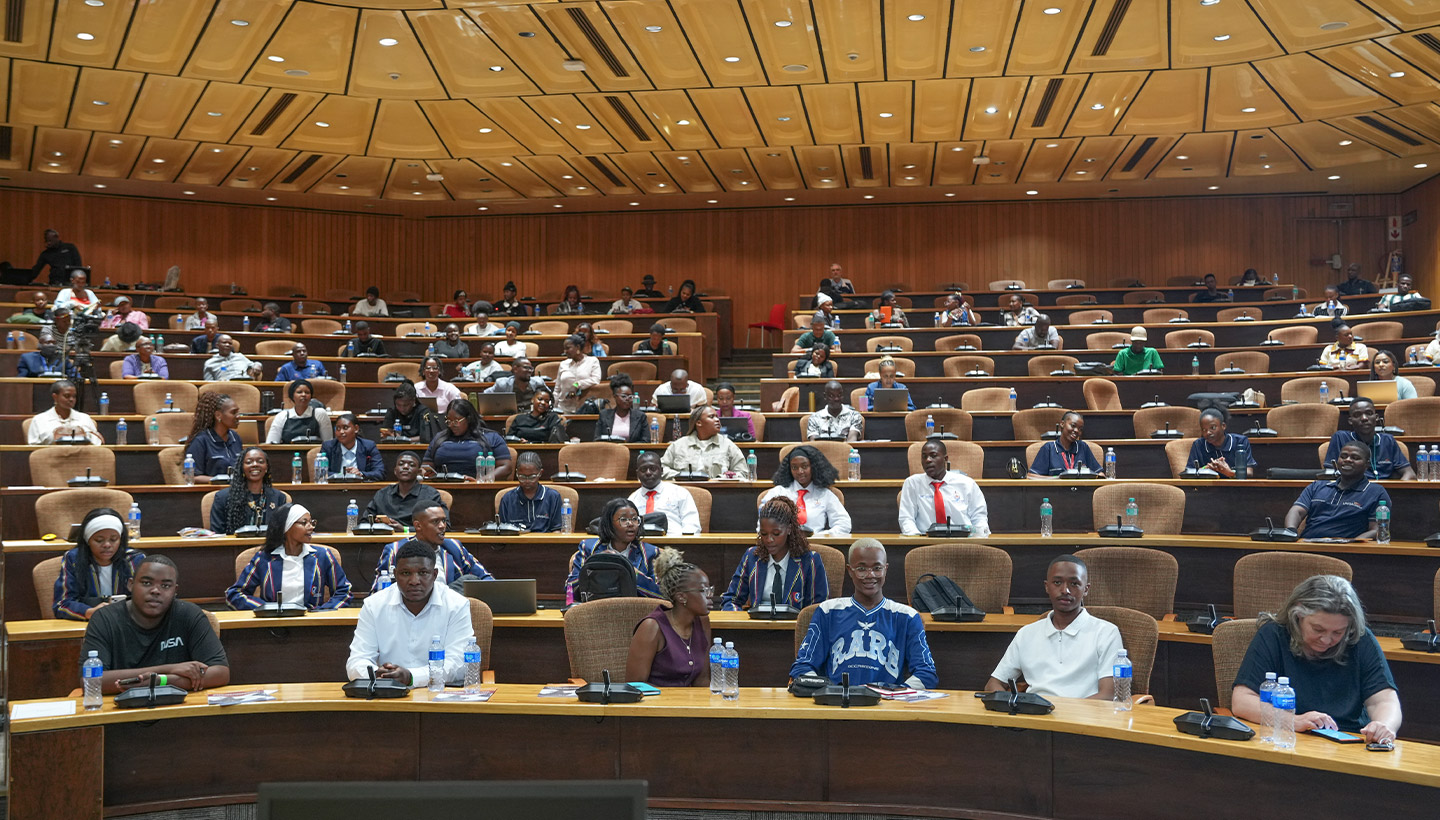
Students and attendees at Unisa’s inaugural National Multilingual Student Debate, held at the Senate Hall, Muckleneuk Campus.
Students took centre stage in a national conversation about language and higher education when the University of South Africa (Unisa) hosted its inaugural National Multilingual Student Debate.
Held under the theme “Students’ Voices on the Language Agenda”, the debate brought together student delegations from Unisa, iYunivesithi Walter Sisulu (WSU), the Central University of Technology (CUT) and the University of Venda (Univen) for a day of multilingual argument and discussion on the future of language in South African higher education.
After three rounds of competition in the Senate Hall, iYunivesithi Walter Sisulu emerged as the overall winner, taking the national title ahead of the other participating institutions.
Opening the event, Professor Meahabo Magano, Executive Director of the Department of Tuition Support and Facilitation of Learning, said Unisa had deliberately brought together universities from different parts of the country to ensure that discussions about the language agenda extended beyond individual institutions.
The initiative, she said, was intended to position multilingualism as a national higher education issue requiring collaboration across the sector.
Dr Azwinndini Tshivhase, Acting Vice Principal for Teaching, Learning, Community Engagement and Student Support, reinforced the importance of giving students a meaningful role in shaping their institutions.
“It cannot be a university without students,” he said, stressing that students should not simply be managed by universities but should participate actively in shaping how institutions operate.
He called for the debate to develop into a sustained platform where universities can return to the issues raised, exchange experiences and share practices.
Setting the context for the debate, Dr Rakwena Monareng, Director of the Directorate Language Services (DLS), said universities had developed language policies over many years, but student voices had not always been central to those processes.
The debate was therefore designed to give students a platform to engage directly with South Africa’s constitutionally grounded multilingual language agenda.
Monareng said students should not be separated from the linguistic resources they bring from their homes and communities, particularly their mother tongues and home languages.
Unisa SRC Midlands Region Chairperson Thapelo Motepe welcomed the participating institutions on behalf of the student body and challenged the debaters to consider what should be preserved from Africa’s linguistic heritage for future generations.
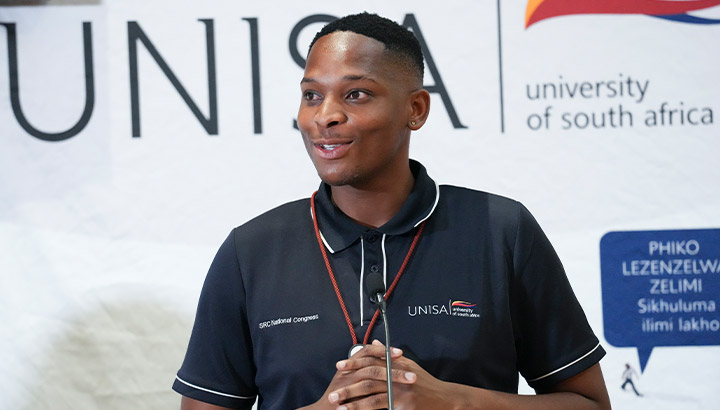
Unisa SRC Midlands Region Chairperson Thapelo Motepe addresses students and attendees during the National Multilingual Student Debate.
The competition followed a formal debate structure, with proposition and opposition teams comprising five main speakers each. Teams also faced questions from the audience and adjudication panel before delivering closing replies.
The competition was structured around six themes central to the multilingualism debate in higher education:
- Language Policy Implementation in Higher Education – examining the gap between policy and practice.
- Students as Language Policy Champions – considering how students can participate in shaping and advancing institutional language policies.
- Academic Access and Success – exploring the role of mother-tongue instruction in student learning and achievement.
- Technology and African Languages – examining how artificial intelligence and digital platforms can support the visibility and development of African languages.
- Language, Identity, Culture and Belonging – considering the relationship between language, dignity, inclusion and belonging in physical and virtual university spaces.
- The Future of South Africa’s Multilingual Language Agenda – looking at priorities and possibilities for the next decade.
The format required students to engage with the issues from different perspectives while demonstrating their ability to construct arguments, respond to opposing views and communicate across linguistic contexts.
The review panel comprised Lekau Rachidi, Manager of the Student Retention Unit; Dr Gabaiphiwe Moleko, Deputy Director for the College of Law in the Directorate Curriculum Development and Transformation; Malefu Mahloane, Adjunct Academic in the Department of African Languages; and Babalwa Resha, Language Practitioner in the Directorate Language Services.
The adjudication panel consisted of Dr Jabulani Nene, Head of the Centre for Professional Development; Nkeke Thosago, Manager of the Directorate Language Services; and Ziyanda Febana-Mkila, Student Success Practitioner and Siyaphumelela.
Following the competition, Rachidi, as chairperson of the review panel, presented the debate resolutions.
Dr Nene, chairperson of the adjudication panel, then announced the results and handed out the awards, with iYunivesithi Walter Sisulu crowned the inaugural National Multilingual Student Debate winner.
Closing the event, Dr Phumza Makgato, Director of Institutional Support and Services, thanked the participating universities, adjudicators, students and the Directorate Language Services for their contributions.
The DLS also provided South African Sign Language (SASL) interpretation throughout the event, which was livestreamed to allow a wider audience to follow the proceedings.
For Unisa, the inaugural debate is intended to become more than a once-off competition.
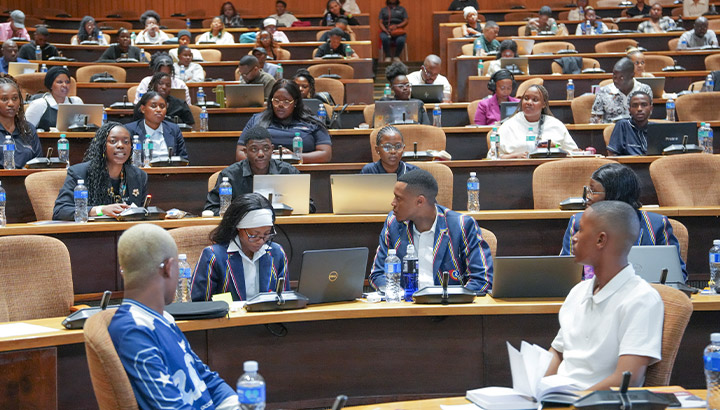
Students from Unisa, iYunivesithi Walter Sisulu, the Central University of Technology and the University of Venda debate the future of multilingualism in South African higher education.
The DLS hopes to establish it as an annual platform that keeps students at the heart of conversations about the place of South Africa’s 12 official languages, as well as the many other home languages spoken by students, in higher education.
The organisers say the long-term focus is on ensuring that language remains part of broader conversations about teaching and learning, research, scholarship, student success and campus life.
* By Babalwa Resha, Language Practitioner, Directorate of Language Services, and Dr Mzamani Aaron Mabasa, Directorate of Language Services
Publish date: 2026-09-22 00:00:00.0