News & Events
Reimaging masculinity at Unisa
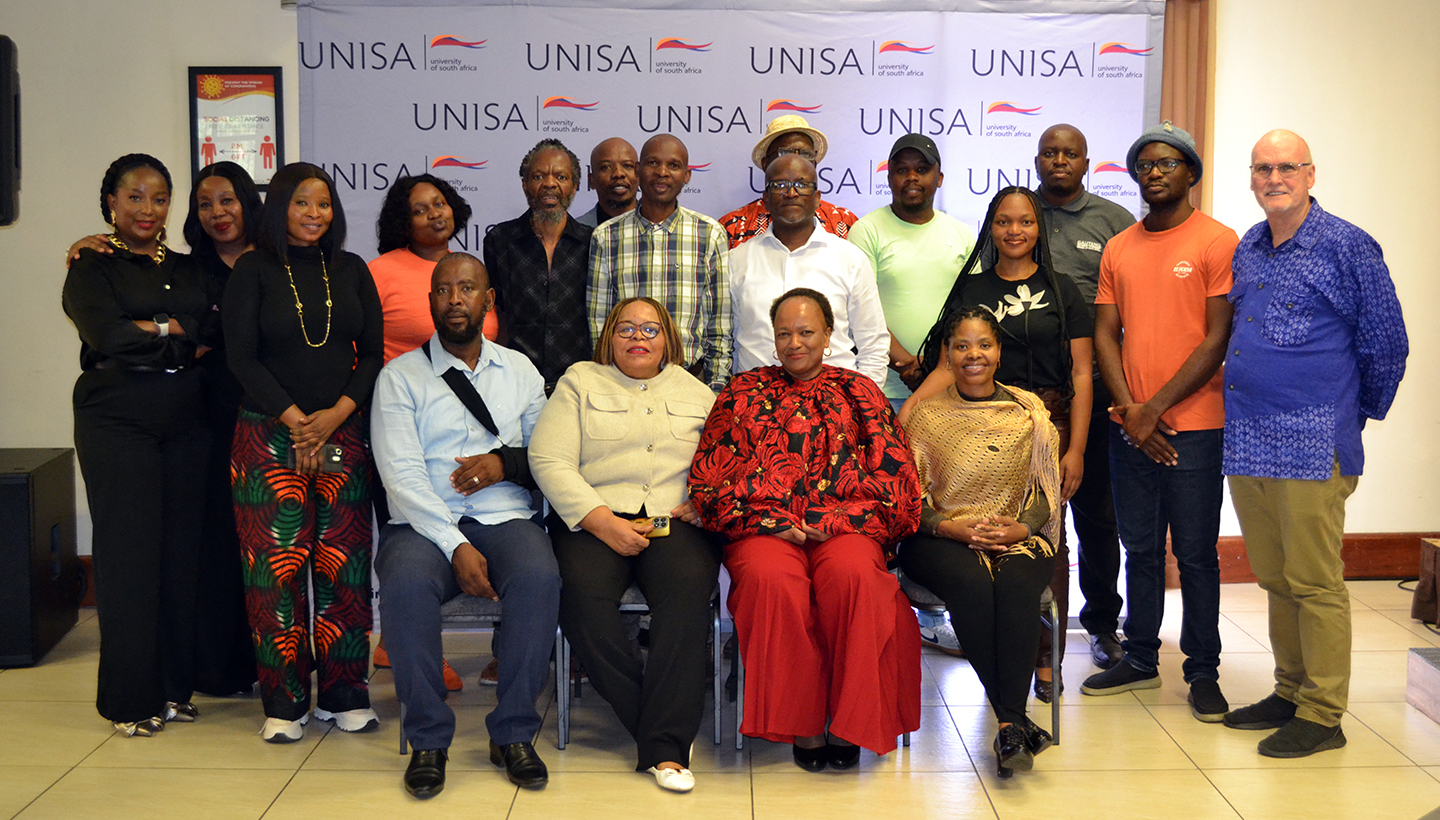
Speakers and guests at the Speak Up Campaign
Unisa’s Department of Leadership and Transformation held a Speak Up Campaign on Thursday, 9 April 2026, aimed at broadening conversations on gender-based violence (GBV) and its triggers.
Despite various reports highlighting that women are often victims and men perpetrators of GBV, through this campaign, the institution aims to dismantle harmful stereotypes, narratives, and societal stigmas that men are subjected to.
Dr Phumzile Dlamini, Deputy Director of Governance, Leadership and Management under Unisa’s Human Resources Department, reiterated that society usually focuses on the victim’s point of view, mainly being women, while treating men as scapegoats. Furthermore, she maintained that every institutional policy must align with the acceleration of human rights. “The lack of gender mainstreaming emanates from our past as a nation, which has become a shadow to gender roles,” said Dlamini.
For her, a reflection on masculinity and the promotion of gender equality within the institution are enablers of dismantling harmful stereotypes and empowerment for inclusivity and male identity. To strengthen social transformation through collaborations, Dlamini emphasised on harnessing awareness and positivity to end gender inequality. She also urged the institution to have equal representation of both men and women by recognising their strengths, individually and collaboratively.
Encouraging men to speak up and redefine their identity, Veli Mahlakwane, acting Assistant Director of Social Crime Prevention at the Gauteng Department of Community Safety and Liaison, shed light on the challenges faced by men. He further cited statistics indicating that there are almost 170000 incarcerated individuals, with about 3800 being women. From these statistics, Mahlakwane remarked that some male counterparts are incarcerated for reasons ranging from unfounded acts of revenge to false accusations.
Recounting his previous campaigns, Mahlakwane spotlighted how these statistics emanate from individuals living in marginalised communities and the rejection they face. Adding, he noted that men are regarded by their titles and not by their personhood.
Thabang Sekhwama, Records Officer at Unisa’s Directorate of Privacy and Records Governance, accentuated the lack of support services, stereotypical norms, and labelling that men face when attempting to speak up. He maintained that there needs to be a new paradigm of thinking based on unbiasedness and collective responsibility in order to tackle GBV effectively.
Leon Roets, Curriculum and Learning Development Specialist at Unisa’s Directorate of Curriculum Development and Transformation, remarked that culture and structures are determinants of how men are treated. “Before gender titles, there is a personhood that we must ascertain,” he said. Advocating for gender equity, Roets continued: “It is, unfortunately, a nonlinear paradigm as whenever gender equality is promoted, womanhood takes centre stage.”
Following the speakers’ addresses was a vibrant question-and-answer session centred on the notions of superiority versus inferiority complex amongst genders, idolisation of cultural standards in society, and other challenges faced by both men and women.
Concluding, Dr Vuyokazi Sigaqa, Supervisor of Student Administration, urged everyone to advocate for and participate in accelerating such robust discussions to address gender equality, demonstratively and collaboratively.
* By Nontsikelelo Ndebele, Communications Intern, Department of Institutional Advancement
** Photography by Moleboheng Mpafa, Communications Intern, Department of Institutional Advancement
Publish date: 2026-04-15 00:00:00.0