News & Events
Reasserting Traditional Leadership: Unisa seminar explores the future of African indigenous justice
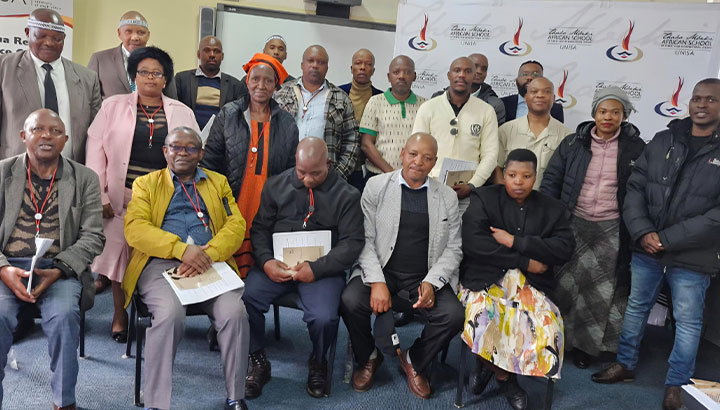
The TM-School researchers and the iinkosi of the Amahegebe sub-clan at the UNISA Mthatha Regional Service Centre
The role of traditional leadership in South Africa’s democracy came under scrutiny when the Lekgotla la Batho Engaged Scholarship project brought scholars, traditional leaders and community representatives together for a seminar exploring the future of African indigenous justice systems.
Held on 9 July 2026 at the Unisa Mthatha Regional Service Centre in the Eastern Cape, the seminar, titled “Reasserting the Institutions of Traditional Leadership in South Africa”, examined how African indigenous knowledge on dispute resolution and traditional courts could be strengthened and incorporated into the mainstream legal framework.
The Lekgotla la Batho Engaged Scholarship project, led by the Thabo Mbeki African School of Public and International Affairs (TM-School), seeks to redefine and reconstruct African indigenous knowledge systems relevant to dispute resolution and indigenous courts.
The seminar brought together members of the TM-School who are involved in the project, Traditional Council members under the leadership of Inkosi Phathekile Holomisa, as well as management from the Mthatha Regional Service Centre.
A central theme throughout the discussions was the need to recognise traditional leadership as an important institution within South Africa’s constitutional democracy and to ensure that traditional leaders and communities have a meaningful role in policymaking.
Opening the seminar, Mthatha Regional Service Centre Manager Thandanani Mdlalose welcomed participants and thanked the Traditional Council and TM-School for bringing the discussion to the region.
He highlighted the importance of collaboration between the university, traditional leadership and communities in creating opportunities for meaningful engagement and advancing initiatives that respond to local needs.
One of the key discussions focused on the Traditional Courts Act No. 9 of 2022 and questions surrounding the powers and status of traditional courts.
Inkosi Phathekile Holomisa, King of the AmaHegebe in Mqanduli, Eastern Cape, raised concerns about what he described as shortcomings in the legislation. He reflected on the extensive parliamentary deliberations around the Act and the objections that contributed to delays before its intended signing.
Holomisa argued that while the legislation deals with traditional courts, it does not provide them with the powers necessary to perform their functions effectively.
He also spoke about the relationship between customary law, democracy and traditional leadership, stressing the importance of adapting customary practices to contemporary circumstances while preserving their underlying principles.
Traditional councils, he explained, also rely on elders who provide guidance and support decision-making. Consultation and consensus-building remain important elements of this process.
Holomisa also referred to an earlier consultation hosted by the Lekgotla la Batho Research Project, which brought together traditional leaders, members of the Rastafarian community and academics to discuss issues affecting traditional leadership and indigenous knowledge systems.
Macdonald Rammala, a project leader at the TM-School, emphasised the importance of reaffirming the place of traditional leadership within South Africa’s constitutional framework.
Drawing on Sections 116 and 211 of the Constitution, Rammala pointed to the challenges facing traditional courts, including the absence of the institutional infrastructure associated with formal judicial systems.
He argued that African approaches to law and justice cannot simply be understood through the framework of Western legal institutions, highlighting the need to examine indigenous systems on their own terms.
The discussion raised broader questions about how South Africa can recognise and strengthen indigenous approaches to justice while ensuring that they remain relevant within a constitutional democracy.
The seminar also examined the relationship between indigenous knowledge, peace and community safety.
Boikhutso Mfusi, a member of the TM-School project team, said human security extends beyond conventional law enforcement. It includes the physical, spiritual, social and environmental wellbeing of communities and how communities draw on indigenous knowledge systems to protect and support themselves.
Mfusi linked these approaches to the broader ideals of Pan-Africanism, the African Renaissance and the objectives of the African Union’s Agenda 2063.
She emphasised the importance of communities having confidence in their own indigenous knowledge systems and their ability to use these systems to resolve conflicts and build peaceful communities.
Restorative justice, forgiveness and healing, she said, are important elements of indigenous approaches to conflict resolution.
Mfusi also stressed the need for traditional leaders and communities to participate actively in policymaking. Such participation, she argued, could contribute to policies that are more inclusive, culturally relevant and sustainable.
For Unisa, the seminar also demonstrated the role universities can play in creating platforms where academic research, traditional knowledge and community experience meet.
The programme concluded with remarks from Nombulelo Momoza, the Inkosazana (Queen) of Mqanduli Village, who expressed appreciation to the organisers, traditional leaders, academics and other participants for contributing to the discussions.
The seminar provided a platform for continued dialogue on the place of traditional leadership, indigenous knowledge and African approaches to justice in contemporary South Africa.
For the Lekgotla la Batho Engaged Scholarship project, the discussions form part of a broader effort to ensure that indigenous knowledge is not only documented and studied, but also considered in debates about law, governance, conflict resolution and community development.
* By Boikhutso Mfusi, Researcher at the Thabo Mbeki African School of Public and International Affairs
Publish date: 2026-08-17 00:00:00.0