News & Events
Lekgotla anchors commitment to student success
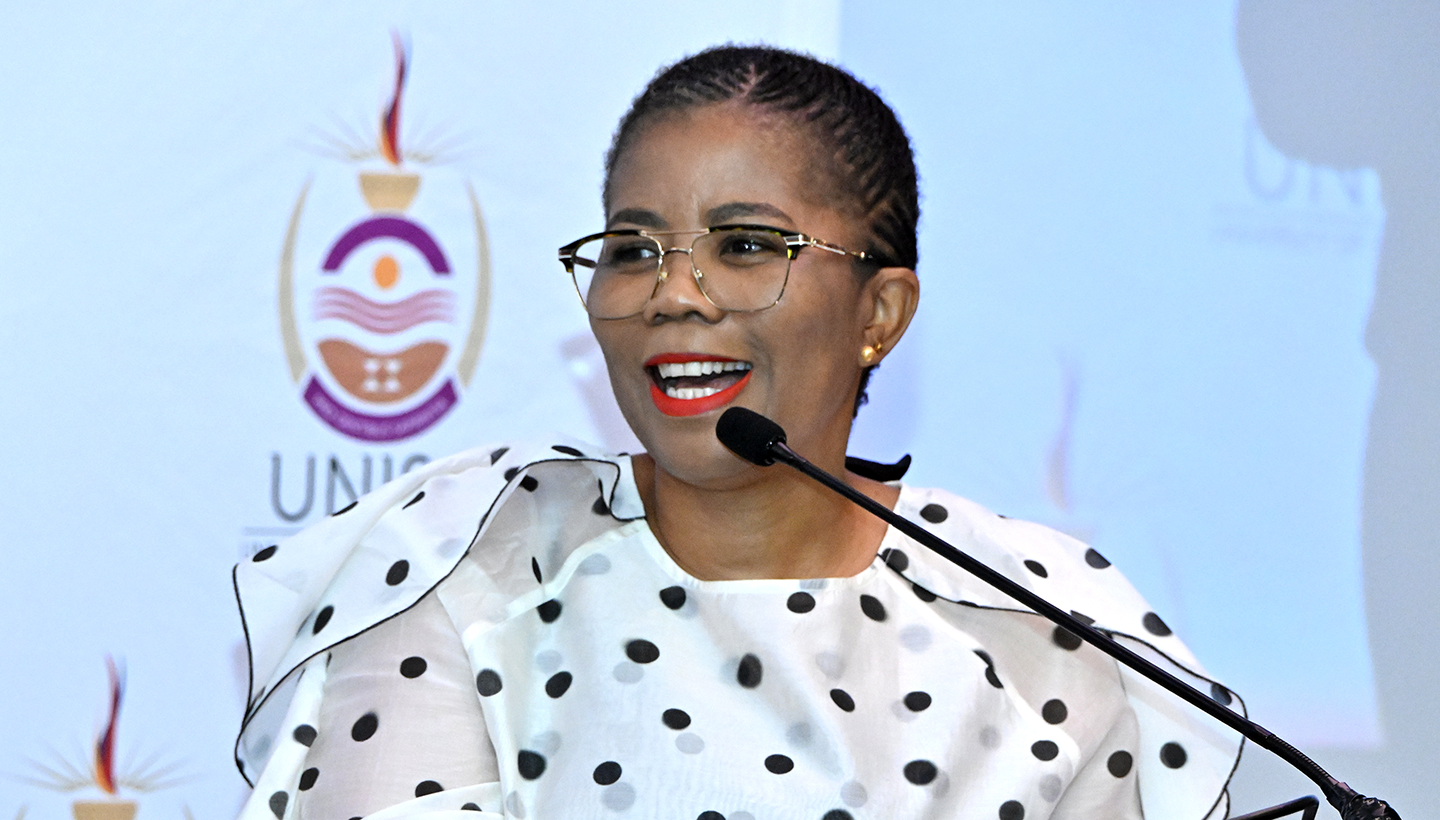
Prof Puleng LenkaBula, Unisa Principal and Vice-Chancellor
On 24 February 2026, the Principal and Vice-Chancellor’s Lekgotla moved into its second day, with discussions shifting from laying the groundwork to sharpening direction. The delegates divided into groups to discuss the development of implementation plans, focusing on collectively identifying the key challenges that have constrained institutional performance.
The key focus was to establish strategic priorities, implementation pathways, and enablers to fortify Unisa's status as the continent's largest and most prominent open, distance and eLearning higher education institution, with increasing global relevance and influence.
The sessions allowed rapporteurs and young academics to present, and designated listeners contributed to high-level discussions.
Addressing delegates, Professor Puleng LenkaBula, Unisa Principal and Vice-Chancellor (VC), thanked them for their contributions and attendance. She said: “This year’s Lekgotla has been a great success. The improvements suggested, and good contributions from diverse colleges, portfolios and Unisans in different fields of study should be shared worldwide, not only with the Unisa community, because our society needs to recognise the trajectory to which this august university contributes.”
Leveraging data and analytics for Unisa’s student success
The Lekgotla gave rise to a comprehensive examination that delved into execution frameworks, addressed delayed programmes that require attention, and fostered research-driven, accountable decision-making systems.
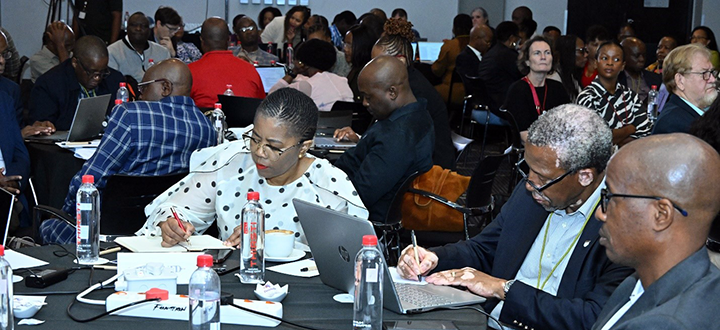
Delegates on the second day of Lekgotla participating in implementation discussions
Presentations shared by the university’s leadership reflected an agile approach to governance and strategic planning. The VC underlined the importance of basing discussions on facts rather than aspirations.
LenkaBula added that the university’s leadership have a clear purpose. “We are committed to thorough ideation, research, and data analysis to ensure our discussions are grounded in facts, not aspirations,” she noted. “This Lekgotla was intended as a deep dive into execution frameworks, delayed programmes needing our attention, and decision-making systems that are research-driven and accountable. Our focus remains on diligence and agility in addressing these systematic, structural, and economic challenges,” she expressed.
The VC also reflected on the quality of the university’s product offerings; not just their quality, size, and volume, but their impact locally and globally. She told Unisans to explore the academic core business and its core curriculum support systems, ensuring they align with the aspirations for excellence.
Furthermore, LenkaBula explained how each priority area will now be supported by clear timelines, decisive leadership, and measurable indicators to ensure delivery to students. She also enjoined academics to investigate the failure rate of unprivileged students using the National Student Financial Aid Scheme (NSFAS). Through these evaluations and assessments, LenkaBula believes that the focus will improve strategy execution and accountability among university members.
Young voices shaping Lekgotla discussions
LenkaBula acknowledged the voices of young academics and the envisioned work. “For the first time,” she said, “we have given them a prominent platform in the Lekgotla to contribute immensely, rather than giving them a seat to listen but not participate. In this instance, we did not invite them just to listen, because we recognise it will be constructive for multigenerational leaders in our university from academic, professional and administrative spaces to hear their critiques, aspirations, inputs, and experiences, and how they want to work with us to strengthen our university.” She also mentioned improvements in mentorship programmes to ensure that young academics’ talents and growth are supported.
Emphasis was also placed on the success and support of Unisa’s students, with implementation plans set to be finalised by the end of March 2026.
The VC encouraged Unisans to actively support international music competitions hosted by Unisa, noting that the university continues to perform strongly in this area both locally and on the global stage. She underscored that music fosters a sense of shared humanity and plays a transformative role in music education and performance worldwide, reinforcing Unisa’s growing international cultural footprint.
Good news was also shared at the event. Distinguished Professor James Okwe Chibueze from the Department of Mathematical Sciences was congratulated for being awarded the prestigious 2025 Royal Society Rising Star Africa Prize for being part of a team contributing exceptionally to astronomy. Professor Solomon Magano, Unisa's Vice-Principal for Institutional Development, delivered a congratulatory message outlining the impact this award has on the university. Chibueze was recognised for pioneering research in high-mass star formation and astrophysics, advancing African astronomy through capacity building.
Evidence-based diagnosis
Another notable feature of day two was the attention given to the data and evidence presented by Dr Letlhogonolo Marumolwa from the portfolio Strategy, Risk and Advisory Services, to showcase gaps hindering performance. His data-driven presentation was clear on student success, access, and dropouts. Marumolwa shared statistics and delved deeper into the institutional culture that needs interconnected commitments requiring coordinated leadership across portfolios.
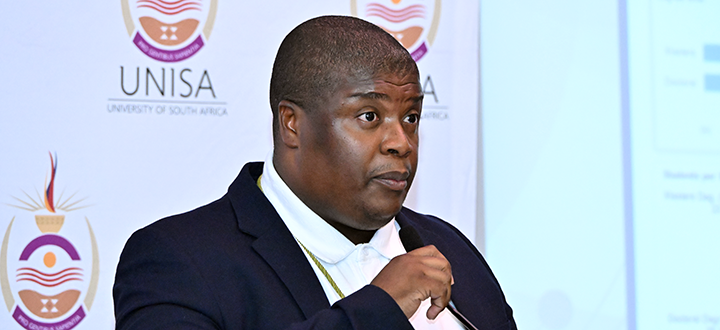
Dr Letlhogonolo Marumolwa delivering a data-driven presentation
After a day of strategic clarity, reflections and robust discussions, the Lekgotla, on its last day, shifted its focus from diagnosis to delivery, outlining, across departments, colleges and other functions, concrete mechanisms to ensure that resolutions or agreements translate into measurable institutional outcomes for students’ success.
Facilitated by Morailane Morailane, a former Chairperson of Council at the Mangosuthu University of Technology (MUT) and governance expert, day two discussions explored how institutional plans, performance indicators, and governance mechanisms can be better aligned to support delivery.
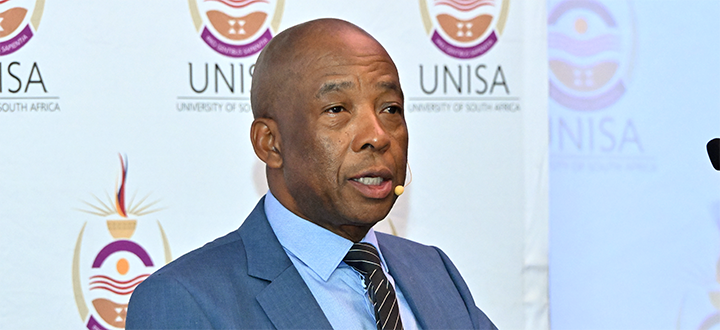
Morailane Morailane, a university governance expert, guided Unisans to work collectively and effectively to achieve their goals
With the conclusion of the Lekgotla, discussions moved beyond broad alignment to a more precise articulation of where the university is heading and how it intends to get there. The groundwork laid through these discussions positions the university to enter the next phase of the Lekgotla with a sharpened sense of purpose, ready to interrogate implementation pathways, institutional commitments, and mechanisms for impact.
Read also: Building Unisa's execution architecture for institutional impact
* By Lesego Chiloane, Journalist, Department of Institutional Advancement
** Photography by Shooheima Champion, Multimedia Centre
Publish date: 2026-02-25 00:00:00.0