News & Events
From waste tyres to shoe polish: Unisa Professor turns waste into opportunity
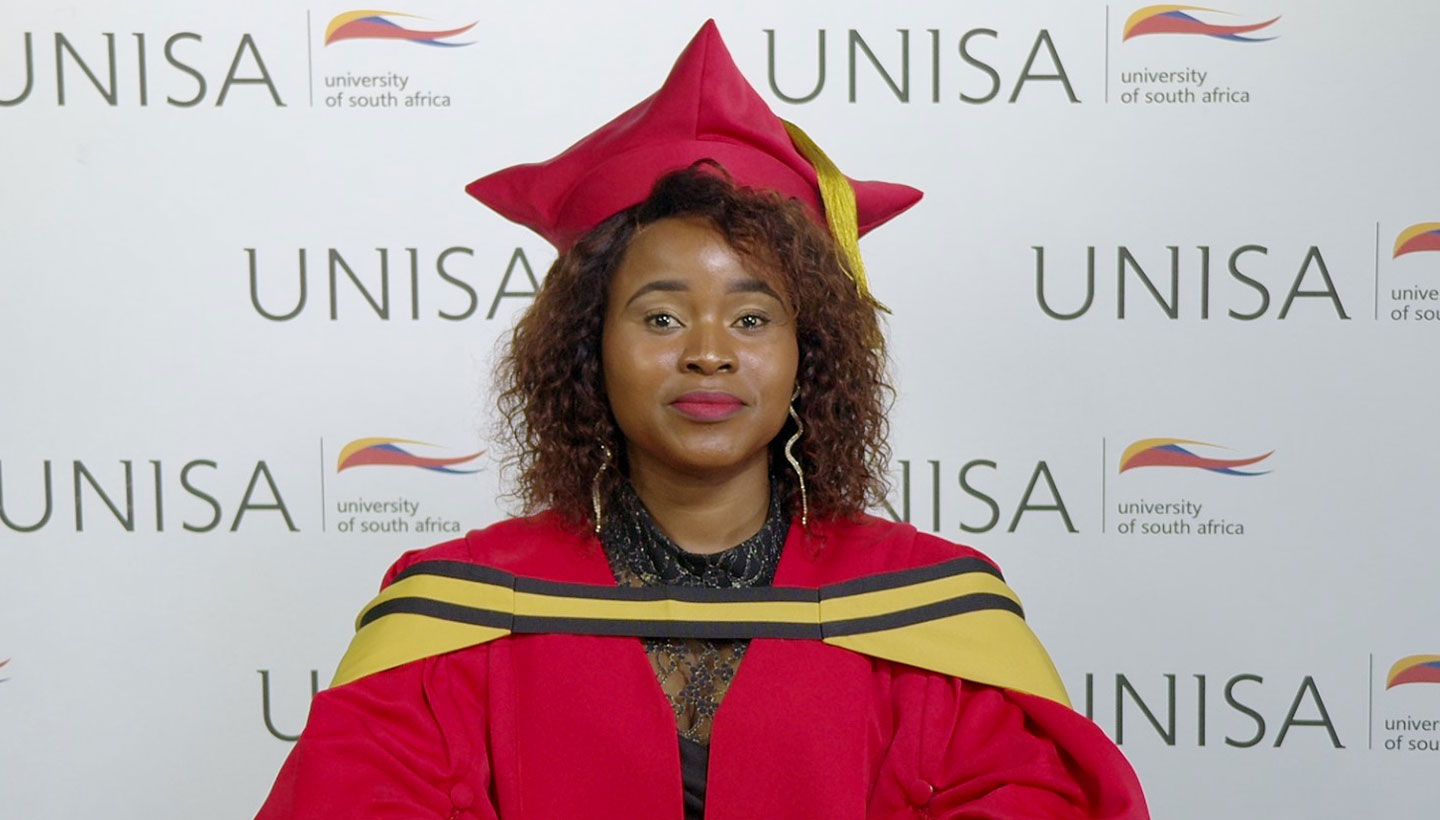
Professor Tebogo Mashifana.
What if a waste tyre could be turned into shoe polish? Or mine tailings transformed into construction materials?
For University of South Africa (Unisa) Professor Tebogo Mashifana, these are examples of how scientific research can challenge conventional thinking about waste and identify new uses for materials that would otherwise be discarded.
Mashifana, from the Department of Chemical and Materials Engineering in Unisa’s College of Science, Engineering and Technology (CSET), delivered her inaugural lecture on 11 September 2026. Titled “Reimagining the Circular Economy as a Catalyst for a Green Economy and Sustainable Development: Addressing Africa’s Grand Challenges”, the lecture focused on Africa’s growing waste problem and the need to rethink how resources are produced, used and discarded.
Africa generates an estimated 174 million tonnes of waste each year, with volumes expected to increase. Much of this waste ends up in landfills or uncontrolled dumping sites. In South Africa, only a relatively small proportion is recycled, while most waste is disposed of through landfilling.
Mashifana linked the challenge, in part, to the conventional linear economic model of “Take → Make → Use → Dispose”.
“Under this model, natural resources are extracted, transformed into usable products, consumed and eventually discarded as waste,” she said.
“While this system has supported industrial development, it has also contributed to environmental pollution, resource depletion, greenhouse gas emissions and environmental degradation.”
Her research focuses on an alternative approach through the principles of the circular economy, in which materials are kept in use for as long as possible through reuse, repair, refurbishment, recycling and recovery.
In this model, waste is not necessarily the end of a production process. It can become an input into another process, while industrial by-products can be recovered and converted into useful materials.
“I argue that the circular economy should be reimagined not only as a recycling technique, but as a fundamentally different way of designing production processes and consumption systems,” Mashifana said.
“This transition offers enormous potential for Africa to achieve green growth and sustainable development.”
For more than a decade, Mashifana and her research team have investigated ways of turning waste and industrial by-products into materials with environmental, economic and social value.
Her research is centred on four areas:
- Waste valorisation: Transforming waste streams and industrial by-products into useful materials and resources.
- Resource recovery: Recovering valuable minerals, metals and other materials from waste.
- Waste-based water treatment: Using waste-derived materials to address water pollution and improve water quality.
- Value-added product development: Converting recovered resources into practical products with potential for wider use and commercialisation.
The research is based on the premise that waste from one process can become a resource for another.
Some of the projects undertaken by Mashifana’s research team illustrate how these principles can be applied beyond the laboratory.
They include developing shoe polish from waste tyre materials; recovering metals such as copper and chromium from industrial waste; producing construction materials from fly ash and slag; and using gold mine tailings as backfilling material to fill excavated mine voids.
The team has also investigated the recovery of silica from spent foundry sand, the conversion of plastic waste and invasive water hyacinth into value-added products, and the conversion of sewage sludge and wood waste into bioenergy products such as briquettes, biochar, oil and gas.
The work demonstrates how waste-management challenges can also provide opportunities for resource recovery, product development and enterprise creation.
Mashifana said research should not end with publication in academic journals, but should progress towards practical application.
“If our work is to make a meaningful difference, it cannot remain confined to academic publications,” she said.
“Many of the technologies that we have developed in our research group have progressed to the prototype stage. The next challenge is to advance them through demonstration, industrial adoption and commercialisation.”
She identified real-world testing, collaboration with industry and entrepreneurship as important steps in moving technologies from the laboratory into wider society.
For Africa, this transition is particularly relevant as universities face growing expectations to contribute to solutions for environmental and socioeconomic challenges while supporting innovation, skills development and economic activity.
Responding to the inaugural lecture, Professor Freeman Ntuli of Botswana International University of Science and Technology (BIUST), who previously supervised Mashifana at doctoral level, reflected on the responsibilities that accompany academic achievement and professorial rank.
“The title of professor carries with it significant responsibilities: advancing knowledge with academic integrity, mentoring emerging scholars, contributing to institutional leadership, and ensuring that research remains responsive to the needs of society,” Ntuli said.
He expressed confidence that Mashifana would continue developing her research while fulfilling these responsibilities.
“I also hope that Unisa will continue to provide the intellectual environment, partnerships and support necessary for her research vision to flourish and achieve an even greater impact,” he added.
Mashifana’s inaugural lecture brought together her research focus on waste valorisation, resource recovery and sustainable product development, while highlighting the broader challenge of changing how waste is understood and managed.
* By Dr Nozipho N. Madzivha, Acting Communication and Marketing Specialist, College of Science, Engineering and Technology
Publish date: 2026-09-21 00:00:00.0