News & Events
COMSA conference examines media accountability in the age of podcasts, influencers and citizen journalism
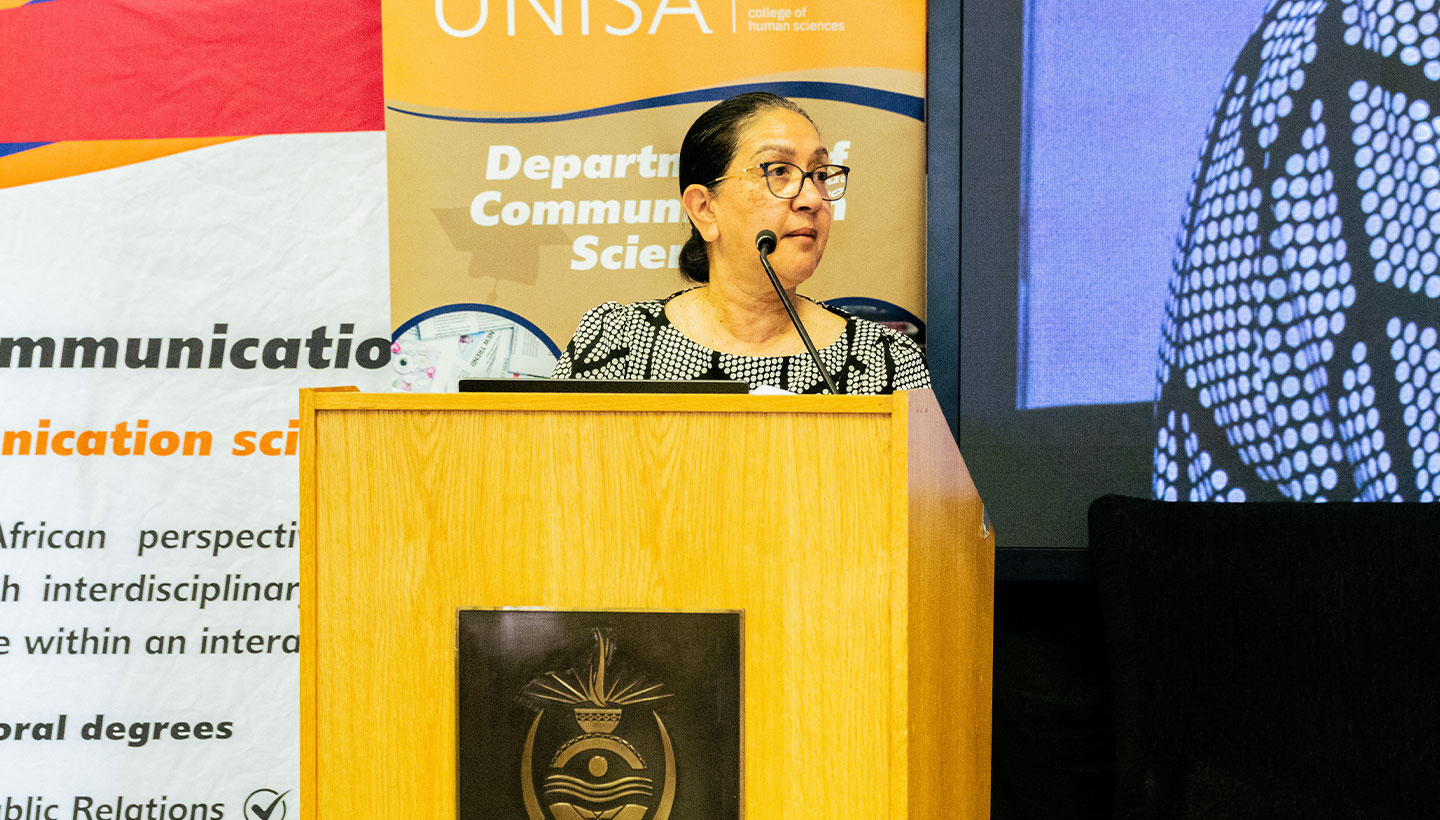
Professor Khatija Khan
The University of South Africa’s (Unisa) Communication Students’ Association (COMSA) has brought communication students from several institutions together to examine how journalism, digital media and public accountability are changing in an increasingly fragmented media environment.
Held on 16 September 2026 at the Kgorong Building Function Hall under the theme, “Social, Political Responsibility and Alternative Media: Podcast, Influence, and Citizen Journalism”, the annual conference was attended by students from Unisa, Tshwane University of Technology (TUT), Vaal University of Technology (VUT), Rosebank College and the University of the Witwatersrand (Wits).
Established by Unisa communication students in 1993, COMSA was created to bridge the gap between communication theory and practice, promote communication as a career, expose students to the corporate world, and provide opportunities for workshops and seminars focused on communication skills.
In her welcome address, Professor Khatija Khan, senior lecturer in the Department of Communication Science and COMSA liaison, said communication had become more powerful, immediate and contested.
“A message can cross the world in seconds, yet a falsehood can travel even faster,” Khan said. She noted that mobile technology had given individuals the ability to reach millions, while institutions with significant resources could still struggle to be heard, understood and trusted.
She challenged students to think beyond whether they could communicate and consider whether they could do so “with truth, judgement and purpose”.
Khan said COMSA’s role extended beyond providing a platform for students to develop professional skills.
For more than three decades, she said, the association had reflected the belief that university education should prepare graduates not only for employment, but also to contribute to society, strengthen democracy and broaden access to opportunity.
Looking ahead, Khan urged students to consider the demands of a media environment that is vastly different from the one in which COMSA was established.
Artificial intelligence can now produce published material within seconds, while synthetic images and videos can create convincing falsehoods. Algorithms influence what millions of people see, often without users understanding how those decisions are made, while competition for public attention has become a major part of the media economy.
Against this backdrop, Khan said technical competence alone was no longer sufficient.
Graduates, she argued, needed to distinguish information from knowledge, visibility from credibility, and influence from manipulation. They also needed to understand emerging technologies without surrendering their own judgement to them.
Professor Rofhiwa Mukhudwana, chair of the Department of Communication Science, focused on another challenge facing journalism education.
“If every specialist can become a beat reporter or journalist within their area of expertise, what should journalism education look like? How should we, as media scholars, prepare our students for this emerging world?” she asked.
Mukhudwana also acknowledged the support of the College of Human Sciences Executive Dean, Professor Zethu Nkosi, and the Director of the School of Art, Professor Siyasanga Tyali, in making the conference possible.
She said Nkosi’s commitment to student support was reflected in the growth of student structures across the college.
Mukhudwana also used the occasion to condemn the continuing killing of women in South Africa, calling for greater responsibility from the media, scholars and society in confronting narratives and conditions that normalise violence against women.
The conference’s keynote address by Dr Phathiswa Magopeni, executive director of the Press Council of South Africa, focused on a distinction she said was central to understanding accountability in the digital media environment.
Magopeni cautioned against treating podcasts, citizen journalism and influencers as though they were equivalent to platforms such as Facebook, YouTube and TikTok.
She said the distinction mattered because platforms are infrastructure that host and distribute content and, through algorithms, influence what content reaches audiences at scale. Companies such as Meta, YouTube, Spotify, TikTok and X also have significant market power and make decisions about which content is promoted or hidden.
These issues, she said, were relevant to competition regulation and platform accountability.
A podcast, by contrast, is a content format rather than a platform. The same applies to an influencer’s video essay or a citizen journalist’s WhatsApp voice note. These are forms of content that use platforms for distribution but are not the infrastructure themselves.
Magopeni said understanding this distinction was important when considering the appropriate response to unethical, antisocial or illegal content.
“When we treat unethical, antisocial, or even illegal content as if it were a platform simply because it went viral on a platform, we make an error with real consequences for accountability interventions,” she said.
She questioned whether the answer was to introduce new forms of regulation specifically for podcasters and other digital creators.
Instead, Magopeni said the fundamental principles of journalism ethics, including truth, balance, fairness and accuracy, remained important in an environment increasingly affected by disinformation.
She also raised concerns about the absence of a single South African repository or system that encourages responsible and accurate content, arguing that the current digital environment often rewards material that attracts the most clicks.
The conference therefore left students with a central question: how can communication professionals, journalists and digital creators exercise social and political responsibility while working in a media environment shaped by technology, commercial pressures and rapidly changing forms of influence?
* By William Thubakgale, Department of Institutional Advancement, and Sharon Lizzy Maponya, Department of Communication
* Photography by Thembinkosi Ngwenya and Mologadi Mmako, Department of Communication Science
Publish date: 2026-09-23 00:00:00.0